
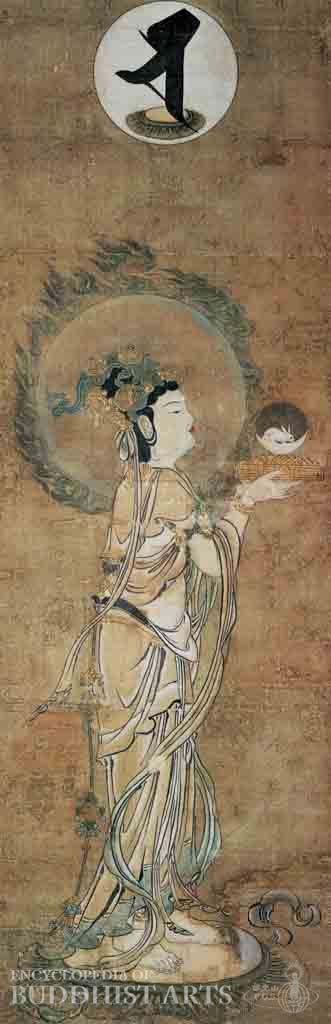
Twelve Heavenly Beings - Candra by Takuma Shoga; Kamakura period, dated 1191
Color on silk
Takuma Shoga
JAPAN; Heian to Kamakura period
Takuma Shoga, originally named Takuma Tamemoto, was a monk and painter specializing in Buddhist imagery. He was the second son of Takuma Tameto, the founder of the Takuma school, and he followed in his father’s footsteps in fusing traditional Heian Buddhist painting with new iconography, rapid brushwork, and delicate color sensibilities, pioneering the new style of Buddhist art in the Kamakura period. In 1184, he was honored with the titles of Hogen (Dharma Eye) and Hokkyou (Dharma Bridge). He created the Mandala of the Two Realms and screens painted with Twelve Heavenly Beings at Toji Temple, and painted another set of screens with Twelve Heavenly Beings at Jingoji Temple.
For more details, go to the Encyclopedia of Buddhist Arts: People, page 251.
Cite this article:
author = Hsingyun and Youheng and Youlu and Pokorski, Stefanie and Yichao and Mankuang and Miaohsi,
booktitle = {Encyclopedia of Buddhist Arts: People },
pages = 251,
title = {{Takuma Shoga}},
volume = 19,
year = {2016}}