
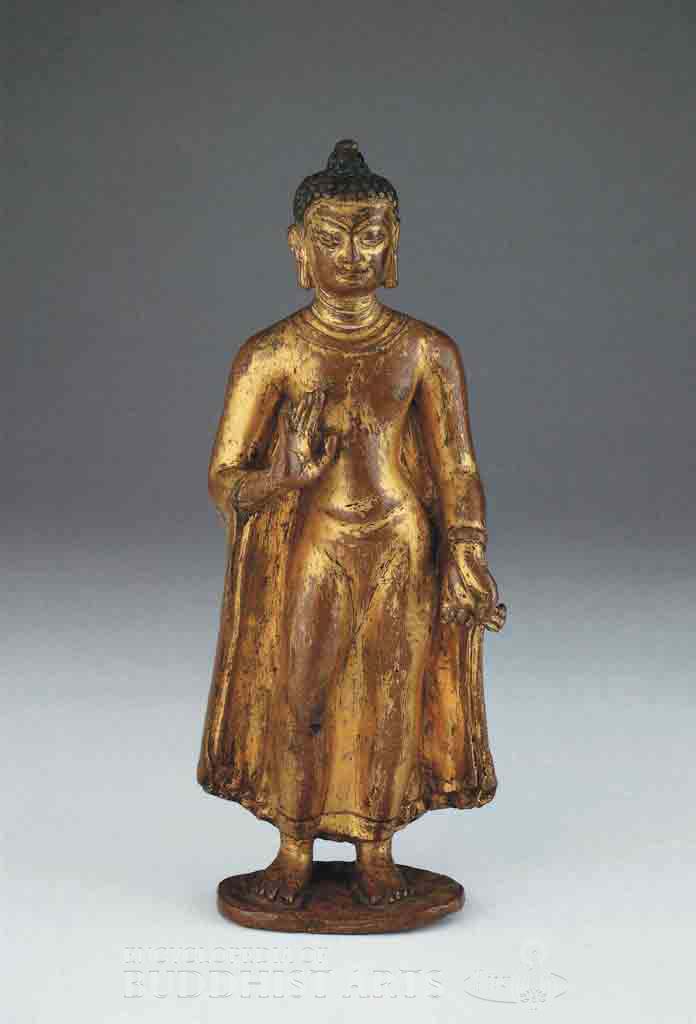
Sakyamuni Buddha
Gilt copper
Sakyamuni Buddha
NEPAL
The Buddha stands with the body’s weight on the left leg, causing the waist to sway slightly to one side. The right hand is in abhaya (fearlessness) mudra while the left hand holds the fold of the monastic robe. The diaphanous garment falls voluminously down to calf level in the style made popular during the Indian Gupta period (circa 320–550). Features such as the gem decorating the top of the usnisa and the unfinished state on the back of the statue, are sculptural traits shared with Tibet. Statues made in this material were common in the Kathmandu Valley from the 11th to 12th century.
For more details, go to the Encyclopedia of Buddhist Arts: Sculpture N-Sr, page 922.
Cite this article:
Hsingyun, et al. "Sakyamuni Buddha." Encyclopedia of Buddhist Arts: Sculpture N-Sr, vol. 12, 2016, pp. 922.
Hsingyun, Youheng, Yann Lovelock, Yuan Chou, Susan Huntington, Gary Edson, and Robert Neather. 2016. "Sakyamuni Buddha" In Encyclopedia of Buddhist Arts: Sculpture N-Sr, 12:922.
Hsingyun, Youheng, Lovelock, Y., Chou, Y., Huntington, S., Edson, G., & Neather, R.. (2016). Sakyamuni Buddha. In Encyclopedia of Buddhist Arts: Sculpture N-Sr (Vol. 12, pp. 922).
@misc{Hsingyun2016,
author = Hsingyun and Youheng and Lovelock, Yann and Chou, Yuan and Huntington, Susan and Edson, Gary and Neather, Robert,
booktitle = {Encyclopedia of Buddhist Arts: Sculpture N-Sr},
pages = 922,
title = {{Sakyamuni Buddha}},
volume = 12,
year = {2016}}
author = Hsingyun and Youheng and Lovelock, Yann and Chou, Yuan and Huntington, Susan and Edson, Gary and Neather, Robert,
booktitle = {Encyclopedia of Buddhist Arts: Sculpture N-Sr},
pages = 922,
title = {{Sakyamuni Buddha}},
volume = 12,
year = {2016}}