
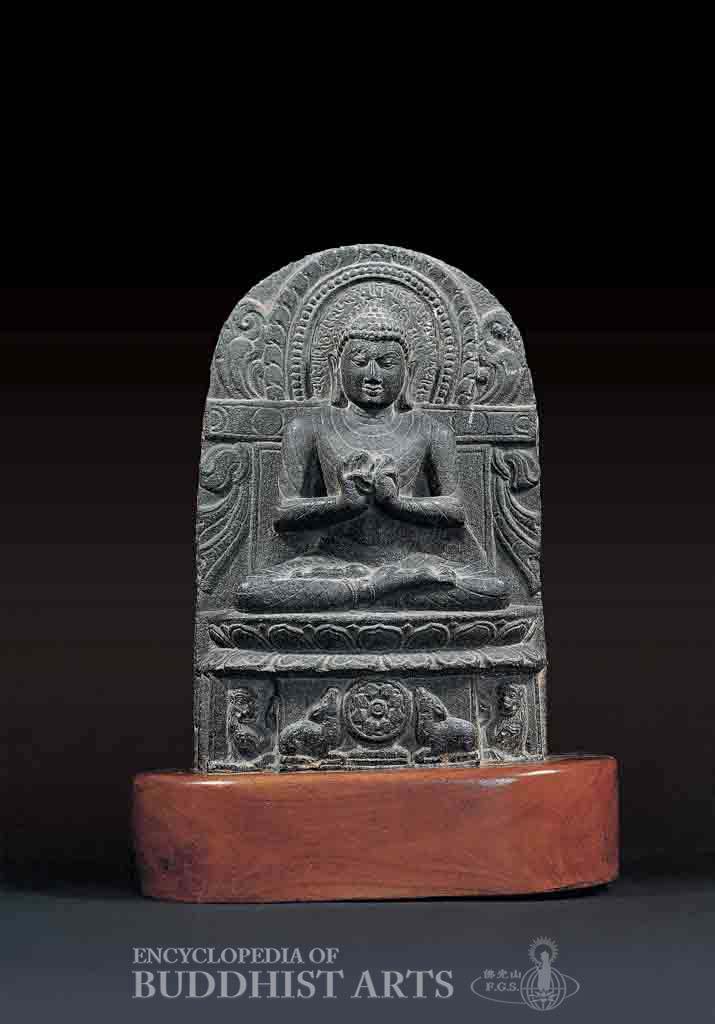
Life of the Buddha – First Turning of the Dharma Wheel
Stone
Life of the Buddha - First Turning of the Dharma Wheel
INDIA
The sculpture depicts the Buddha’s first turning of the Dharma wheel and shows several sculptural details that indicate that it dates from the early Pala period (circa 8th–12th century), such as the hands forming the Dharmacakra (Dharma wheel) mudra and the carvings on the throne. The Dharma wheel at the bottom with its lotus center flanked by deer indicates that the scene is in Deer Park at Sarnath. The lions at either end symbolize the resonant force of the Buddha’s voice.
The Buddha is seated in full lotus posture on a double lotus throne. Although the figure shows the enduring influence of the Gupta period (circa 320–550) style, local features are also visible such as the jewel decoration on the urna and the arc-like sweep of the elongated ears to the shoulders. The simple folds of the monastic robe are indicated by line incisions. The Buddha’s distinctive nimbus contains three bands, an inscription in old Bengali, a beaded band, and a rim of curling flames.
For more details, go to the Encyclopedia of Buddhist Arts: Sculpture G-M, page 594.
Cite this article:
author = Hsingyun and Youheng and Lovelock, Yann and Chou, Yuan and Huntington, Susan and Edson, Gary and Neather, Robert,
booktitle = {Encyclopedia of Buddhist Arts: Sculpture G-M},
pages = 594,
title = {{Life of the Buddha - First Turning of the Dharma Wheel}},
volume = 11,
year = {2016}}