
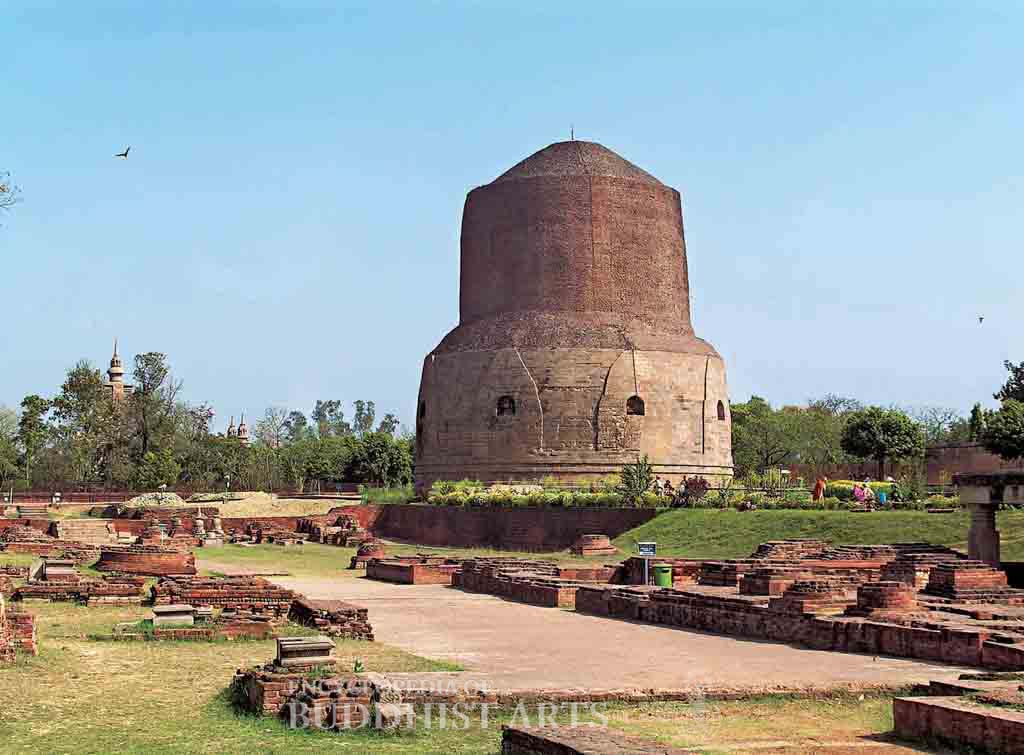
Dhamekh Stupa
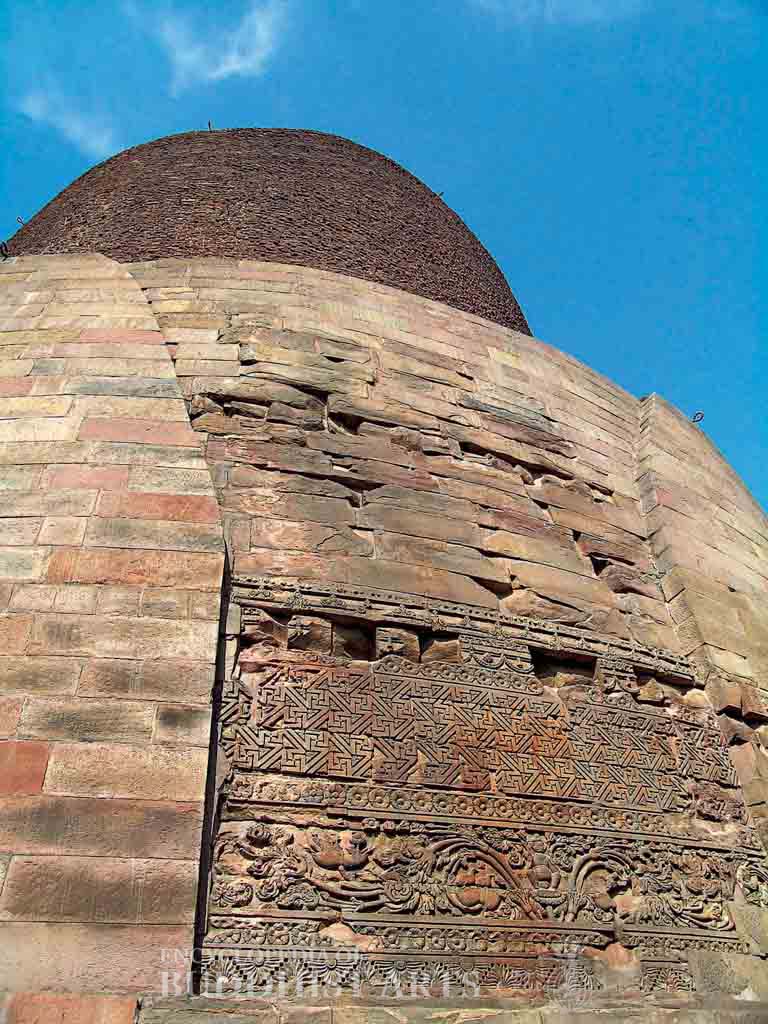
Dhamekh Stupa (detail)
Dhamekh Stupa
INDIA, Uttar Pradesh, Sarnath
The original stupa is believed to have been built by King Asoka (reigned circa 269–232 BCE) of Maurya to mark the spot where the Buddha delivered his first teaching to his first five disciples. It was enlarged during the Gupta Empire (circa 320–550). According to Great Tang Records on the Western Regions, written by Chinese Master Xuanzang who visited India in the 7th century, there was a stupa at Sarnath that was nearly 60 m high, built of stone and brick with niches and Buddhist images around it. The stupa that Xuanzang mentioned was probably this Dhamekh Stupa. Along with the destruction of Sarnath by the Muslims in 1194, the stupa was damaged and left abandoned. It was not until 1956, when a park was built at Sarnath, that the stupa was repaired.
Built of stone and red brick, the Dhamekh Stupa is 43.6 m high, including the base, which is 28 m in diameter. The body of the stupa is cylindrical in two sections, with the upper one narrower than the lower one. The wall of the lower section is covered in exquisite carvings of Gupta origin, including floral patterns, depictions of people and birds, and the swastika symbol. There are also carvings of eight lotus petals, each with a Buddha niche at the center, but unfortunately the Buddha statues once enshrined in these niches are no longer extant.
For more details, go to the Encyclopedia of Buddhist Arts: Architecture A-F, page 229.
Cite this article:
author = Hsingyun and Youheng and Johnson, Peter and Mankuang and Lancaster, Lewis,
booktitle = {Encyclopedia of Buddhist Arts: Architecture A-F},
pages = 229,
title = {{Dhamekh Stupa}},
volume = 1,
year = {2016}}