
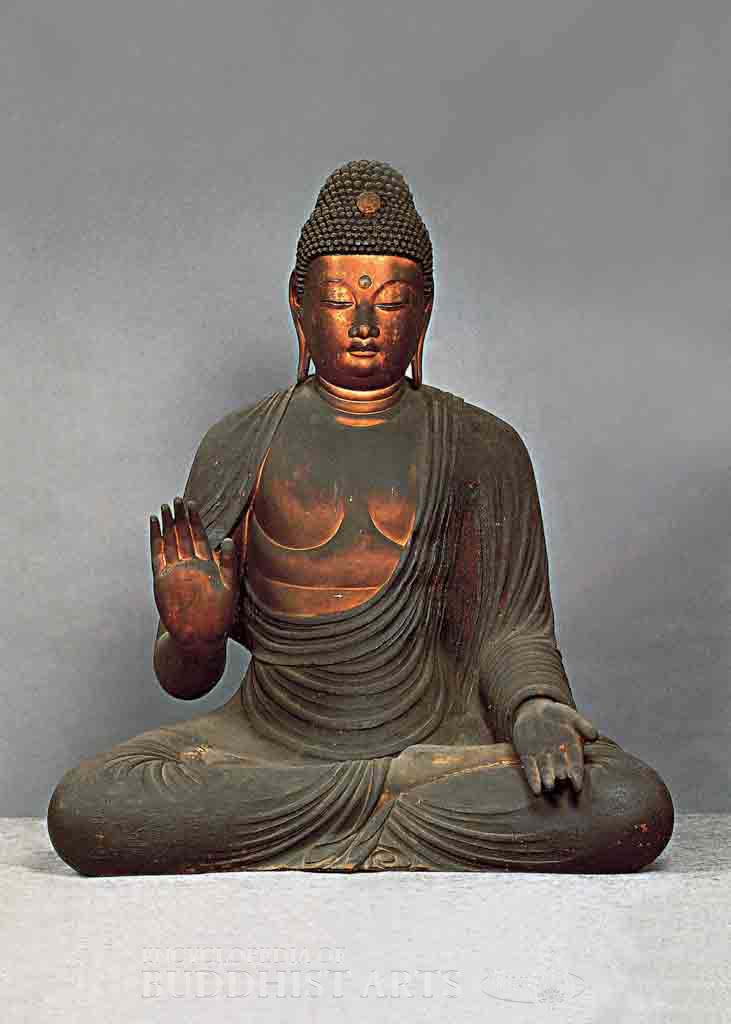
Hobukuji Temple Main Hall: Sakyamuni Buddha
Cypress wood
Hobukuji Temple Main Hall: Sakyamuni Buddha
JAPAN, Shiga, Takashima; Heian period
According to an inscription found inside the pedestal, the statue was repaired in 1678 of the Edo period. It was stated that from its first completion to its repair, 770 years had passed. From this information, experts calculated that it was created in the early 10th century. It has been recognized as an Important Cultural Property.
The Buddha’s head and body were carved in two pieces from a single piece of cypress wood and then fitted together. Today there are some portions which are partially missing at the bottom. The body of the statue is covered with gold leaf worked to a burnish and depicts the Buddha seated in full lotus position with his right hand in abhaya (fearlessness) and the left in varada (wish-granting) mudra. The figure wears monastic robes, the detailed folds of which lack definition about the knees.
For more details, go to the Encyclopedia of Buddhist Arts: Sculpture G-M, page 431.
Cite this article:
author = Hsingyun and Youheng and Lovelock, Yann and Chou, Yuan and Huntington, Susan and Edson, Gary and Neather, Robert,
booktitle = {Encyclopedia of Buddhist Arts: Sculpture G-M},
pages = 431,
title = {{Hobukuji Temple Main Hall: Sakyamuni Buddha}},
volume = 11,
year = {2016}}