
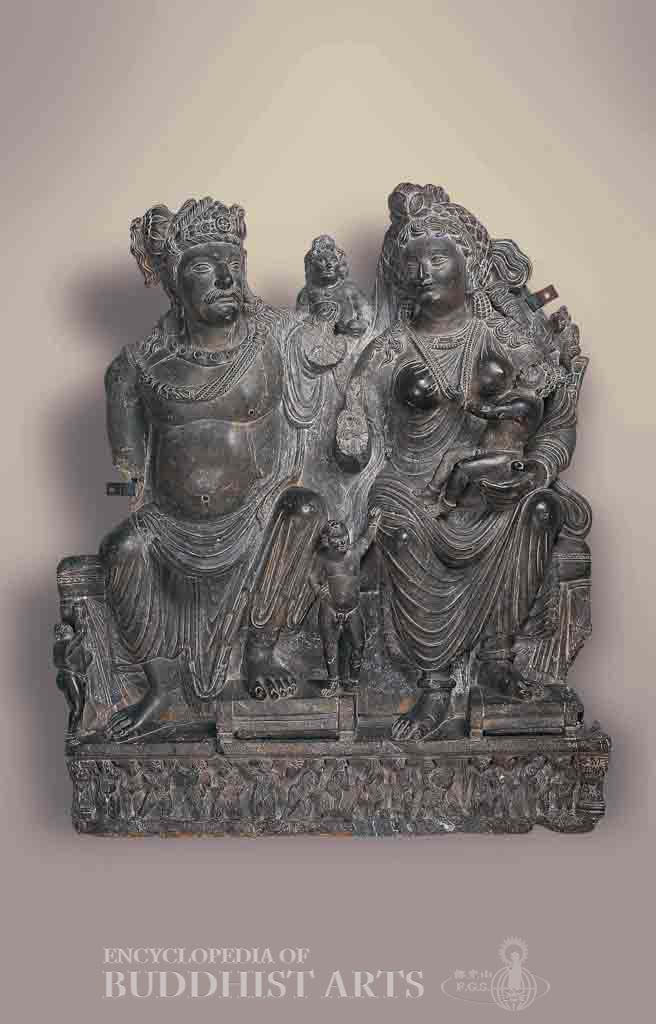
Sahri Bahlol: Hariti and Pancika
Schist
Sahri Bahlol: Hariti and Pancika
PAKISTAN, Khyber Pakhtunkhwa, Peshawar
Hariti was the mother of five hundred children and is revered as a goddess of the family and fertility. Hariti’s consort, Pancika, is a yaksa and the protector of wealth and prosperity. The two were popular subjects of Gandharan sculpture during the 2nd century CE.
The motherly aspect of Hariti is emphasized in this statue, with her youngest son Pingala portrayed in her arms and playing with her necklace. Other children surround the couple, while more are crowded into the frieze at the base, pictured at play. In Hariti’s flowing hair is a garland fronted by a large lotus, symbolizing fertility. Hariti, like her partner, is seated on a bench with one foot supported on a stool. Pancika has a paunch and looks up alertly. He wears a mustache and a stylish headdress studded with ornaments like most Gandharan figures.
For more details, go to the Encyclopedia of Buddhist Arts: Sculpture N-Sr, page 889.
Cite this article:
author = Hsingyun and Youheng and Lovelock, Yann and Chou, Yuan and Huntington, Susan and Edson, Gary and Neather, Robert,
booktitle = {Encyclopedia of Buddhist Arts: Sculpture N-Sr},
pages = 889,
title = {{Sahri Bahlol: Hariti and Pancika}},
volume = 12,
year = {2016}}