
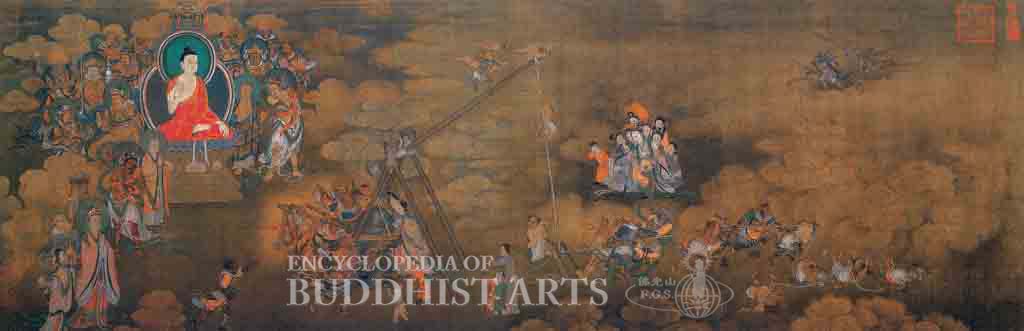
Hariti Rescuing Her Son
Ink and color on silk

Hariti Rescuing Her Son (detail)

Hariti Rescuing Her Son (detail)
Hariti Rescuing Her Son
CHINA; Yuan dynasty
Hariti was an ogress who fed her children by kidnapping and killing the children of others. To teach her a lesson, the Buddha hid her son beneath an alms bowl. She became frantic, and finally understood the suffering she was causing to others. The Buddha returned her son to her, and she converted to Buddhism, becoming the protector of mothers and small children. This painting depicts Hariti and an army of demons attempting to free her son from beneath the alms bowl.
Pictures of Hariti taking refuge in the Buddha first appeared in the Kizil Caves. Later, during the Northern Wei dynasty (386–534), Hariti’s story was told in the Samyukta Ratna Pitaka Sutra, but it was not until the Northern Song dynasty (960–1127) that paintings of the story began to appear. In this painting, the Buddha is on the left, surrounded by Bodhisattvas, disciples, Heavenly Kings, and heavenly beings. In the middle section, demons attempt to lift the bowl using a system of levers and pulleys. On the right, the rope snaps, sending the demons tumbling to the ground. Hariti is shown standing beside the bowl, dressed in robes and looking down at her trapped son. She is depicted again above the demons pulling on the rope, where she has collapsed to the ground in grief. She is surrounded by her other children, who attempt to console her.
The seals on the painting are thought to be falsified. There is also an inscription by Ni Can of the Qing dynasty (1644–1911) that quotes the Maharatnakuta Sutra as the origin of this story. However, as there is no such account in the Maharatnakuta Sutra, Ni may have mistaken the Samyukta Ratna Pitaka Sutra for the Maharatnakuta Sutra.
For more details, go to the Encyclopedia of Buddhist Arts: Painting A-H, page 325.
Cite this article:
author = Hsingyun and Youheng and Youlu and Wilson, Graham and Manho and Mankuang and Huntington, Susan,
booktitle = {Encyclopedia of Buddhist Arts: Painting A-H},
pages = 325,
title = {{Hariti Rescuing Her Son}},
volume = 14,
year = {2016}}