
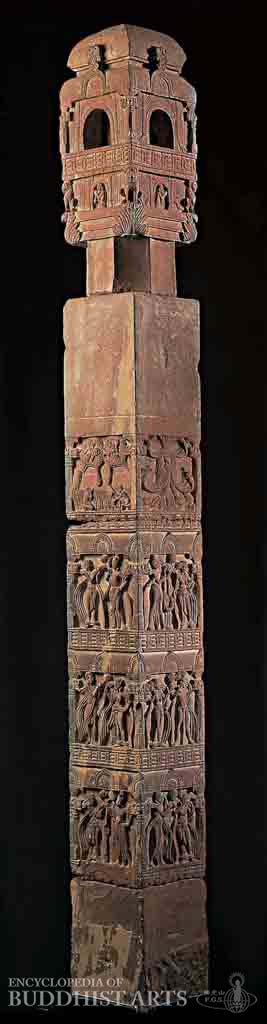
Mathura: Railing Post
Sandstone
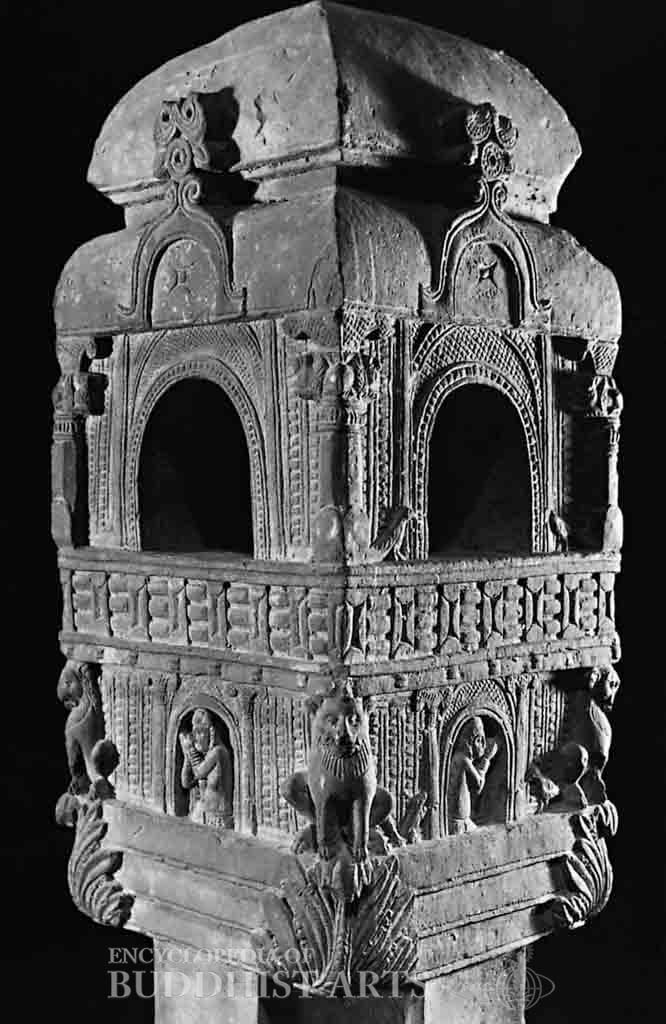
Mathura: Railing Post - Capital
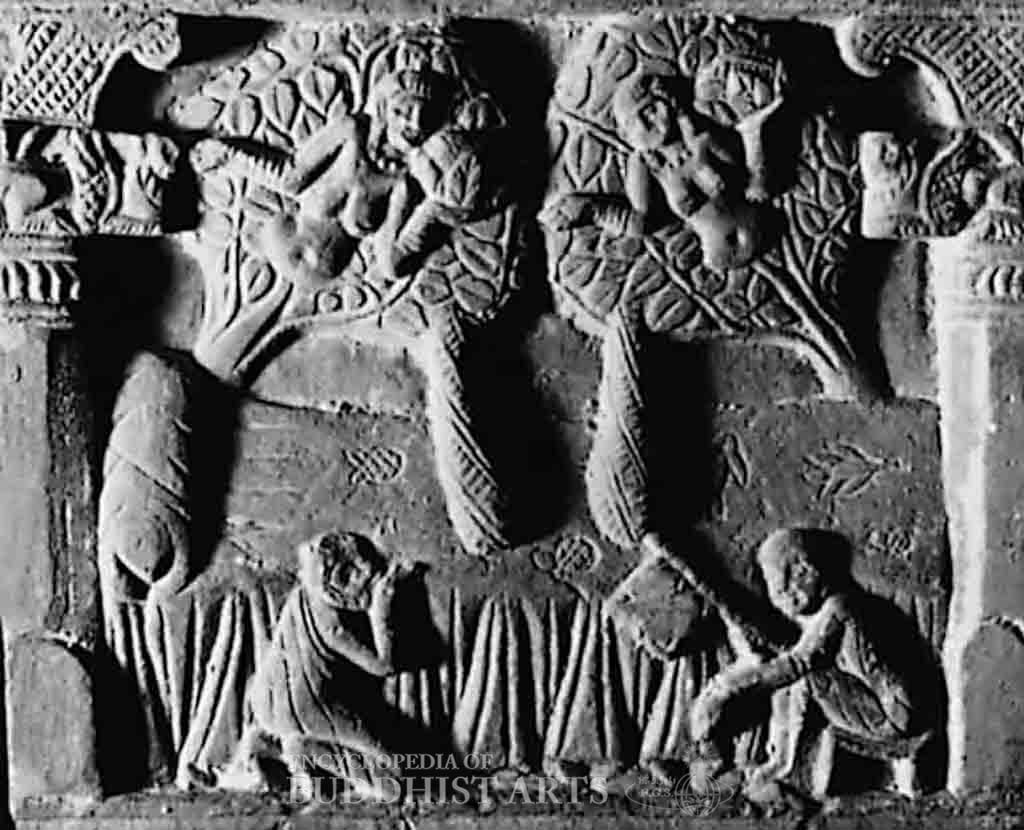
Mathura: Railing Post - Parinirvana
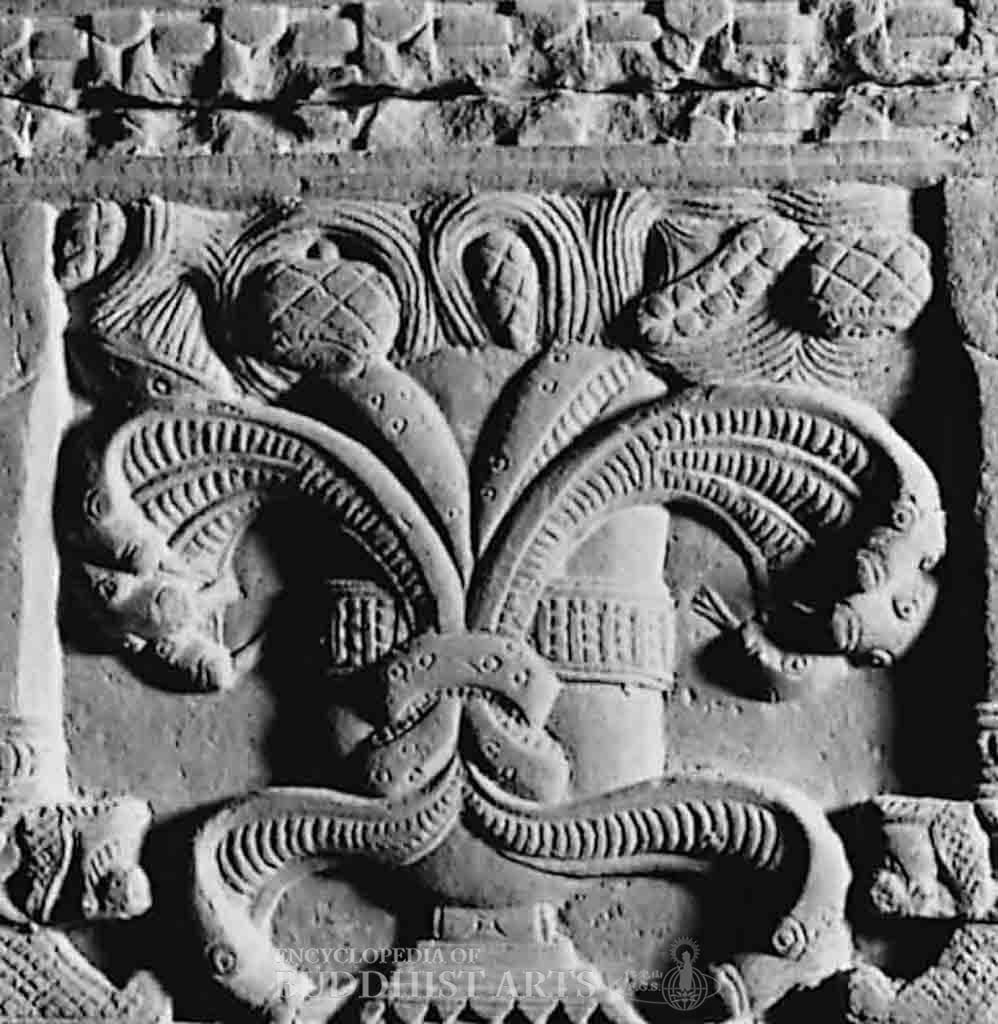
Mathura: Railing Post - Protection by the Naga King
Mathura: Railing Post
INDIA, Uttar Pradesh, Mathura
This is the corner post of a railing that once surrounded a stupa believed to be of Kushan (circa 1st–3rd century) origin. Two of its sides are decorated with reliefs, while the others have mortise holes that served as locks to secure the panels.
The capital is styled like a two-story temple and rests on a short octagonal column. The corners of the temple’s base are decorated with acanthus leaves, above which are lions. In the arched doorways between these on the first story are figures with their palms joined. The upper story is enclosed with balustrades and has four arched doorways with pilasters beyond them at the corners. The curved roof consists of two sections. The bottom section has false caitya windows on every side, decorated above with Dharma wheels accompanied by the triratna symbol. The symbols extend into the four-sided dome above.
The two decorated surfaces of the shaft each contain four reliefs which are separated by balustrades and false caitya windows. The relief in the upper register on the left may depict the Buddha’s parinirvana in Kushinagar. An empty bed with a pillow symbolizes the Buddha, while two disciples kneel before it. Twin sala trees are bent over it, paying their respects, with tree spirits among the branches, scattering flowers.
The relief on the upper register to the right has been identified as the story of the naga king of Ramagrama protecting the Buddha’s relic stupa. About it, four nagas are intertwined at the tail and spread out in the four directions; below the stupa in the background is a lotus pond. The remaining six registers contain characters holding garlands or bunches of flowers as they journey to the two pilgrimage sites.
For more details, go to the Encyclopedia of Buddhist Arts: Sculpture G-M, page 704.
Cite this article:
author = Hsingyun and Youheng and Lovelock, Yann and Chou, Yuan and Huntington, Susan and Edson, Gary and Neather, Robert,
booktitle = {Encyclopedia of Buddhist Arts: Sculpture G-M},
pages = 704,
title = {{Mathura: Railing Post}},
volume = 11,
year = {2016}}