
Kaihua Temple Lianli Pagodas
Kaihua Temple Lianli Pagodas
CHINA, Shanxi, Taiyuan
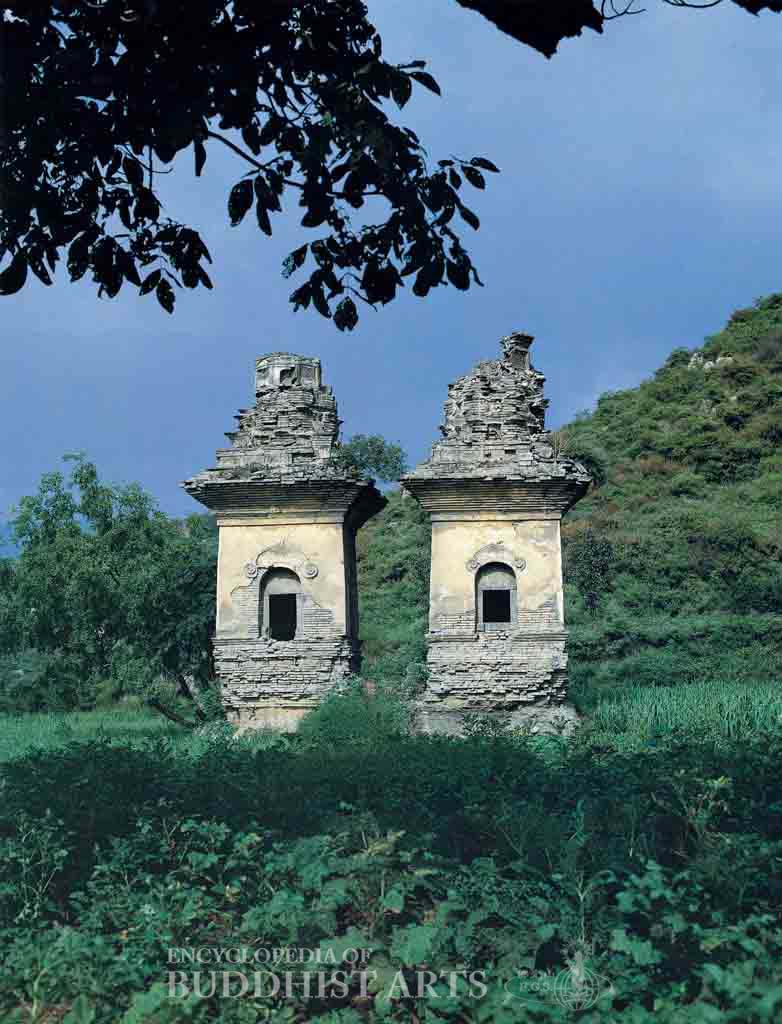
Located among the ruins of Kaihua Temple, which is situated at the foot of Mengshan (Cloud Mountain) 17 km southwest of Taiyuan, the pagodas were built in 990 during the Northern Song dynasty. The one on the left is the Relic Pagoda of Sakyamuni Buddha, while the one on the right is the Relic Pagoda of Dipamkara Buddha. They are called the Lianli (Connected) Pagodas because they are connected at the base. They were listed as a Provincial Cultural Heritage Site in 2006.
The single-story pagodas are constructed from brick and earth and are around 12 m high. The bottom sections are shaped like Sumeru platforms and the pagoda bodies are square with each side measuring 3 m long. Decorated arched doorways carved with floral motifs are located at the front of each pagoda. The eaves are in the form of 11-tier brick corbeling, while reverse corbeling is found on the pagoda roof. The bases of the spire are square and support four-tier lotus petals, above which there are small octagonal sections. The upper parts of the spires are missing.
The two pagodas are built in the single-story style of the Tang dynasty (618–907); however, the roof and spire are more in the style of the Song (960–1279) and Liao (907–1125) dynasties. Although there are examples of twin Buddhist pagodas in China, those connected at the base such as these ones are quite rare.
For more details, go to the Encyclopedia of Buddhist Arts: Architecture G-L, page 573.
Cite this article:
author = Hsingyun and Youheng and Johnson, Peter and Mankuang and Lancaster, Lewis,
booktitle = {Encyclopedia of Buddhist Arts: Architecture G-L},
pages = 573,
title = {{Kaihua Temple Lianli Pagodas}},
volume = 2,
year = {2016}}