
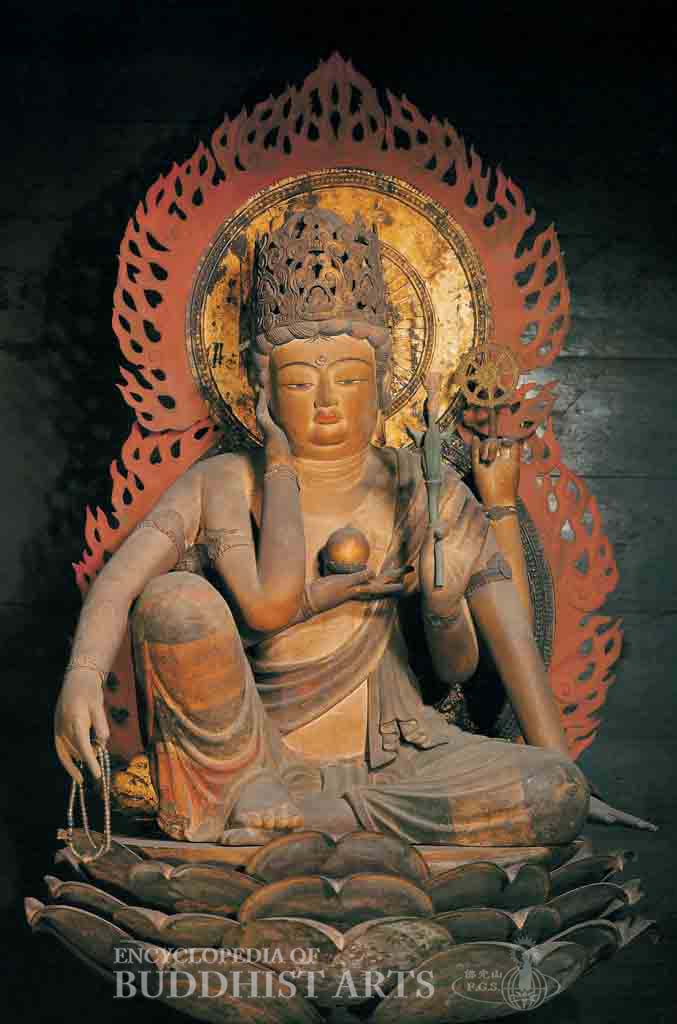
Kanshinji Temple Golden Hall: Cintamanicakra Avalokitesvara
Nutmeg wood
Kanshinji Temple Golden Hall: Cintamanicakra Avalokitesvara
JAPAN, Osaka, Kawachinagano; Heian period
The figure was commissioned by Empress Tachibana no Kachiko for the health of Emperor Saga (reigned 809–823). It is thought that the monk Shinsho created it on the basis of Vajrayana texts brought back by Master Kukai from China. Although it is not dated, the temple records mention a Cintamanicakra as being there since the temple’s establishment and it is therefore counted as the oldest surviving Cintamanicakra figure from the Heian period. It was listed as a National Treasure in 1951.
Wearing a tall openwork crown about a topknot, the Bodhisattva’s head is slightly tilted to one side. The figure sits in the posture of royal ease on an eight-layered lotus throne with only a stole draped about the upper body. The figure is six armed, with the hands to the right supporting the cheek, carrying a wish-fulfilling jewel and some prayer beads. Hands on the left support a Dharma wheel, carry a lotus stalk, and support the body. Behind the figure is an interlocking aureole and nimbus, both edged with flames. The head, body, arms and feet are made of Chinese nutmeg wood, while the crown is carved out of Japanese cypress. The stole and skirt are painted in bright colors with a sprinkling of gold and the bangles and armlets are made of gilt bronze. Because it was created using the wood-core dry lacquer technique of the Nara period (710–794), this graceful figure appears smooth and polished.
For more details, go to the Encyclopedia of Buddhist Arts: Sculpture G-M, page 522.
Cite this article:
author = Hsingyun and Youheng and Lovelock, Yann and Chou, Yuan and Huntington, Susan and Edson, Gary and Neather, Robert,
booktitle = {Encyclopedia of Buddhist Arts: Sculpture G-M},
pages = 522,
title = {{Kanshinji Temple Golden Hall: Cintamanicakra Avalokitesvara}},
volume = 11,
year = {2016}}