
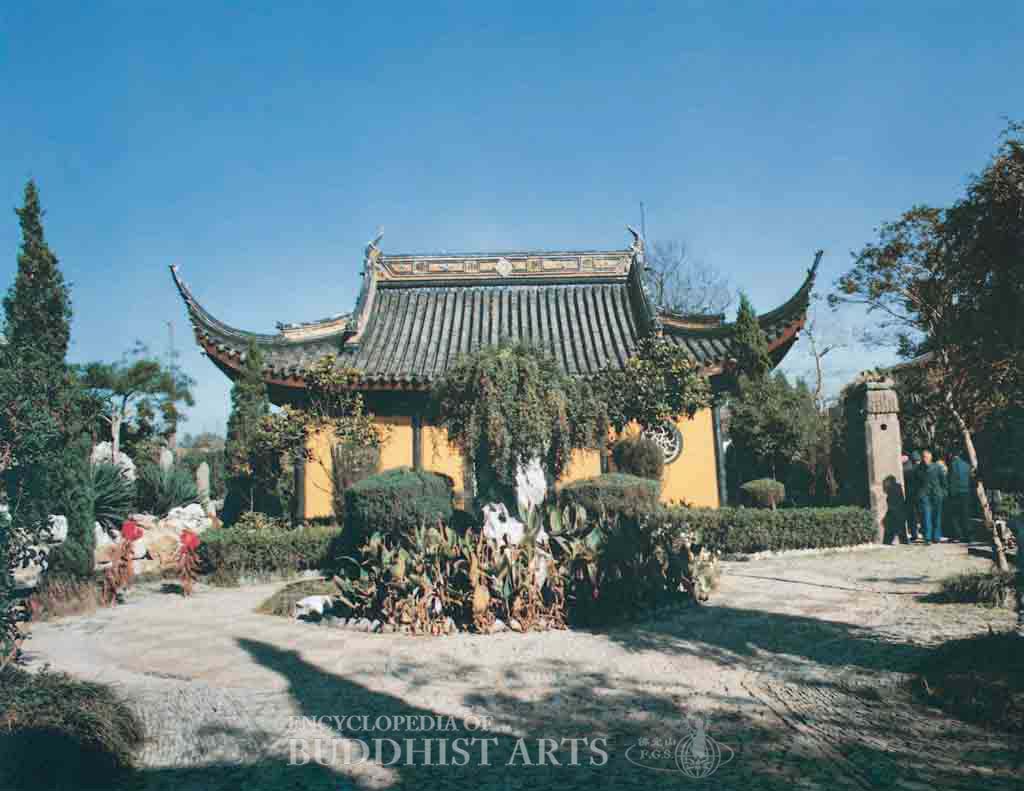
Baosheng Temple: Heavenly King Hall
Baosheng Temple
CHINA, Jiangsu, Suzhou
According to one historical record, it was built in 503 during the Liang dynasty. However, another record states that it was built during the rule of Emperor Xuanzong (reigned 846–859) of the Tang dynasty, and was repaired in 1073 during the Northern Song dynasty. Throughout its history, the temple has flourished and fallen into disrepair a number of times. It is said that at its peak the temple had 1,000 monastics with 5,000 halls and shrines, and was equal in fame to Lingyin Temple in Hangzhou. In 1927, when the main hall was destroyed by fire, only nine Arhat statues and nine sections of the wall survived. Eventually the Artifacts Museum was built in place of the main hall and the surviving Arhat statues and sections of wall were repaired and included in the exhibition. The Arhat statues were listed as National Cultural Heritage Properties in 1961.
The existing structures include the main temple gate, Heavenly King Hall, main hall or Artifacts Museum, and a sutra pillar. According to research, the Heavenly King Hall was built in 1629 during the Ming dynasty, upon an older site which dates back to the Song dynasty (960–1279). Inside there are pillar bases dating back to the Song dynasty. The Heavenly King Hall was repaired between 1851 and 1874 during the Qing dynasty. The building is a three-by-two bay structure, with a stone arched door in the central bay and round decorative windows in the side bays. It has a single-eave hip-and-gable roof with corners that curve upwards. The columns incline slightly toward the center of the building. At either end of the decorated ridge there are ornate owls with curved tails. The hall has no ceiling, so that the roof frame is exposed.
The octagonal, 5.2 m high sutra pillar was created in 854 during the Song dynasty, and was re-erected in 1053 during the Northern Song dynasty. It is made from limestone and is carved with the Usnisavijaya Dharani Sutra.
For more details, go to the Encyclopedia of Buddhist Arts: Architecture A-F, page 54.
Cite this article:
author = Hsingyun and Youheng and Johnson, Peter and Mankuang and Lancaster, Lewis,
booktitle = {Encyclopedia of Buddhist Arts: Architecture A-F},
pages = 54,
title = {{Baosheng Temple}},
volume = 1,
year = {2016}}