
Shotorak: Prophecy of Dipamkara Buddha
Schist
Shotorak: Prophecy of Dipamkara Buddha
AFGHANISTAN, Parwan, Bagram
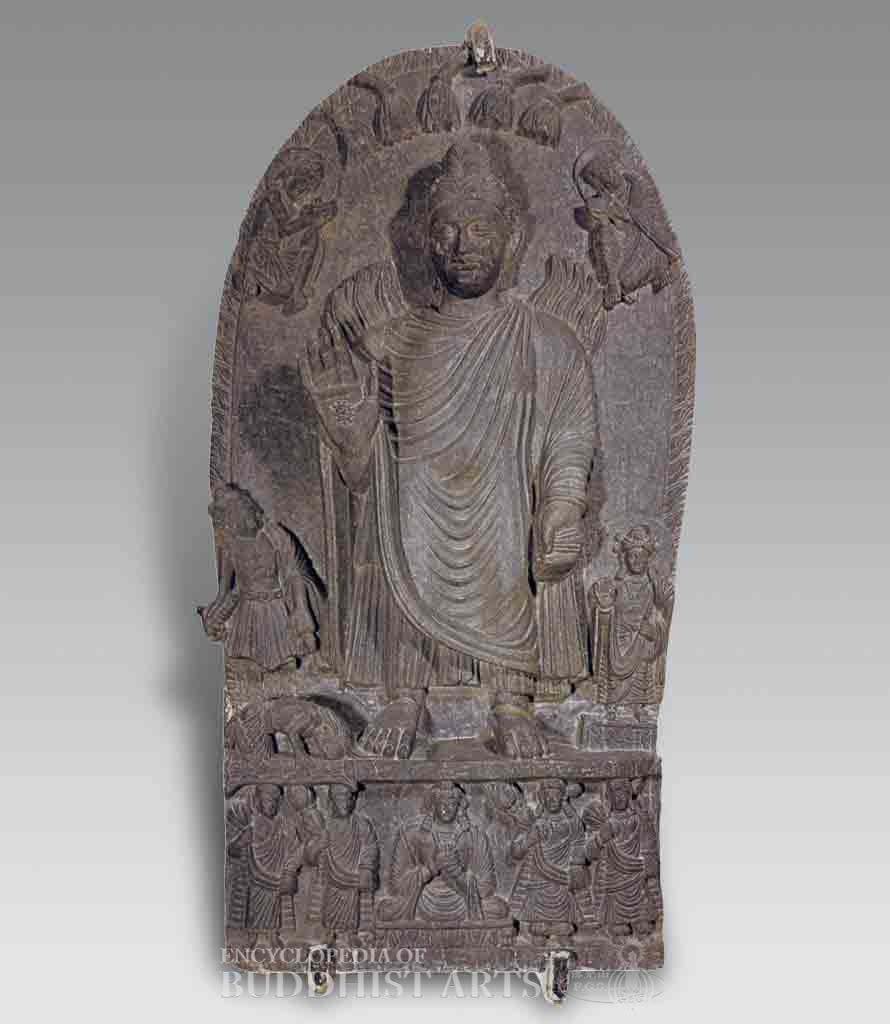
The sculpture was unearthed from a monastery at Shotorak, once the ancient city of Kapisa. The story of Dipamkara Buddha’s prophecy is recorded in a large number of varying sources such as the Caryanidana Sutra, Prince Mangala Nidana, Abhiniskramana Sutra, and the Sutra of Cause and Effect in the Past and Present. A young man named Megha once laid his hair upon the muddy ground so Dipamkara, the Buddha of that bygone age, would not dirty his feet. As Megha did this act of reverence he resolved to become a Buddha himself, whereupon Dipamkara prophesized that that this would be, and that he would eventually be reborn as the Buddha Sakyamuni. Megha rises into the air in jubilation with this prophecy.
Dipamkara is portrayed in this early Gandharan relief in a monastic robe that covers both shoulders with flames rising from them. This particular feature is limited to the Kapisa style. The Buddha’s right hand is marked with a Dharma wheel and raised in abhaya (fearlessness) mudra. The arched back-screen is a mandorla with a flaming edge. Five lotuses are seen above the Buddha’s head, identified as the flowers that Megha threw as an offering. Megha appears lower down, on the left, in the act of throwing flowers. He is shown again further down with his hair spread under the Buddha’s foot. The floating, kneeling figure on the left side is believed to be Megha who has risen in the air upon hearing Dipamkara’s prophecy. The figure on the other side near Dipamkara’s foot is a Bodhisattva.
The bottom register depicts Maitreya teaching the Dharma with heavenly beings on either side holding flower offerings. This inset represent the future Buddha waiting in Tusita Heaven for the time of his final rebirth. The style of the Kushan period (circa 1st–3rd century) is evident in the figures.
For more details, go to the Encyclopedia of Buddhist Arts: Sculpture N-Sr, page 1069.
Cite this article:
author = Hsingyun and Youheng and Lovelock, Yann and Chou, Yuan and Huntington, Susan and Edson, Gary and Neather, Robert,
booktitle = {Encyclopedia of Buddhist Arts: Sculpture N-Sr},
pages = 1069,
title = {{Shotorak: Prophecy of Dipamkara Buddha}},
volume = 12,
year = {2016}}