
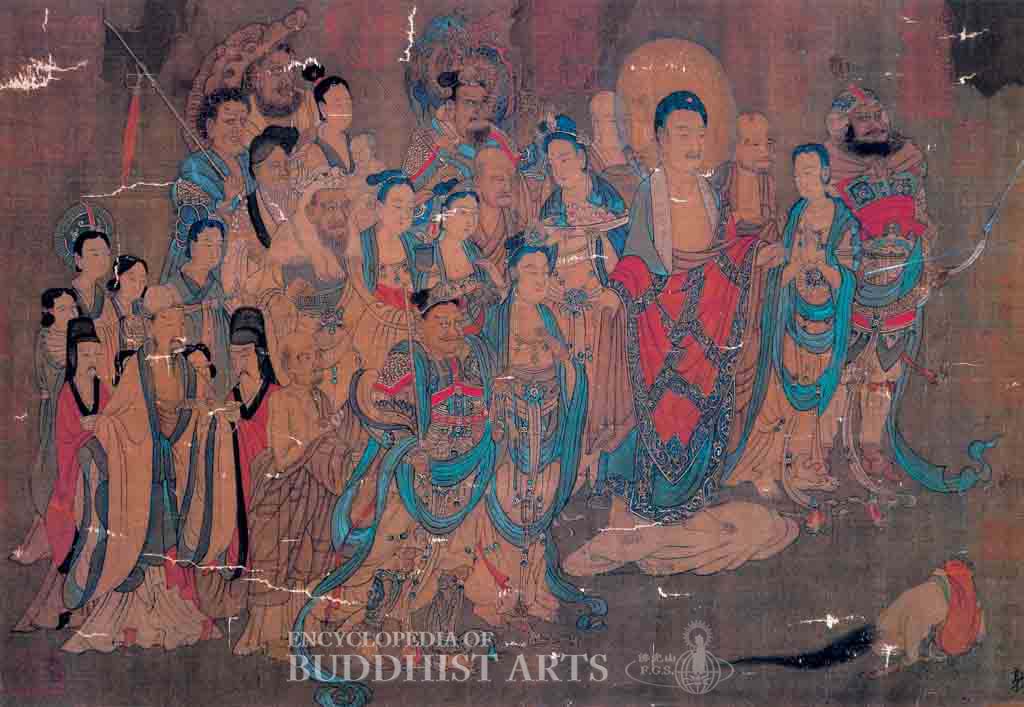
Prophecy of Dipamkara Buddha
Ink and color on silk
Prophecy of Dipamkara Buddha
CHINA; Southern Song dynasty
According to scriptures including the Caryanidana Sutra, Prince Mangala Nidana, Abhiniskramana Sutra, and the Sutra of Cause and Effect in the Past and Present, in one of Sakyamuni Buddha’s past lives, he was a man named Megha who came to the place where Dipamkara Buddha was teaching and made an offering of flowers. Later, when the Buddha was walking and approached a puddle, Megha knelt and laid his hair across it to keep the Buddha’s feet dry. Dipamkara Buddha then predicted that a few hundred kalpas later, Megha would become a Buddha named Sakyamuni.
In the painting, Dipamkara Buddha has a nimbus, wears a patterned monastic robe, and stands barefooted on a piece of cloth. The Buddha is accompanied by a retinue of 28 figures including Bodhisattvas, Heavenly Kings, and Arhats. In the lower right corner, Megha bows, laying his hair on the ground. The picture is painted with controlled, delicate brush stokes. Gold highlights and layers of bright color enliven the images. Inscriptions were added to the painting by the Yuan dynasty (1271–1368) monk Hongdao and the early Ming dynasty (1368–1644) monk Shouren.
For more details, go to the Encyclopedia of Buddhist Arts: Painting P-Z, page 754.
Cite this article:
author = Hsingyun and Youheng and Youlu and Wilson, Graham and Manho and Mankuang and Huntington, Susan,
booktitle = {Encyclopedia of Buddhist Arts: Painting P-Z},
pages = 754,
title = {{Prophecy of Dipamkara Buddha}},
volume = 16,
year = {2016}}