
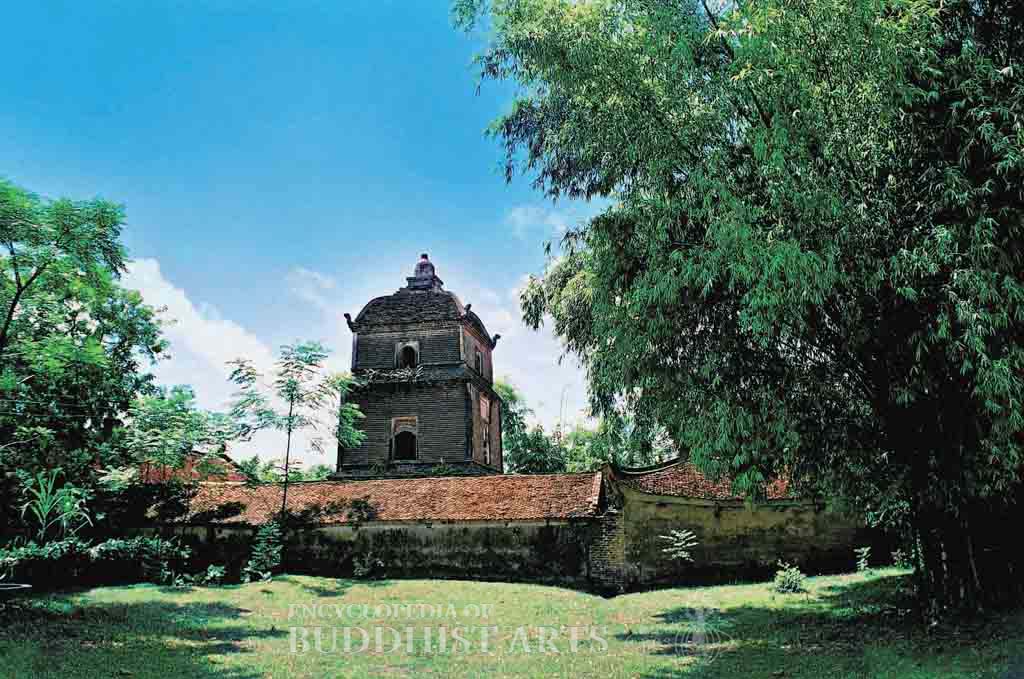
Phap Van Temple: Gentle Breeze Pagoda
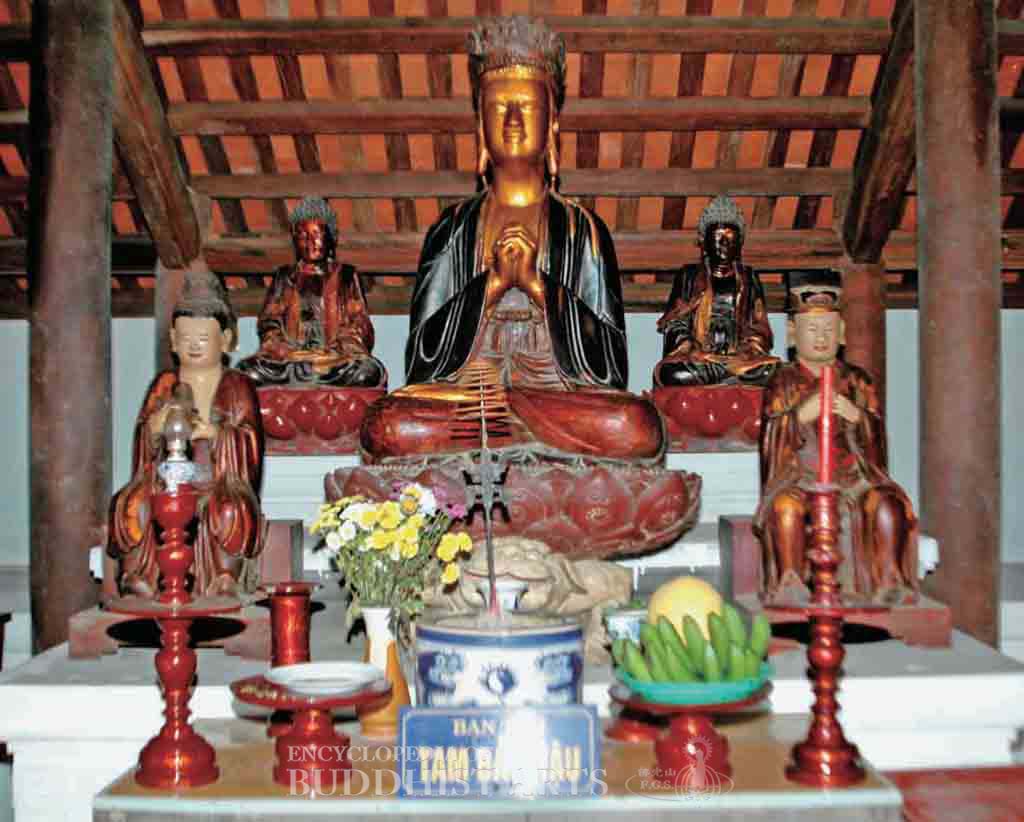
Phap Van Temple: Main Hall (interior)
Phap Van Temple
VIETNAM, Bac Ninh, Thuan Thanh
Phap Van means Dharma Cloud. The temple is associated with Lady Phap Van, the cloud goddess, one of the four goddesses worshipped by the local people. It is located in the ancient capital Luy Lau, a famous Buddhist center during its time, approximately 30 km from Hanoi. It was Vietnam’s first temple and was built between 265 and 316. The temple has undergone a number of restorations throughout its history. Its current appearance exhibits architectural characteristics from the Later Le dynasty (1533–1789). It was listed as a National Cultural Heritage Site in 1972.
The temple occupies 3 ha and has a classical layout resembling a letter H inside a square. The principal buildings include the main hall, Gentle Breeze Pagoda, and Lady Phap Van Shrine. The main hall contains a two-tier altar, with the Three Buddhas seated on lotus thrones on the top tier. The Lady Phap Van Shrine contains a statue of this goddess flanked by a male and a female attendant.
The three-story brick Gentle Breeze Pagoda was built by the local prefect Luu Phong during the 6th century. The pagoda was originally nine stories high, but was partially destroyed due to war. It was restored to its current appearance in 1737 and has relics enshrined within. The pagoda is 17 m high and the base is 7 m long on each side. It has an arched doorway on each side. The eastern and western doorways serve as main entrances. Within the pagoda there is a large bell cast in 1793, as well as a bronze gong cast in 1817. The temple has a collection of statues, including Bodhisattvas and the Eighteen Arhats, as well as other painted statues.
For more details, go to the Encyclopedia of Buddhist Arts: Architecture M-S, page 816.
Cite this article:
author = Hsingyun and Youheng and Johnson, Peter and Mankuang and Lancaster, Lewis,
booktitle = {Encyclopedia of Buddhist Arts: Architecture M-S},
pages = 816,
title = {{Phap Van Temple}},
volume = 3,
year = {2016}}