
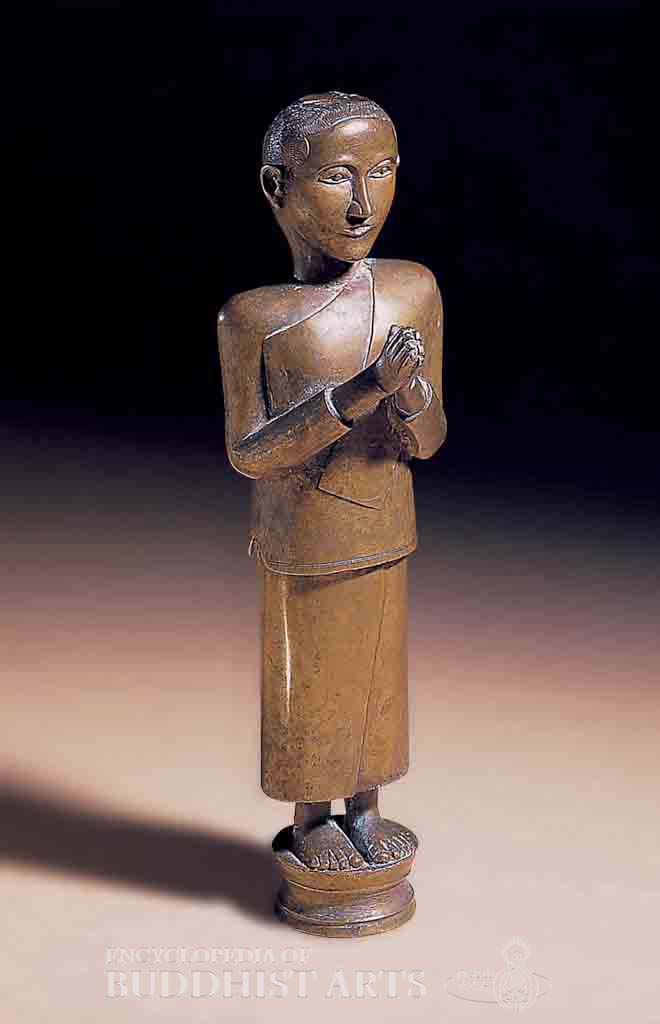
Devotee
Bronze
Devotee
SRI LANKA; Kandy Kingdom
This statue portraying a devotee was created during the later Kandy Kingdom (circa 1590–1815). A Sri Lankan monk most likely brought the small statue back from the region of Rakhine in Myanmar during the 18th century. It could have been placed before the Buddha in a temple to commemorate an ancestor or presented by a devotee as an offering object for a blessing.
The figure stands barefoot on a small rounded pedestal with palms joined in reverence. The flattened head has carved details such as hair. A long-sleeved shirt is worn over a shawl-like abbreviated form of a monk’s robe that is often worn by religious devotees. The diagonal folds over the chest indicate a robe that leaves the right shoulder uncovered. The lower body is wrapped in a seamless lungi; the fold tucked in at the waist is hidden but indicated by a diagonal line where the two ends of the cloth join. The broad, shoulders, sturdy neck, and flattened face are distinct features that differ from the general Sri Lankan image.
For more details, go to the Encyclopedia of Buddhist Arts: Sculpture A-F, page 288.
Cite this article:
author = Hsingyun and Youheng and Lovelock, Yann and Chou, Yuan and Huntington, Susan and Edson, Gary and Neather, Robert,
booktitle = {Encyclopedia of Buddhist Arts: Sculpture A-F},
pages = 288,
title = {{Devotee}},
volume = 10,
year = {2016}}