
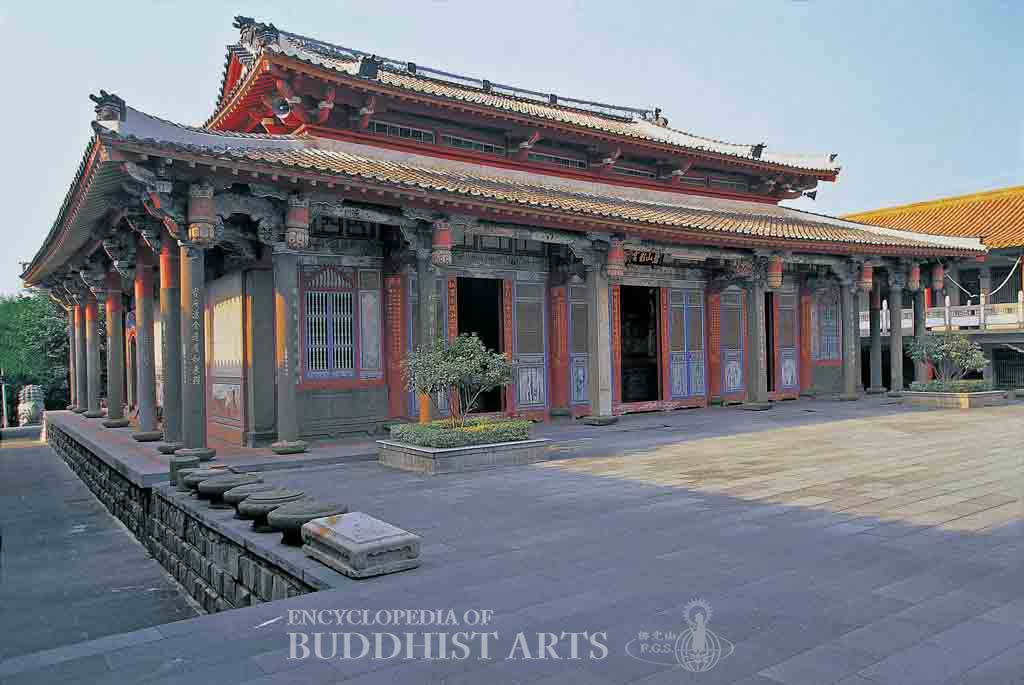
Daxian Temple: Great Hero Hall
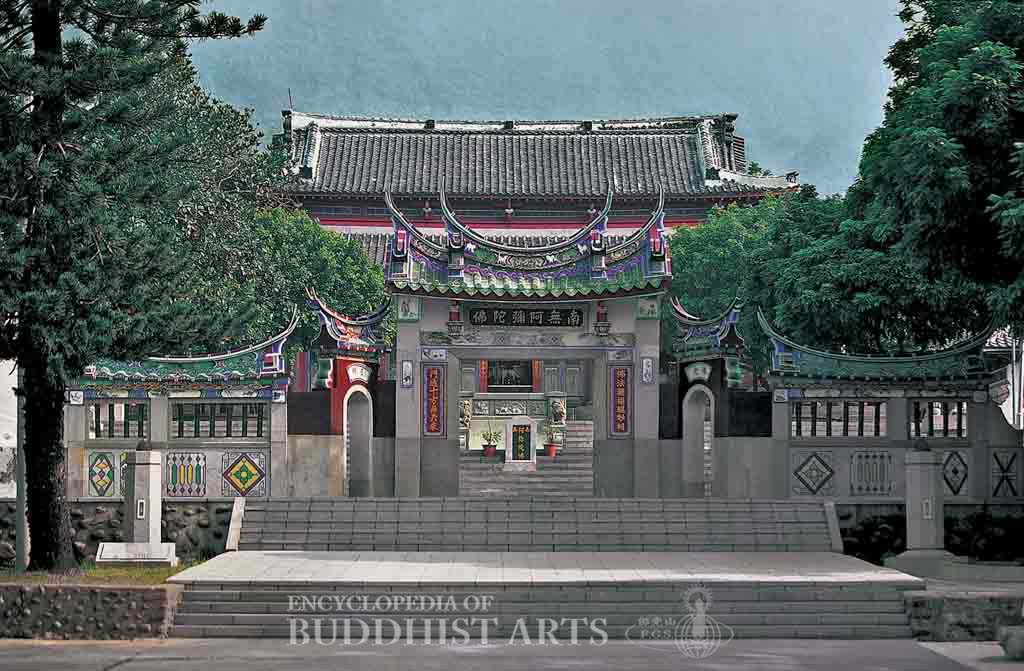
Daxian Temple: Main Temple Gate
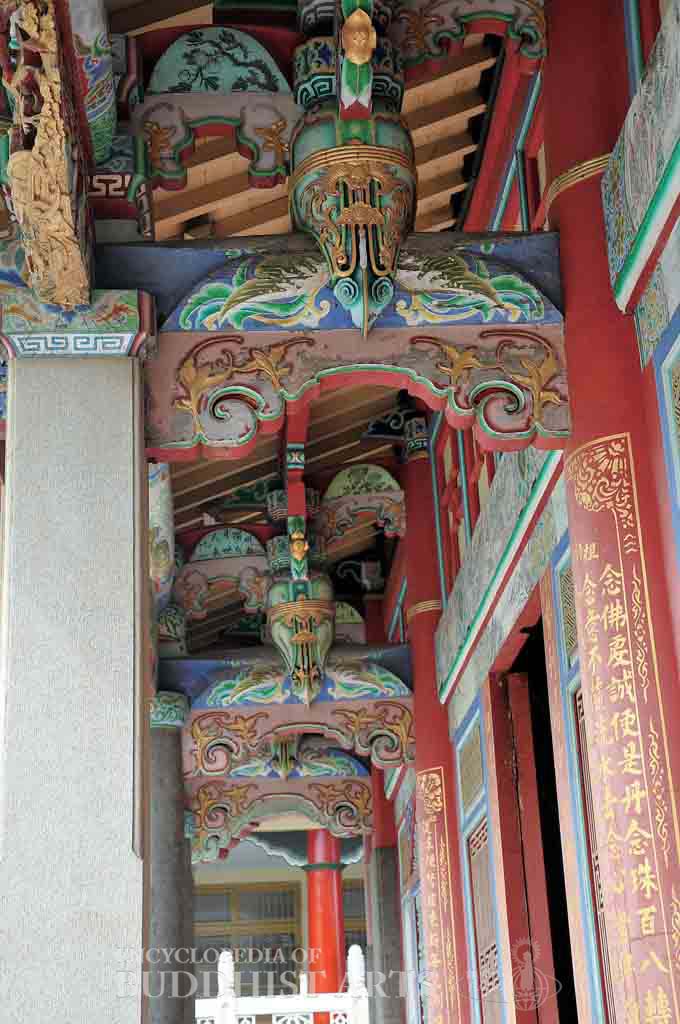
Daxian Temple: Great Hero Hall (detail)
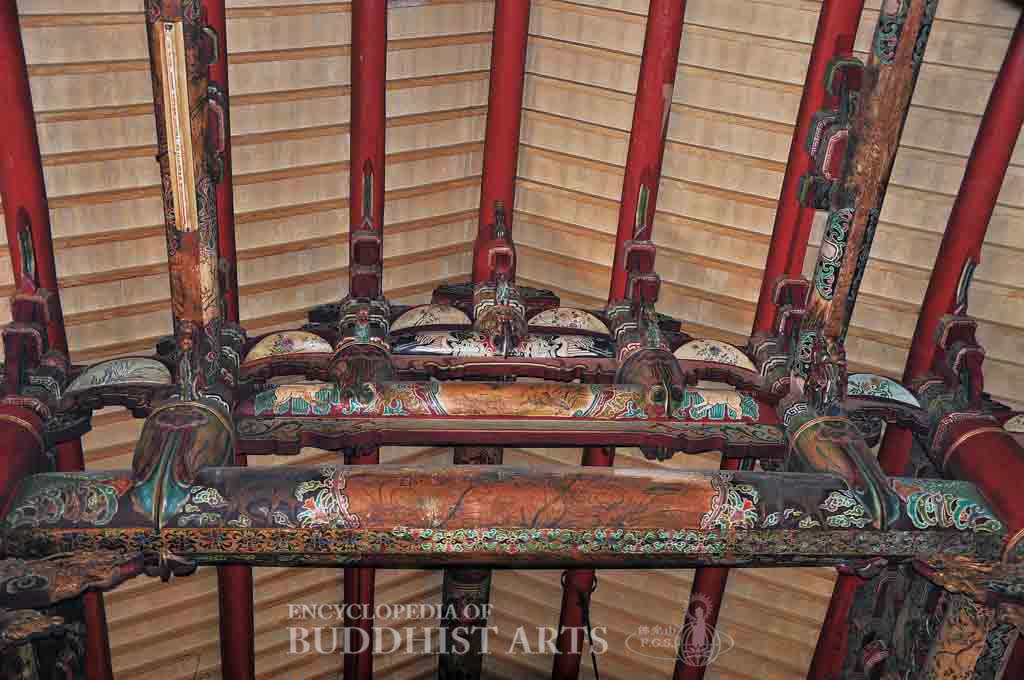
Daxian Temple: Great Hero Hall (interior)
Daxian Temple
TAIWAN, Tainan
The temple was built in 1701 by Canche, a Chan monk who went to Taiwan during the Qing dynasty. It was reconstructed a number of times throughout its history. In 1946, the monk Kaican was invited by the temple to serve as the abbot and it has continued to expand.
The temple faces west and along the central axis there are the inner and outer temple gates, the Great Hero Hall, the Avalokitesvara Hall, and the Triple Gem Hall. On the south and north sides of the Triple Gem Hall, there are the Ksitigarbha Hall, the Patriarch Hall, and the Cundi Hall. The inner temple gate and the Great Hero Hall are listed as Municipal Historic Monuments.
The three-bay inner temple gate has a square doorway in the central bay, while the two flanking bays are angled outwards with arched openings. The main roof of the inner temple gate is supplemented by lower roof extensions on either side. Its bow-shaped main ridges terminate with swallowtails.
The five-by-four bay Great Hero Hall has a double-eave hip-and-gable roof. The main ridge and the hips are straight, which is unlike the ridges in the southern Fujian style which are bow-shaped with upturned eave ends. The roof is covered in black tiles and the ridges are plain and undecorated. The hall is surrounded by a veranda with 26 square and round columns. The structure has an exposed roof framework: three horizontal beams with five brackets can be seen supporting the roof purlins. The Great Hero Hall houses a seated statue of Sakyamuni Buddha, flanked by two standing figures, Mahakasyapa and Ananda. A standing statue of Amitabha Buddha placed in front of the Sakyamuni statue originates from Myoshinji Temple in Japan, and was relocated to Daxian Temple in 1918. At the back of the Buddha niche there is an illustration of the Great Compassion Dharani Sutra painted by Pan Li-Shui in 1973. The five-bay wide Avalokitesvara Hall is a reinforced concrete building constructed in imitation of a wooden structure. It has a double-eave hip roof covered with yellow glazed tiles. A statue of Avalokitesvara Bodhisattva is enshrined in the hall.
For more details, go to the Encyclopedia of Buddhist Arts: Architecture A-F, page 216.
Cite this article:
author = Hsingyun and Youheng and Johnson, Peter and Mankuang and Lancaster, Lewis,
booktitle = {Encyclopedia of Buddhist Arts: Architecture A-F},
pages = 216,
title = {{Daxian Temple}},
volume = 1,
year = {2016}}