
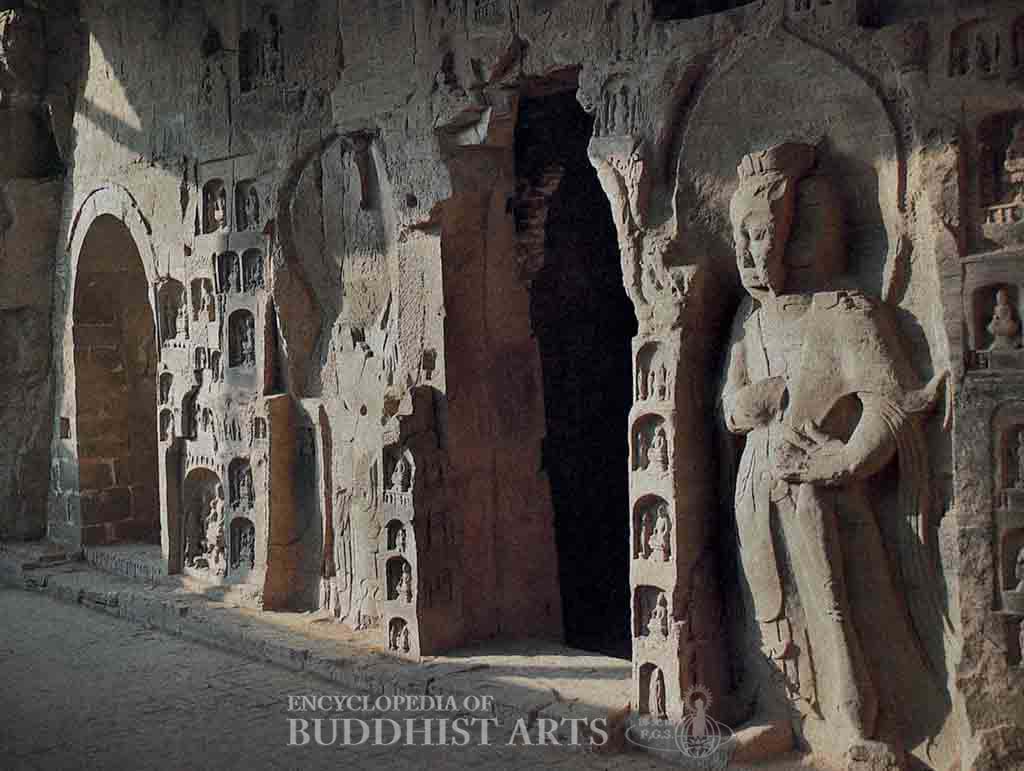
Gongxian Caves 3 and 4
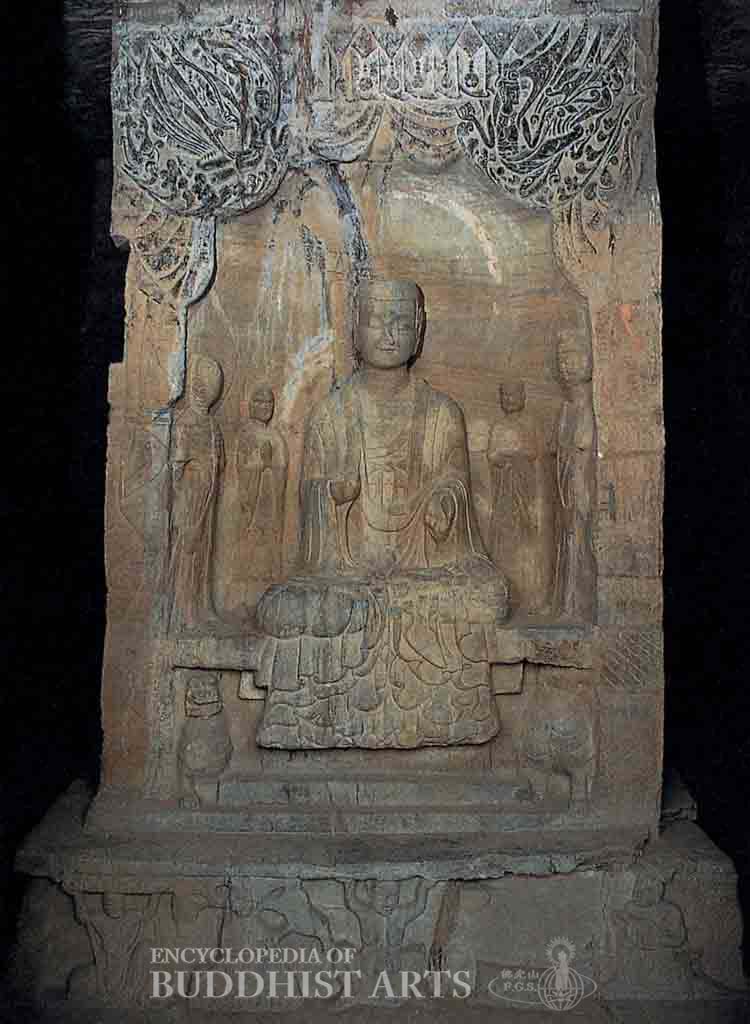
Gongxian Cave 3: Buddha, Bodhisattvas, and Disciples (central pillar, south side)
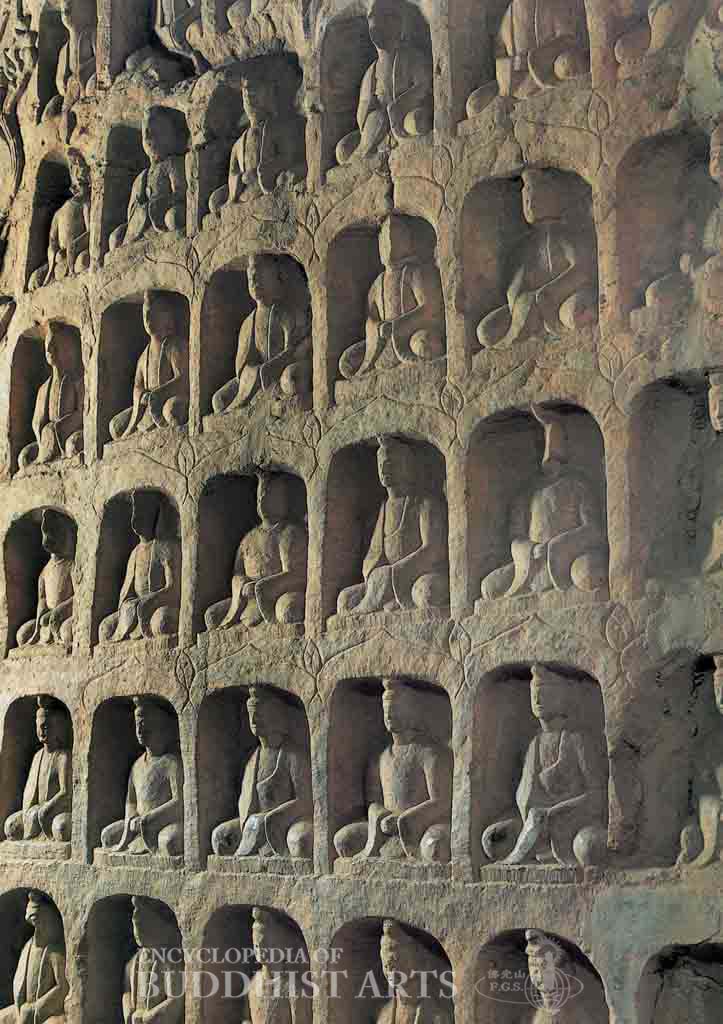
Gongxian Cave 3: Thousand Buddhas (west wall)
Gongxian Cave 3
CHINA, Henan, Zhengzhou
Located in the eastern section of the cave site, this central pillar cave was excavated during the Northern Wei dynasty (386–534). The interior of the cave is 5 m wide, 4.25 m high, and 5 m deep. Most of the original entrance has collapsed, but it has since been repaired using bricks.
Canopy-style niches containing a central figure flanked by two disciples and two Bodhisattvas are located on all four sides of the central pillar. The central figure on the east side is Maitreya Bodhisattva, while the rest are seated Buddhas. Bas-reliefs of apsaras are on the south side, while all four sides are carved with lions and deities.
On the top sections of the walls are bas-reliefs of draperies and curtains, similar to those on the upper sections of the central pillar. There are rows of the Thousand Buddha motif directly below the curtains. The back (north), east, and west walls are carved with 11 rows of Buddhas surrounding a central niche. A Buddha, two disciples, and two Bodhisattvas are found inside the niches in the back and west walls, while the niche in the east wall contains a Buddha and two Bodhisattvas. The upper section of the front (south) wall is engraved with three rows of the Thousand Buddha motif, and on each side of the entrance is engraved with three rows of figures paying respect to the Buddha. Heavenly musicians are carved on the lower sections of the front, east, and west walls, while the bottom of the back wall is carved with seven figures with animal heads and human bodies. The ceiling of the cave is carved with apsaras, lotus-born beings, and lotuses, and a checkerboard pattern is faintly visible on the floor.
For more details, go to the Encyclopedia of Buddhist Arts: Caves R-L, page 387.
Cite this article:
author = Hsingyun and Youheng and Johnson, Peter and Mankuang and Huntington, Susan and Edson, Gary and Neather, Robert,
booktitle = {Encyclopedia of Buddhist Arts: Caves R-L},
pages = 387,
title = {{Gongxian Cave 3}},
volume = 6,
year = {2016}}