
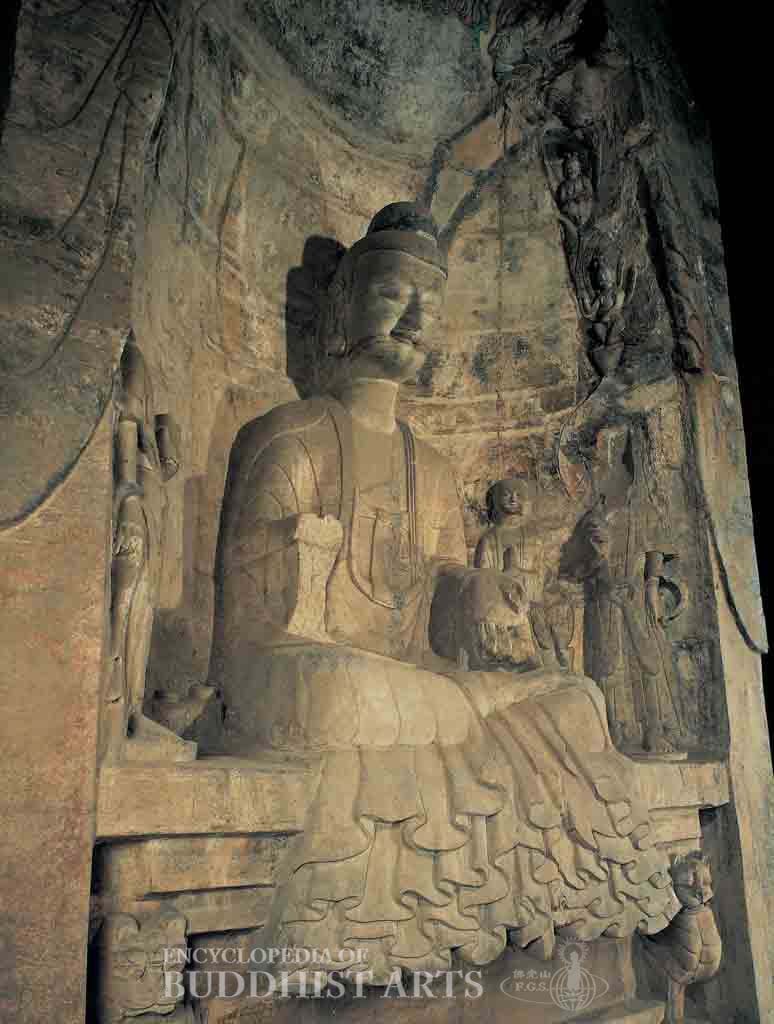
Gongxian Cave 1: Seated Buddha (central pillar, west side)
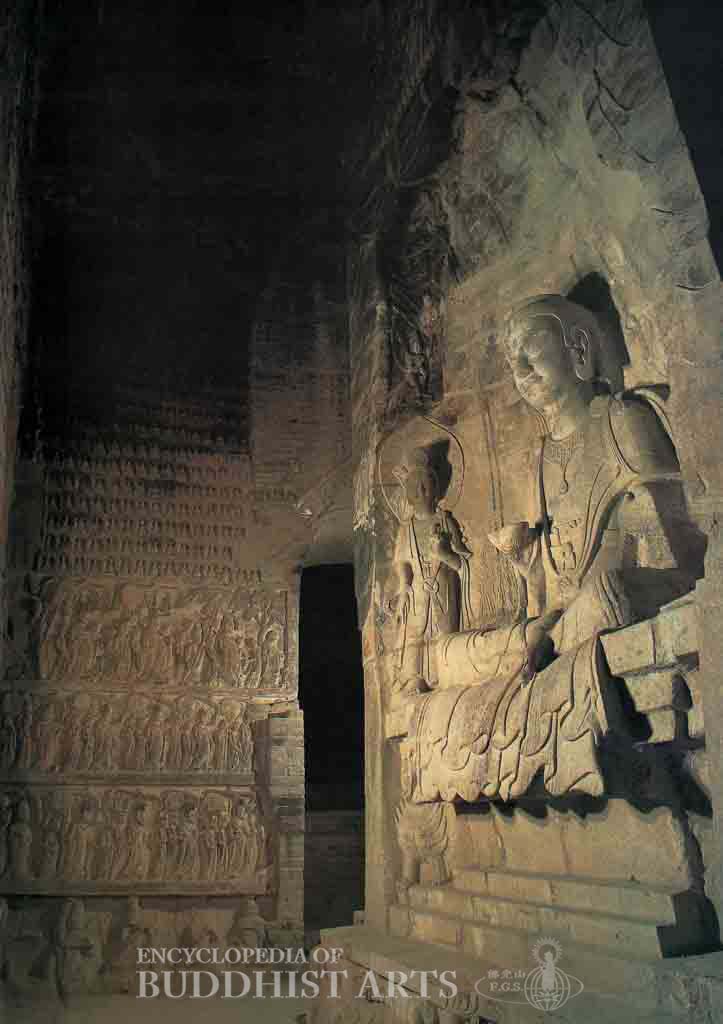
Gongxian Cave 1: Maitreya Bodhisattva (central pillar, east side)

Gongxian Cave 1: Deities (central pillar, east side, lower section)
Gongxian Cave 1
CHINA, Henan, Zhengzhou
This central pillar cave is located in the western section of the site and faces south. The cave measures more than 6 m in both width and depth, and 6 m in height. It is the oldest and largest of the Gongxian Caves, as well as being the most exquisitely carved and most complex in design.
A warrior stands outside the cave on each side of the entrance. The one on the left is 3.43 m high and the one on the right is 3.63 m. Two mythical creatures are located above the window on the front (south) wall within the cave. Above the doorway are 15 rows of the Thousand Buddha motif. A carving of the Emperor Paying Respect to the Buddha is depicted on the left side of the doorway, while a symmetrical Empress Paying Respect to the Buddha is located on the left.
Each side of the central pillar contains a niche with sculptures. The east side contains a seated Maitreya Bodhisattva, while each of the other three sides contains a Buddha seated in full lotus position. Each central figure is accompanied by two Bodhisattvas and two disciples, with a lion on each side of the throne. The head of each figure is surrounded by a lightly engraved nimbus. Apsaras, lotus-born beings, and lotuses are carved in relief around the nimbuses. The base of the central pillar is carved with deities on each side.
Fifteen rows of the Thousand Buddhas in relief can be seen in the upper sections of the back (north), east, and west walls. Below the Thousand Buddhas on each wall contains four large niches. All of the niches on the back wall contain a Buddha triad. On the east wall, the two niches in the middle contain a Buddha triad. The niche on the left depicts Vimalakirti and Manjusri Bodhisattva, while the niche on the right contains Sakyamuni and Prabhutaratna Buddhas sitting side by side. On the west wall, three niches contain Buddha triads while the fourth niche is badly deteriorated, with only the remnants of seven Arhats still discernible. There are relief carvings of heavenly musicians on the lowermost section of the front (south), east, and west walls, while the lower section of the back wall is carved with 12 different animal-headed deities. The cave ceiling is covered with apsaras, lotus-born beings, and lotuses.
For more details, go to the Encyclopedia of Buddhist Arts: Caves R-L, page 383.
Cite this article:
author = Hsingyun and Youheng and Johnson, Peter and Mankuang and Huntington, Susan and Edson, Gary and Neather, Robert,
booktitle = {Encyclopedia of Buddhist Arts: Caves R-L},
pages = 383,
title = {{Gongxian Cave 1}},
volume = 6,
year = {2016}}