
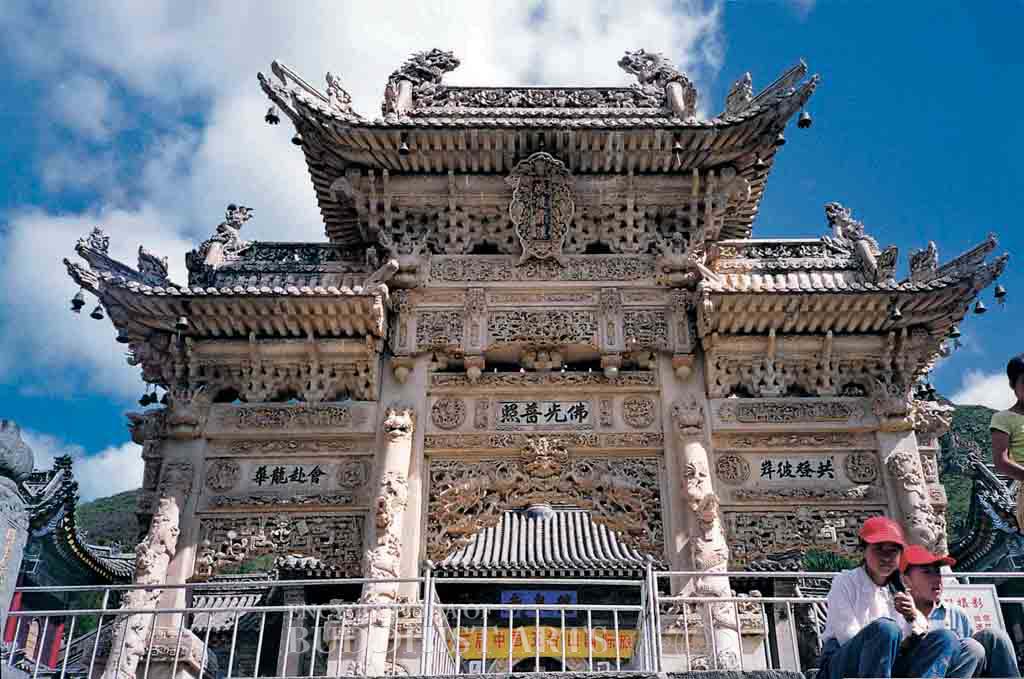
Wutaishan Longquan Temple: Gateway
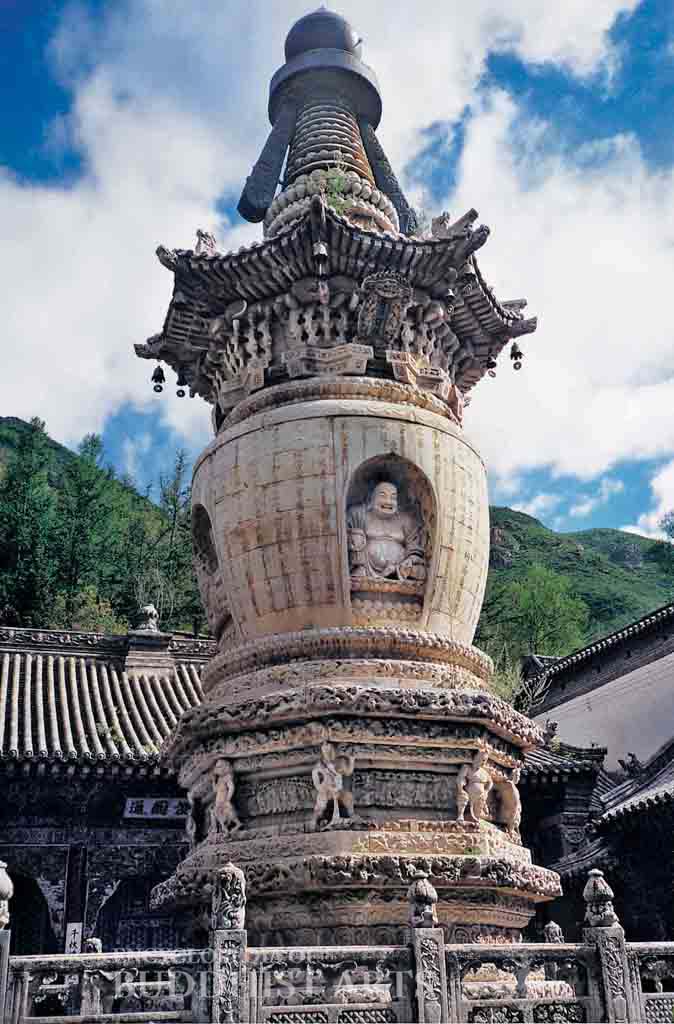
Wutaishan Longquan Temple: Puji Funerary Stupa
Wutaishan Longquan Temple
CHINA, Shanxi, Xinzhou
Longquan menas Dragon Spring. It was built during the Song dynasty (960–1279) as the ancestral temple of the Yang clan and later converted to a Buddhist temple. The existing buildings are 1910 reconstructions. The temple is listed as a Provincial Cultural Heritage Site.
The temple faces south and occupies 1.6 ha. It consists of three compounds, which are linked together but each having its own main gate. The east compound has two courtyards and contains the Heavenly King Hall, Avalokitesvara Hall, and Great Hero Hall. The screen wall and gateway are aligned with the east compound with 108 stone steps linking them. The central compound, also known as the Pagoda Compound, contains the Puji Funerary Stupa, together with other buildings.
The three-bay gateway was built between 1922 and 1930. It is constructed from white marble and has a hip-and-gable roof. In between its columns are two tiers of architraves and bracket sets on the beam. Eave purlins are visible above the bracket sets which in turn support the normal and flying rafters. Intricate carvings can be found on the architraves, plinths, and support columns, with suspended flower columns above the architraves of the central bay. The whole gateway is designed to imitate wooden structures.
The Puji Funerary Stupa was built in 1917. It is made from white marble and is in the style of a Tibetan stupa. It has a double-tier Sumeru base with warriors carved at the corners. The stupa body has four arched niches, each enshrining Maitreya Buddha and an inscription of the Heart Sutra. A ring of lotus petals supports the prominent upturned eaves. There are ridge decorations in the shape of mythical creatures. The spire consists of 13 stacked rings, a canopy, and a bronze jewel.
For more details, go to the Encyclopedia of Buddhist Arts: Architecture T-Z, page 1289.
Cite this article:
author = Hsingyun and Youheng and Johnson, Peter and Mankuang and Lancaster, Lewis,
booktitle = {Encyclopedia of Buddhist Arts: Architecture T-Z},
pages = 1289,
title = {{Wutaishan Longquan Temple}},
volume = 4,
year = {2016}}