
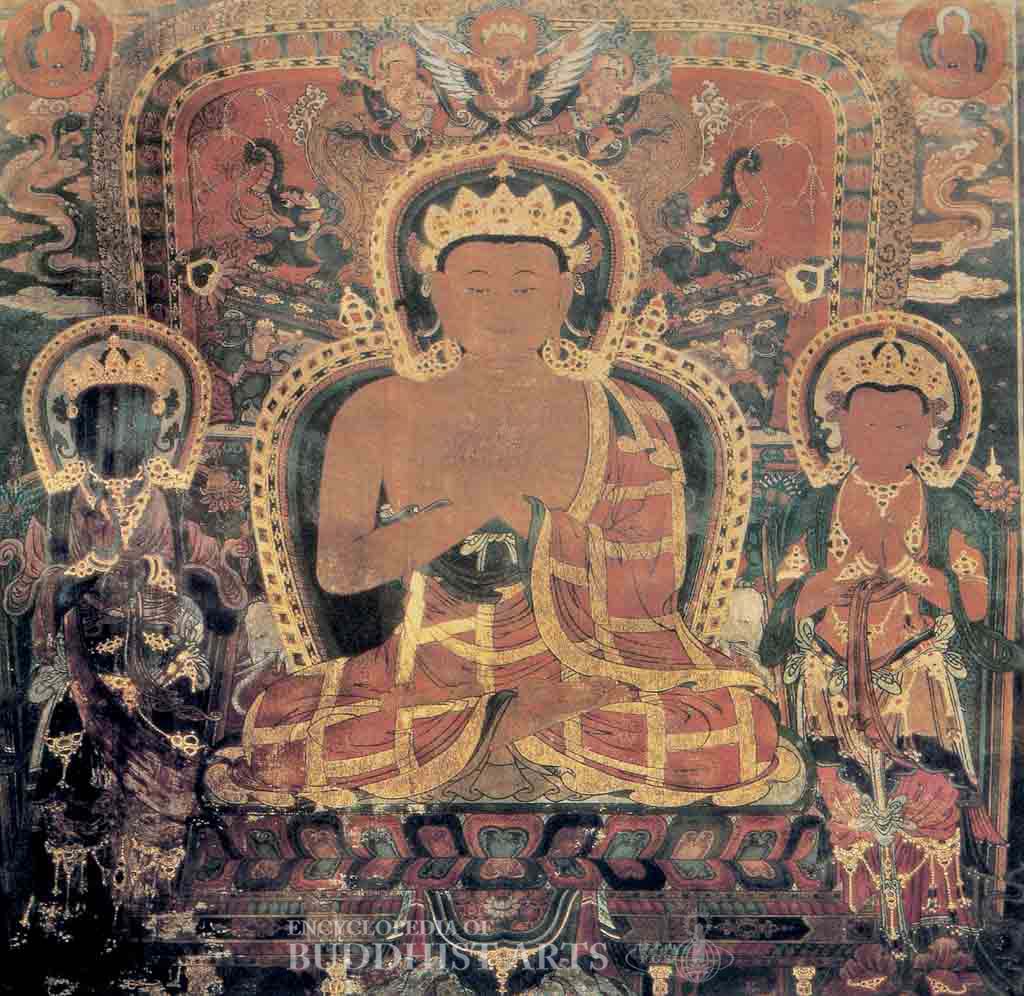
Drotsang Monastery Murals: Prosperous Nation Hall - Buddha Triad (west wall); 542 x 505 cm
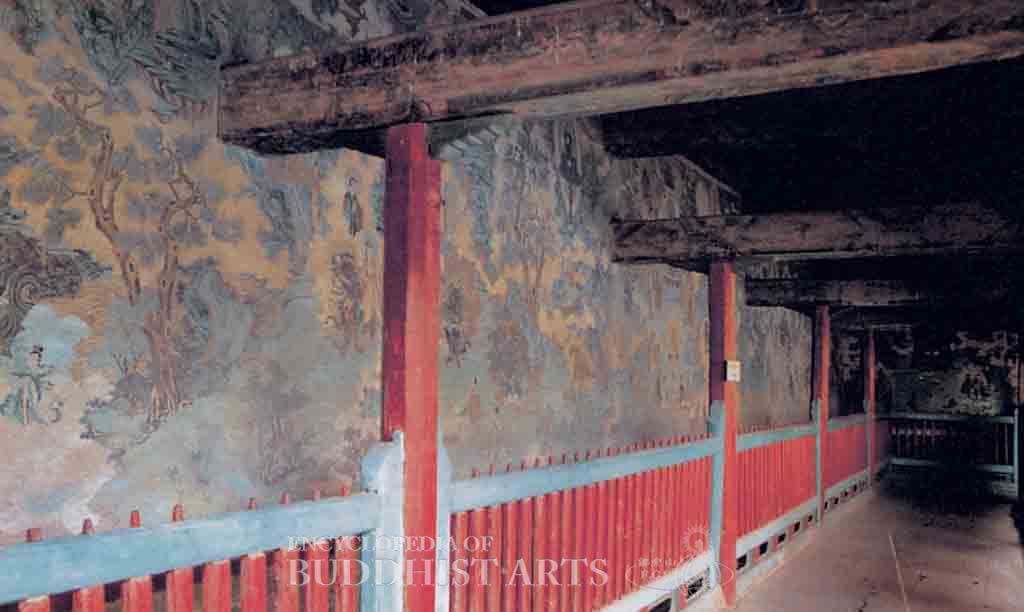
Drotsang Monastery Murals: Covered Walkway Murals
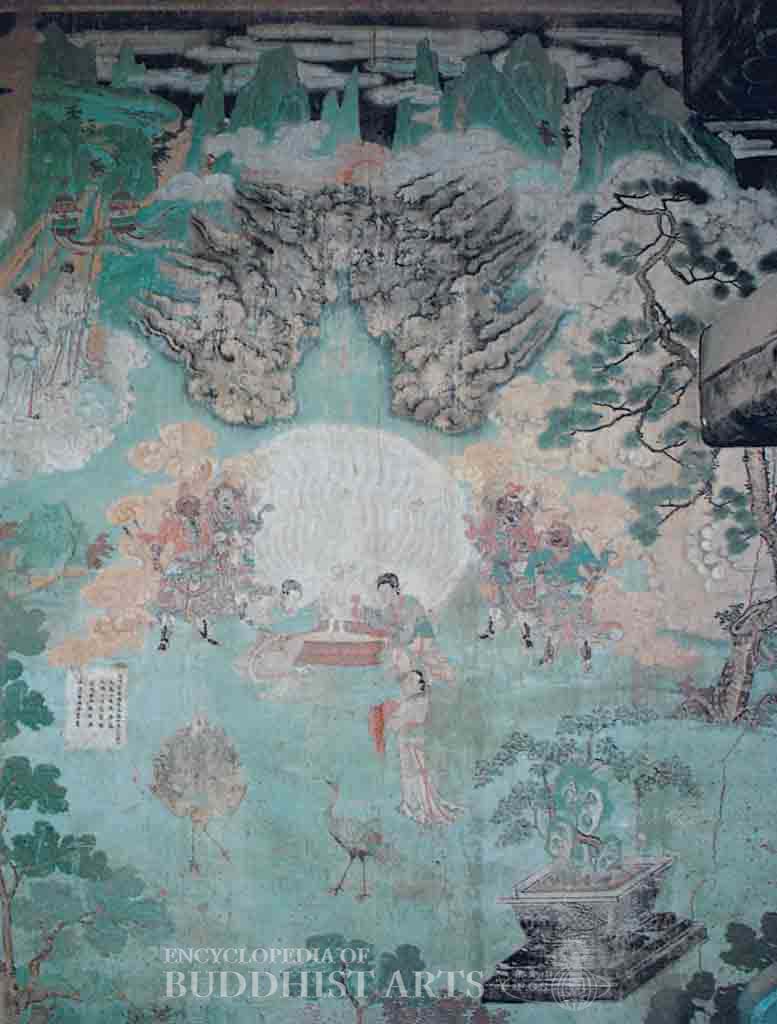
Drotsang Monastery Murals: Life of the Buddha - Bathing of Prince Siddhartha (covered walkway)
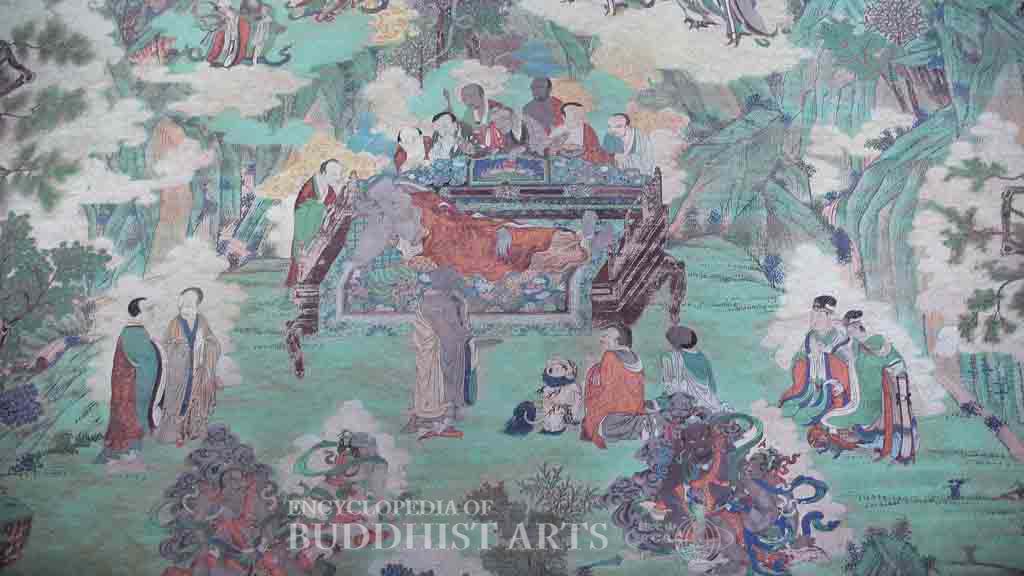
Drotsang Monastery Murals: Life of the Buddha - Parinirvana (covered walkway)

Drotsang Monastery Murals: Life of the Buddha - Parinirvana (detail) (covered walkway)
Drotsang Monastery Murals
CHINA, Qinghai, Ledu; Ming to Qing dynasty
Drotsang Monastery, also known as Qutan Temple, was built in 1392. Many exquisite Chinese and Tibetan Buddhist murals from the Ming dynasty (1368–1644) are painted on the walls of the halls and covered walkways of the monastery. During the Qing dynasty (1644–1911), the monastery converted to the Gelug school. Qing dynasty murals are mostly found within small halls and the ends of the covered walkways. These murals include images of Tsongkhapa and other important figures of the Gelug school.
The Prosperous Nation Hall, Amitabha Hall, and Vajradhara Hall are decorated with large Ming dynasty murals of Buddhist figures. The murals within the Prosperous Nation Hall depict Buddhas, Bodhisattvas, and scenes from sutras. On the west wall, there is an illustration of a Buddha with two Bodhisattvas painted in Tibetan style. The main Buddha figure is over 5 m high, and is seated in full lotus position on a lotus throne. Wearing a five-pointed crown, he has a gentle countenance and wears a monastic robe that reveals the right shoulder. Both hands form a mudra in front of the chest. The two attendant Bodhisattvas, one with red skin and the other green, also wear five-pointed crowns. They are dressed in ornate monastic robes and are adorned with ornaments. The entire mural is rich in color and is gilded in many areas, resulting in a dazzling gold appearance. It is one of the most exquisite murals in the monastery.
Originally, 51 bays of the covered walkways contain murals, but now only 28 bays still contain them. These murals cover a total surface area of 360 sq m. Some of the murals are narrative paintings of the Life of the Buddha from his birth to his final passing into parinirvana. The different stories are not distinguished by partitions; rather, they are separated naturally by landscapes, rocks, forests, buildings, and other structures. The murals display the artistic styles and techniques of the early Ming, late Ming, and Qing dynasties. The early Ming murals were painted soon after the construction of the temple. They were probably the work of imperial court artists or famous painters. Each mural has an elegant layout, is painted with skillful technique, and is inscribed with praise in the form of a seven-line verse, a rare feature among temple murals. The late Ming murals have similar characteristics, but are not as striking as their early Ming counterparts. They are marked with inscriptions by Sun Kegong of Gansu, Wang Zhu, Xu Runwen, He Jihan, and other artists.
Along the covered walkway, there is a mural depicting the Bathing of Prince Siddhartha. The prince is shown standing in a lotus basin with his left hand pointing at the heavens and his right hand pointing at the earth. Behind the prince, there is a large white mandorla decorated with curving gray lines, and above him are the nine nagas spouting water. Two maids bathe the prince, and another maid holds the clothes. The Four Heavenly Kings stand guard on the sides. In the illustration of Parinirvana located along the covered walkway, the Buddha lies on his right side on a carved wooden bed surrounded by mourning disciples, Bodhisattvas, and heavenly beings. The dominant turquoise color and delicate brushstrokes used in these two murals give them a unique, peaceful appearance.
For more details, go to the Encyclopedia of Buddhist Arts: Painting A-H, page 202.
Cite this article:
author = Hsingyun and Youheng and Youlu and Wilson, Graham and Manho and Mankuang and Huntington, Susan,
booktitle = {Encyclopedia of Buddhist Arts: Painting A-H},
pages = 202,
title = {{Drotsang Monastery Murals}},
volume = 14,
year = {2016}}