
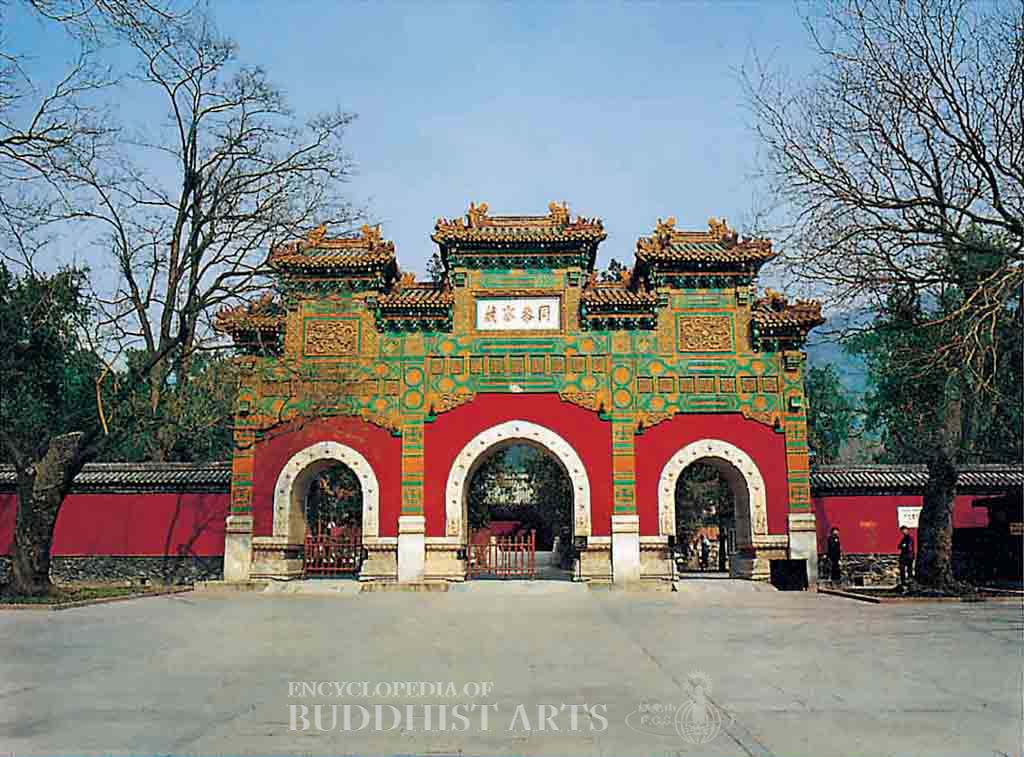
Shifang Pujue Temple: Glazed Gateway
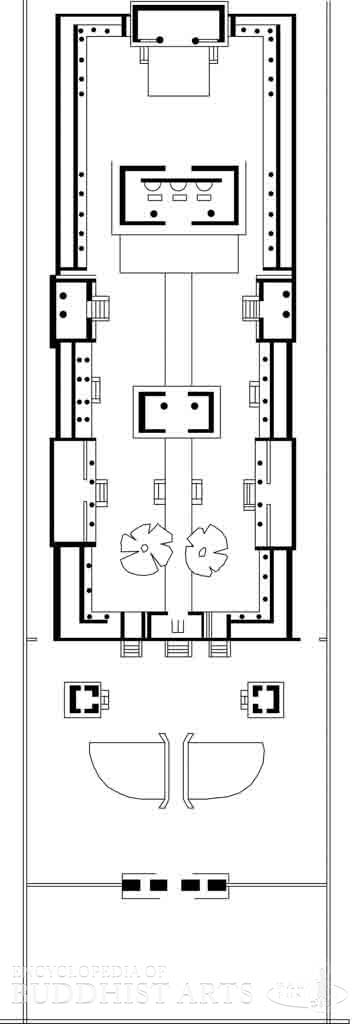
Shifang Pujue Temple: Central Path (site layout)
Shifang Pujue Temple
CHINA, Beijing
It was originally named Tusita Temple and it is also called the Reclining Buddha Temple. Located on the southern foothills of Shouanshan (Longevity and Tranquility Mountain), the temple was founded during the rule of Emperor Taizong (reigned 626–649) of the Tang dynasty. The temple underwent considerable expansion during the Yuan dynasty (1271–1368). During the Ming dynasty it was refurbished five times. During the rule of Emperor Yongzheng (reigned 1722–1735) of the Qing dynasty it underwent large-scale renovation and was renamed Shifang Pujue Temple by imperial decree. It was listed as a National Cultural Heritage Site in 2001.
The temple faces south and has three paths: the east, central, and west. The main buildings are situated along the central axis of the central path: the glazed gateway, temple gate, Heavenly King Hall, Hall of the Three Buddhas, and the Reclining Buddha Hall. Along the sides there are covered walkways, abbot’s quarters, reception hall, and side halls. The inner and exterior structure of each hall is in Qing dynasty (1644–1911) architectural style.
The central path is surrounded by covered walkways which connect the side buildings with the rear hall. This type of layout was common during the Tang (618–907) and Song (960–1279) dynasties, and can be observed in the murals of Dunhuang. In Japan there are examples of this type of layout at temples built in the Asuka (538–645) and Heian (794–1185) periods, but in Beijing this is the only remaining one.
The glazed gateway is three bays wide. The archways are each built on a white marble Sumeru base. The columns, architraves, and upper parts of the gate are covered with yellow and green glazed tiles. There are seven decorated roofs supported by bracket sets. The Reclining Buddha Hall enshrines a 5.3 m long reclining Buddha. The hall also contains a horizontal inscribed board written by Emperor Qianlong (reigned 1736–1795) of the Qing dynasty.
For more details, go to the Encyclopedia of Buddhist Arts: Architecture M-S, page 989.
Cite this article:
author = Hsingyun and Youheng and Johnson, Peter and Mankuang and Lancaster, Lewis,
booktitle = {Encyclopedia of Buddhist Arts: Architecture M-S},
pages = 989,
title = {{Shifang Pujue Temple}},
volume = 3,
year = {2016}}