
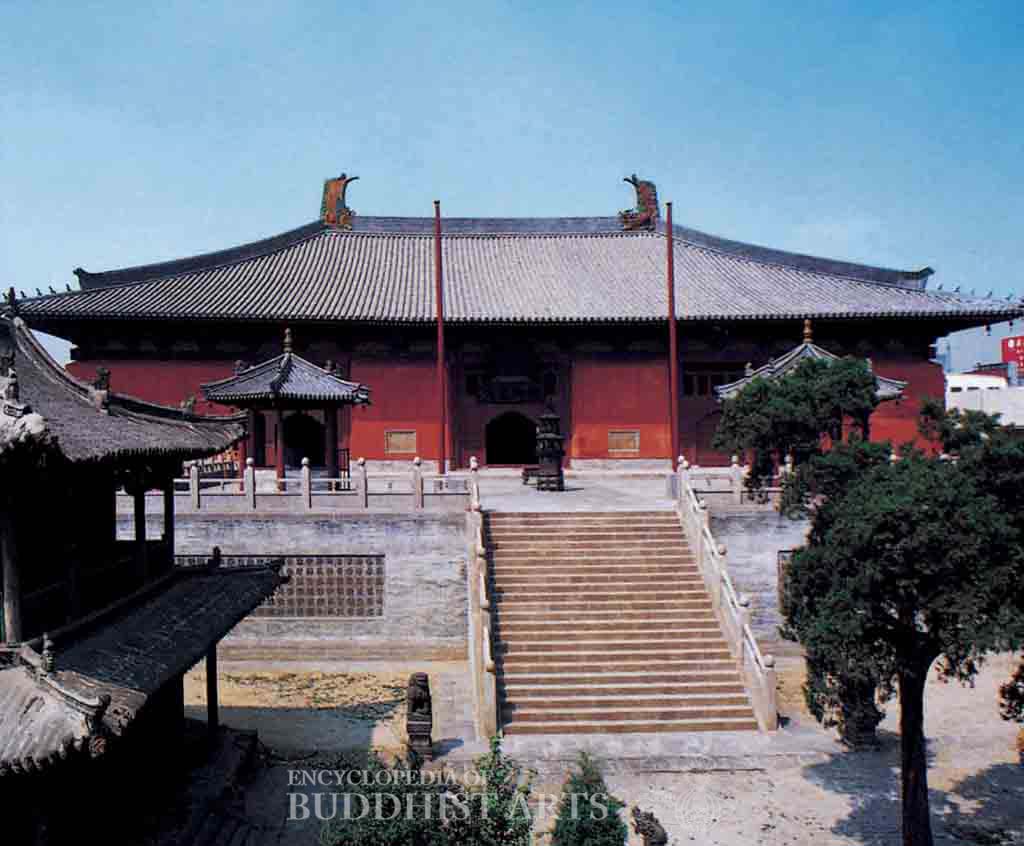
Huayan Upper Temple: Great Hero Hall
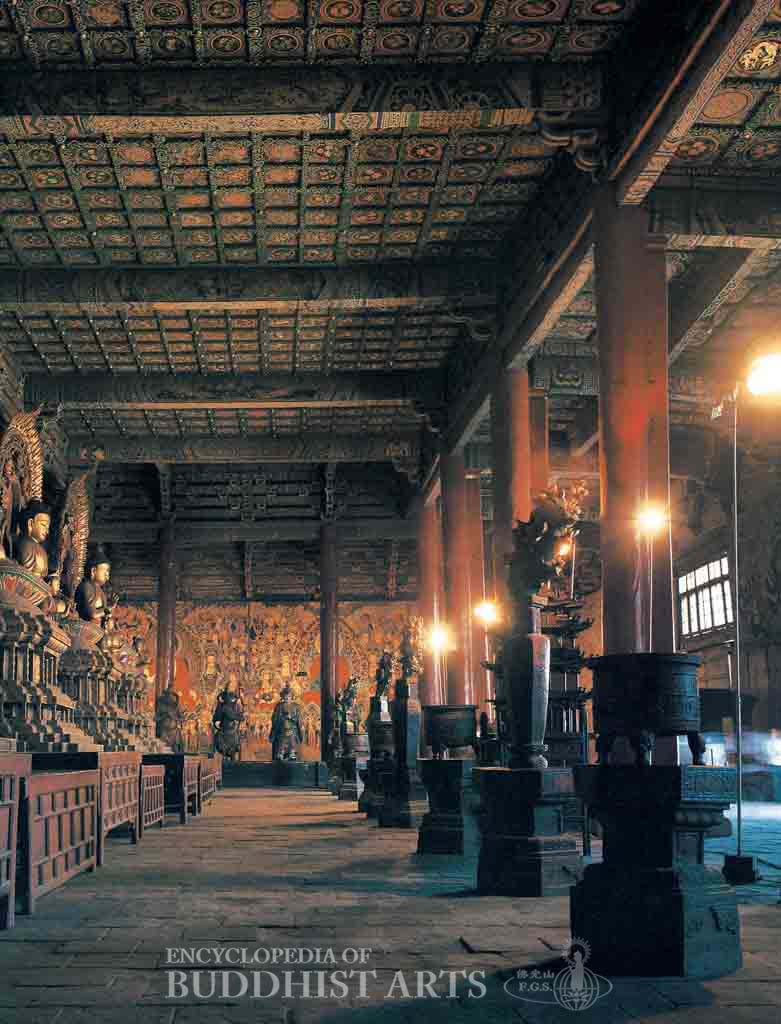
Huayan Upper Temple: Great Hero Hall (interior)
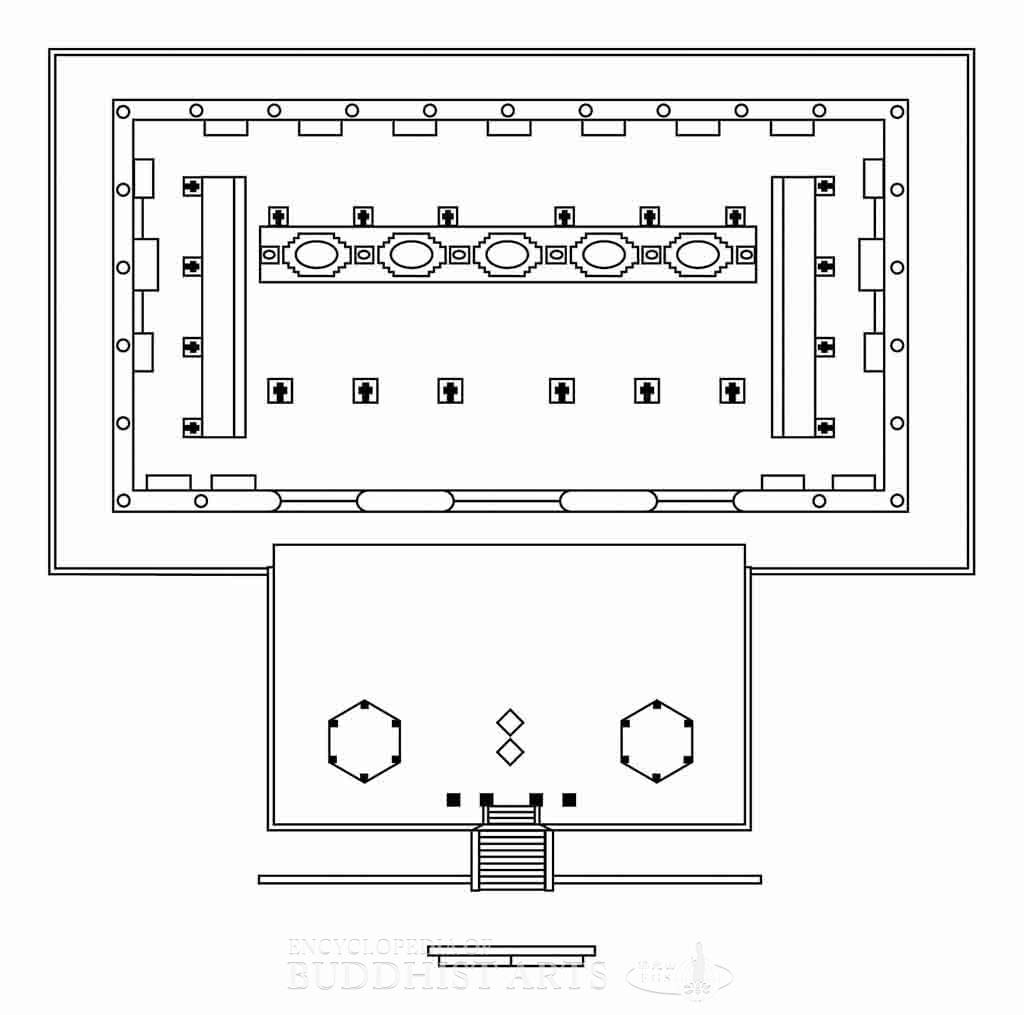
Huayan Upper Temple: Great Hero Hall (plan)
Huayan Temple
CHINA, Shanxi, Datong
Huayan Temple was built during the Liao dynasty (907–1125) and was regarded as one of the most important temples following the Huayan school during the Liao and Jin (1115–1234) dynasties. Since Datong was the western capital during the Liao dynasty, this temple acted as the ancestral temple for Liao royalty and it housed stone and bronze statues of Liao dynasty emperors. In 1122 the temple was largely destroyed by war and it was not until between 1138 and 1140, during the Jin dynasty, that a new temple was built on the old site. It later became one of the greatest temples in the north of China. In the early period of the Ming dynasty (1368–1644) it was confiscated as state property. After the middle of the Ming dynasty, the temple was divided into Upper Temple and Lower Temple, each with its own main temple gate and its own layout. In 1963 the two temples were recombined, and listed as a National Cultural Heritage Site in 1961.
The temple faces the east, following the Liao dynasty’s Khitan custom of facing eastward to show respect. The buildings were arranged according to their height. Along the Upper Temple’s central axis there are the main temple gate, intermediate hall, Great Hero Hall, Avalokitesvara Pavilion, and the Ksitigarbha Pavilion. The layout of the Lower Temple is less hierarchical, with the Bhagavad Sutra Hall functioning as the focal point. Other buildings located in the north and south include the main temple gate, the Heavenly King Hall, and various side halls.
The nine-by-five bay Great Hero Hall is the Upper Temple’s main building, which was rebuilt in 1140 during the Jin dynasty. It stands on a high platform and has a single-eave hip roof. It covers an area of 1,559 sq m and is one of the largest extant Buddha halls from the Yuan dynasty (1271–1368). The eaves are 9.5 m high and there is a glazed owl’s beak at either end of the main ridge. The three simple doors set in the central and side bays date back to the Jin dynasty. Within the hall 12 columns were removed to create space in the front section of the hall for Buddhist rituals and other activities.
The altar within the Great Hero Hall is five bays wide and holds 11 statues including the Five Dhyani Buddhas together with attendant Bodhisattvas. There are 20 Ming dynasty statues of heavenly beings lined up along the north and south walls. The surfaces are covered with murals totaling 887 sq m painted by the Datong artist Dong’an during the rule of Emperor Guangxu (reigned 1875–1908).
For more details, go to the Encyclopedia of Buddhist Arts: Architecture G-L, page 464.
Cite this article:
author = Hsingyun and Youheng and Johnson, Peter and Mankuang and Lancaster, Lewis,
booktitle = {Encyclopedia of Buddhist Arts: Architecture G-L},
pages = 464,
title = {{Huayan Temple}},
volume = 2,
year = {2016}}