
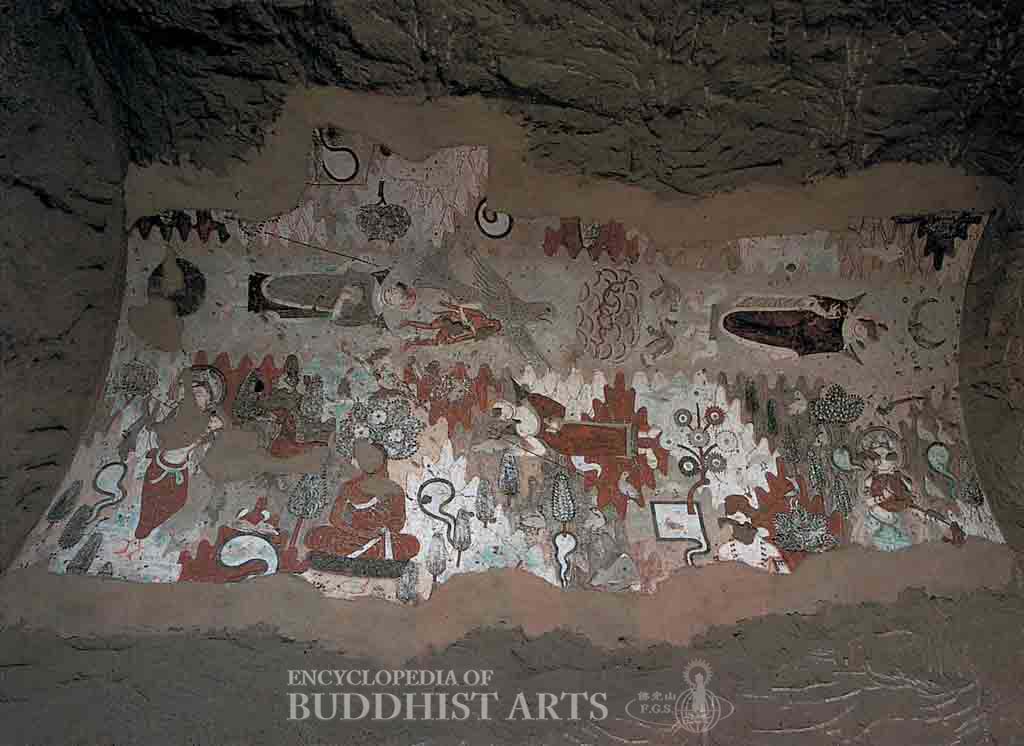
Kizil Cave 118 (main chamber, ceiling)
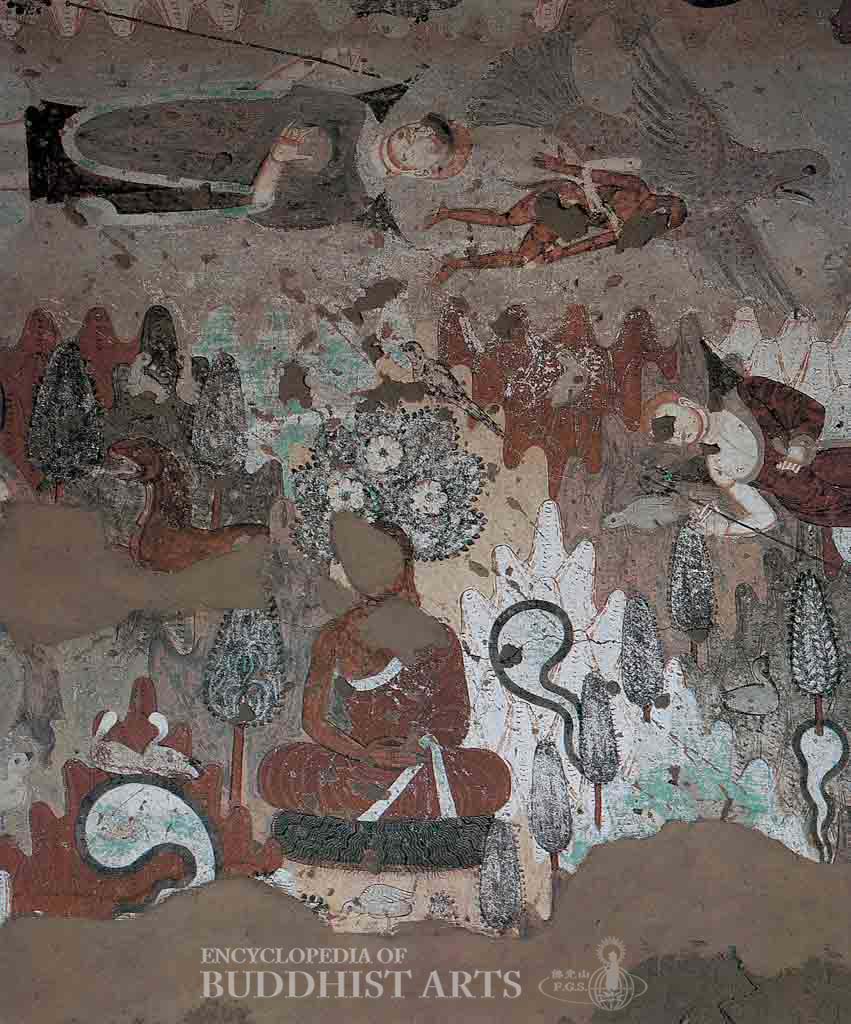
Kizil Cave 118 (main chamber, ceiling)
Kizil Cave 118
CHINA, Xinjiang, Aksu
This cave, located in the inner valley, is one of the earliest at Kizil, built during the 3rd to 4th century. The cave has an antechamber and a main chamber. The antechamber measures 4.01 m to 4.24 m wide, 3.88 m high, and 1.74 m deep, and has a truncated pyramidal ceiling. The front of the antechamber is no longer intact. A doorway that is slanted at the top and leads to the main chamber is located on the back wall. The main chamber is rectangular and has a barrel-vaulted ceiling.
The front wall of the main chamber has a window on each side of the entrance. An illustration of the Palace Life from the Life of the Buddha is in the center of the back wall, and takes up much of the wall. Figures making offerings are seen below. Each of the four walls displays inscriptions in Chagatai and Brahmi script.
Astrological signs are depicted on the central ridge of the barrel-vaulted ceiling. From top to bottom, they are Candra, a standing Buddha, a pair of birds, Vayu, a hawk holding a monkey, a second standing Buddha, and Surya. The images reflect Buddhist cosmology. There are diamond-shaped illustrations of monks meditating in forests on the sides of the ceiling, however, only the top few rows of these images are still intact. The illustrations are derived from anecdotes in the Account of the Causes and Conditions of the Dharma-Treasury Transmission and illustrate the practice of meditation by monks. Added to the composition are mountains, trees, and flying beasts. Paintings of heavenly musicians flank these illustrations.
The overall cave is painted in warm colors of yellow, red, ocher, and gray, with graduated changes in color shades. The figures are influenced by the Gandharan style. Particularly, the heavenly beings share many similarities with 3rd century Bodhisattvas from Gandhara, and the thick, woolen monastic robes worn by the standing Buddha in the astrological signs on the ceiling are reminiscent of the Gandharan style.
For more details, go to the Encyclopedia of Buddhist Arts: Caves R-L, page 552.
Cite this article:
author = Hsingyun and Youheng and Johnson, Peter and Mankuang and Huntington, Susan and Edson, Gary and Neather, Robert,
booktitle = {Encyclopedia of Buddhist Arts: Caves R-L},
pages = 552,
title = {{Kizil Cave 118}},
volume = 6,
year = {2016}}