
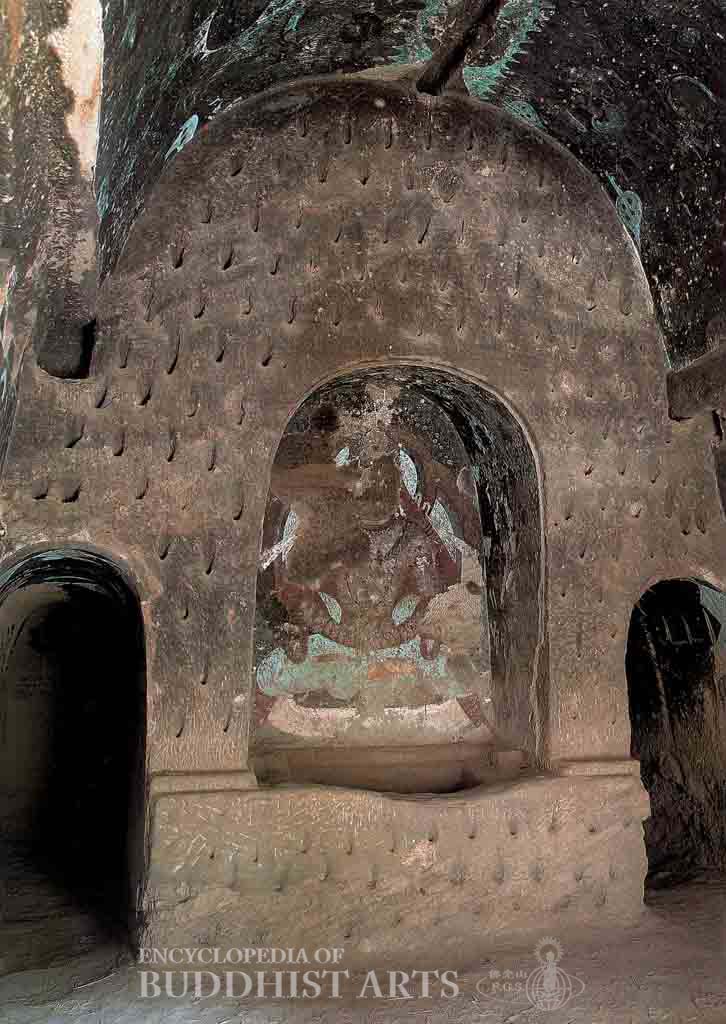
Kizil Cave 114: Main Chamber - Back Wall
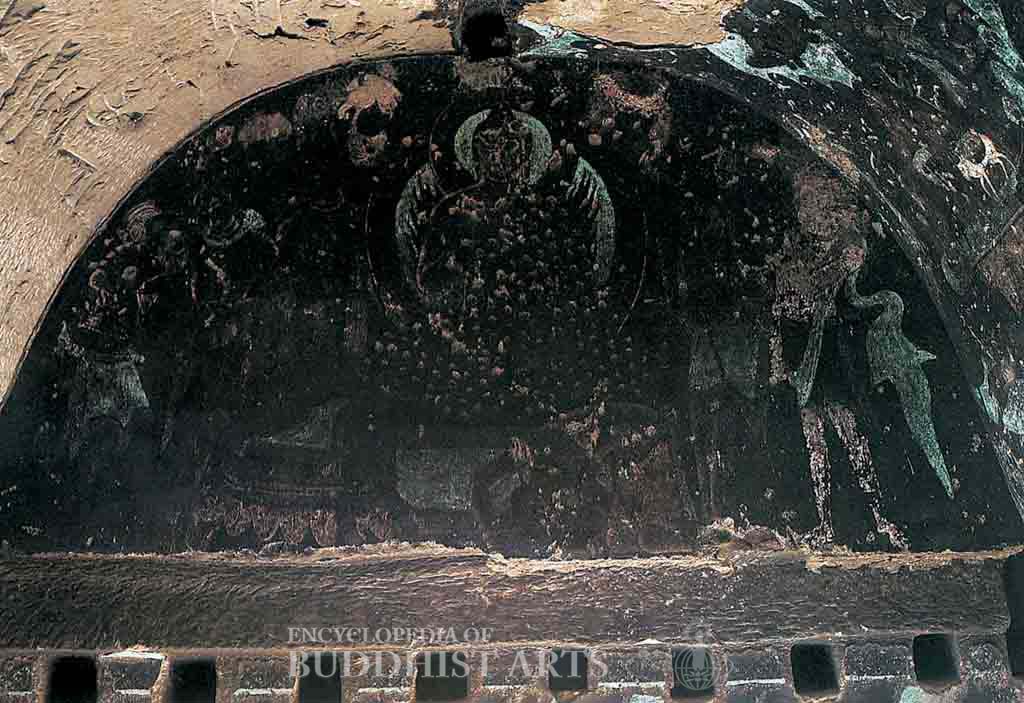
Kizil Cave 114: Main chamber - Front Wall (above the entrance)
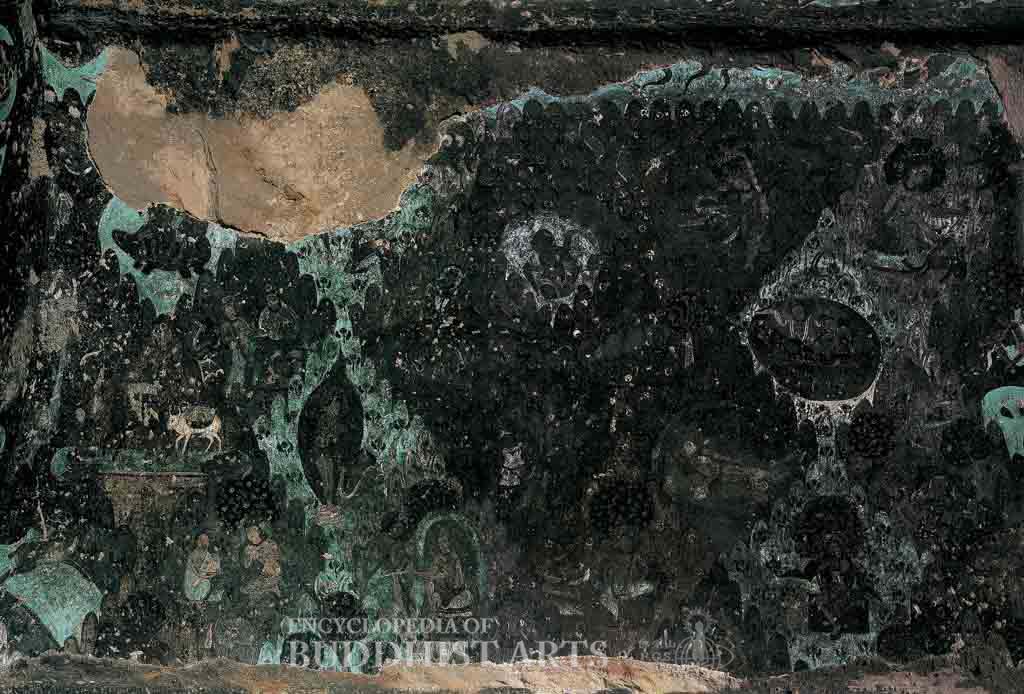
Kizil Cave 114: Main Chamber - Ceiling (left side)
Kizil Cave 114
CHINA, Xinjiang, Aksu
This central pillar cave is found in the inner valley and dates from the 4th to 5th century. It consists of an antechamber, main chamber, and corridors. The antechamber has a portico with eaves, which connects to Cave 113 in the west, and Cave 115 in the east. The front and left walls of the antechamber are damaged. The back wall was once covered in murals, however, they have mostly faded beyond recognition.
The main chamber measures 4.8 m wide, 4.75 m high, and 5 m deep. It has a barrel-vaulted ceiling and the back wall contains two doorways that lead into the corridors which form the central pillar. The rear corridor also has a barrel-vaulted ceiling. A large niche with a mural of Maitreya Buddha seated in full lotus position on a circular throne is located on the back wall of the main chamber. Maitreya is attended by Bodhisattvas, while diamond-shaped images form a pattern on the ceiling and walls of the niche, portraying landscapes, a garuda, and heavenly beings. A series of neat chisel marks, which once depicted Mount Sumeru, is found outside the niche on the back wall.
Twelve square chisel marks are carved into each of the side walls, beneath which are scenes from the Life of the Buddha, six on each wall. On the semicircular section of the front wall, above the entrance, is a depiction of the Buddha seated among disciples and non-Buddhist teachers. Just below this are square chisel marks with the same height and appearance as those on the two side walls. Niches on either side of the entrance house painted images of seated Buddhas, along with heavenly beings, monks, and donors. Finally, a row of seven small seated Buddhas is located just above the entrance.
Four rows of diamond-shaped illustrations portraying Jataka tales are depicted on each side of the vaulted ceiling. Among those intact are the King Sudolagarne Jataka, King Maitribala Jataka, King Sudhira Jataka, King Sibi Jataka, Prince Sujata Jataka, Prince Mahasattva Jataka, Lion King Jataka, Jataka of Dove’s Self-Sacrifice, Jataka of the Woodcutter and the Bear, Bhojajaniya Jataka, and Ksantidevi Jataka. Those which have been removed include the Milinda Jataka, Syama Jataka, and Prince Sudana Jataka.
There are also diamond-shaped illustrations on the vaulted ceilings of the rear corridor, and along the inner walls of the side corridors are six portraits of monks. The rear corridor depicts the Mahaparinirvana Sutra. A mural of a burning coffin is on the left side, and on the right is a depiction of the First Buddhist Council. The inner wall displays a mural of the Distribution of Relics Among the Eight Kings.
For more details, go to the Encyclopedia of Buddhist Arts: Caves R-L, page 545.
Cite this article:
author = Hsingyun and Youheng and Johnson, Peter and Mankuang and Huntington, Susan and Edson, Gary and Neather, Robert,
booktitle = {Encyclopedia of Buddhist Arts: Caves R-L},
pages = 545,
title = {{Kizil Cave 114}},
volume = 6,
year = {2016}}