
Kizil Cave 101: Disobedient Drummer and the Bandits
Kizil Cave 101: Disobedient Drummer and the Bandits
CHINA, Xinjiang, Aksu
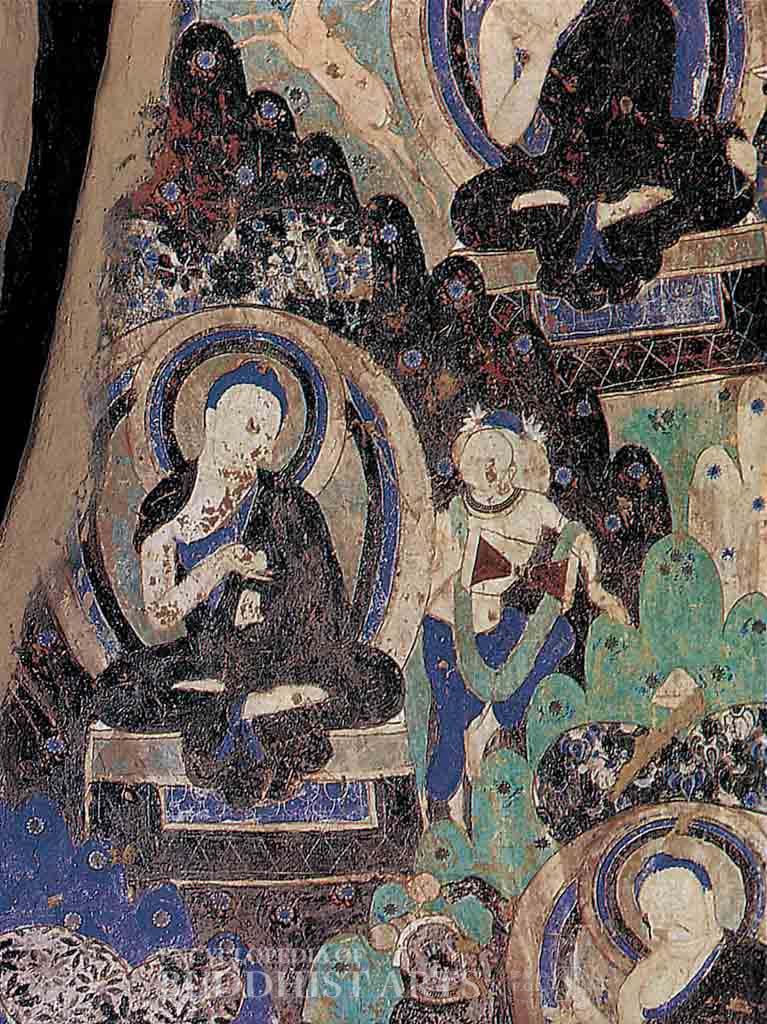
This painting is located on the left side of the barrel-vaulted ceiling in the main chamber. It portrays Sakyamuni in one of his past lives as a drummer who had a young son. One day they went to a festival to earn some money. On their way home, his son happily played the drum. When passing by a village notorious for bandits, the drummer advised his son to cease playing, but the boy did not listen. His drumbeats therefore attracted a bandit intent on robbing them of their money.
In the illustration, the Buddha wears a monastic robe that bares the right shoulder. He is seated in full lotus position on a square throne and has a nimbus, an aureole, and a canopy. The young drummer is on his right, wearing a headdress decorated with green and white flowers and a flowing stole. The drummer wears blue trousers and is barefoot. He carries a red waist drum and raises his left leg, facing toward the Buddha.
For more details, go to the Encyclopedia of Buddhist Arts: Caves R-L, page 541.
Cite this article:
author = Hsingyun and Youheng and Johnson, Peter and Mankuang and Huntington, Susan and Edson, Gary and Neather, Robert,
booktitle = {Encyclopedia of Buddhist Arts: Caves R-L},
pages = 541,
title = {{Kizil Cave 101: Disobedient Drummer and the Bandits}},
volume = 6,
year = {2016}}