
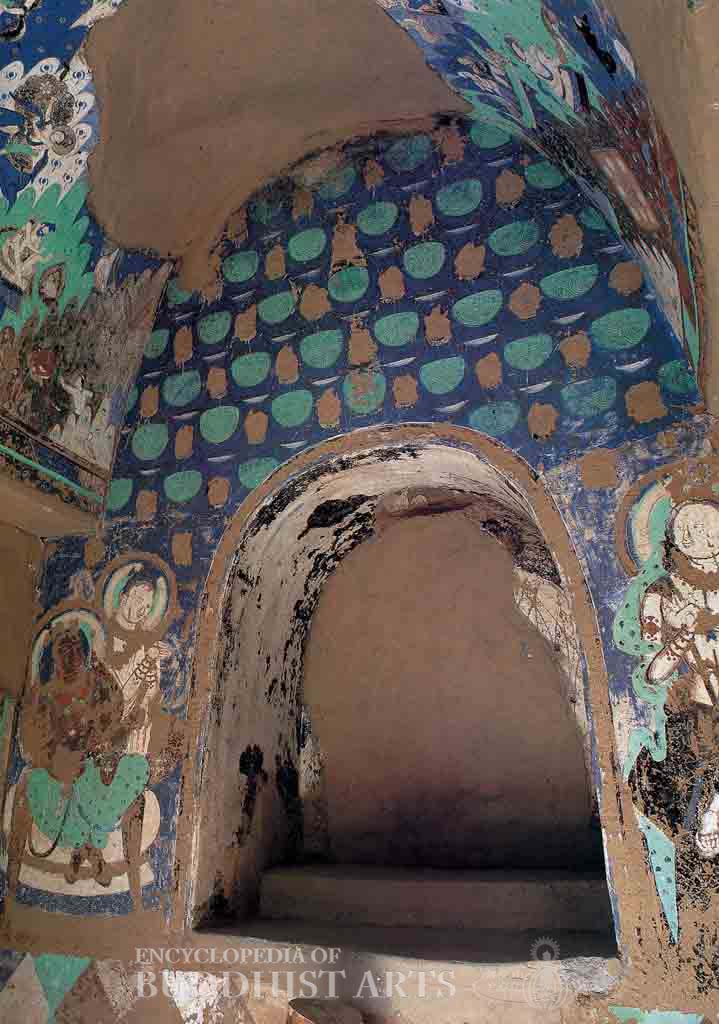
Kizil Cave 14: Back Wall
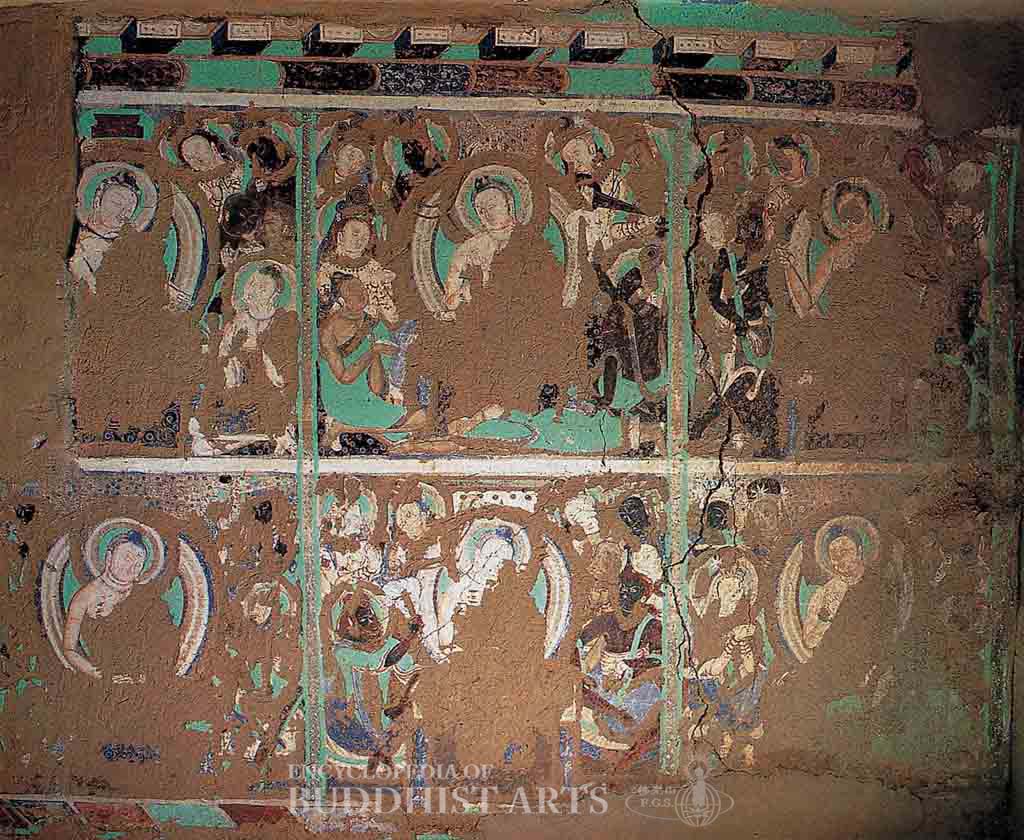
Kizil Cave 14: Jakata Tales (right wall)
Kizil Cave 14
CHINA, Xinjiang, Aksu
Situated in the west valley, this cave was constructed during the 6th and 7th centuries. The rectangular cave measures 2.2 m wide, 2.55 m high, and 2.05 m deep. The vaulted ceiling has a corbel on the left and right walls. A niche with a vaulted ceiling is at the center of the back wall within the main chamber. The niche statue is missing and parts of the murals have become detached. Bodhisattvas listening to the Dharma are depicted on both sides outside the niche. Six rows of Buddhas seated on lotus flowers within a pond are above the niche, while below it are four rows of diamond-shaped images, bordered by a row of patterns and decorative ribbons.
The left and right walls of the main chamber each have two rows of Jataka tales and stories from the Life of the Buddha. Three panels are aligned vertically. The first panel in the top row on the right wall displays a brahmin elder grasping a woman’s left arm while facing the Buddha. This is likely the story of the Brahmin Offering His Daughter as a Bride to the Buddha, as chronicled in the Arthavargiya Sutra. The last panel in the bottom row is said to be an illustration of the story of Brahma and Sakra’s Request, as recorded in the Abhiniskramana Sutra. The middle panel in the bottom row likely refers to the Renunciation of Maudgalyayana and Sariputra, recorded in the Abhiniskramana Sutra.
On the front wall and to the left of the cave entrance, there is a partial portrait of a standing Buddha. The right side has been damaged. A mural which illustrates Maitreya Teaching in Tusita Heaven is above the lintel; however, most of this mural has also been damaged. A row of quadrilateral and foliage patterns can be seen on the lower section of the front wall.
A series of astrological signs are painted on the ridge of the vaulted ceiling. The majority of the mural is damaged, with only two nagas remaining in the center. Diamond-shaped images of Jataka tales are found on both sides of the ceiling, but many parts are unidentifiable. The stories which can still be discerned include: the King Mahaprabhasa Avadana, the Jataka of Sacrifice for a Gatha by Enduring the Burning of Flesh, the Nigrodharaja Jataka, the Jataka of Rabbit King’s Self-Sacrifice, the Jataka of the Lion King, the Chaddanta Jataka, the Bhojajaniya Jataka, the Valahassa Jataka, the Jataka of the Naga King, the Jataka of the Woodcutter and the Bear, and the Milinda Jataka. Rows of key patterns and a row of foliage patterns can be seen at the bottom of the ceiling on each side.
For more details, go to the Encyclopedia of Buddhist Arts: Caves R-L, page 475.
Cite this article:
author = Hsingyun and Youheng and Johnson, Peter and Mankuang and Huntington, Susan and Edson, Gary and Neather, Robert,
booktitle = {Encyclopedia of Buddhist Arts: Caves R-L},
pages = 475,
title = {{Kizil Cave 14}},
volume = 6,
year = {2016}}