
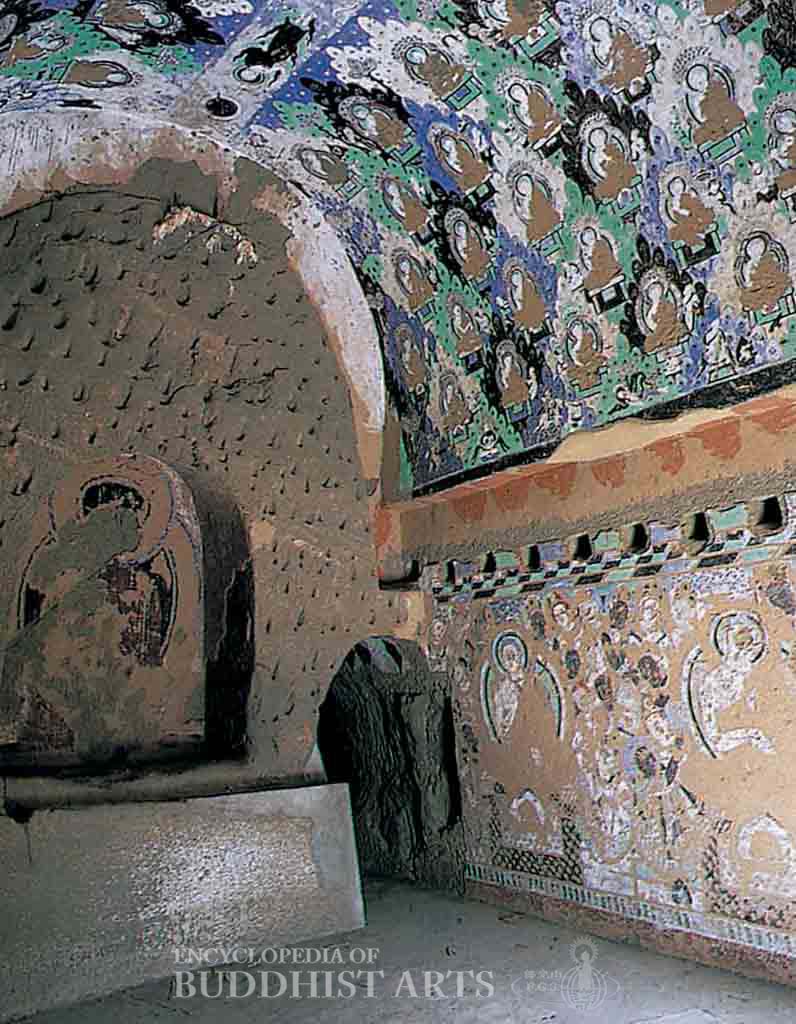
Kizil Cave 8: Main Chamber - Back and Right Walls
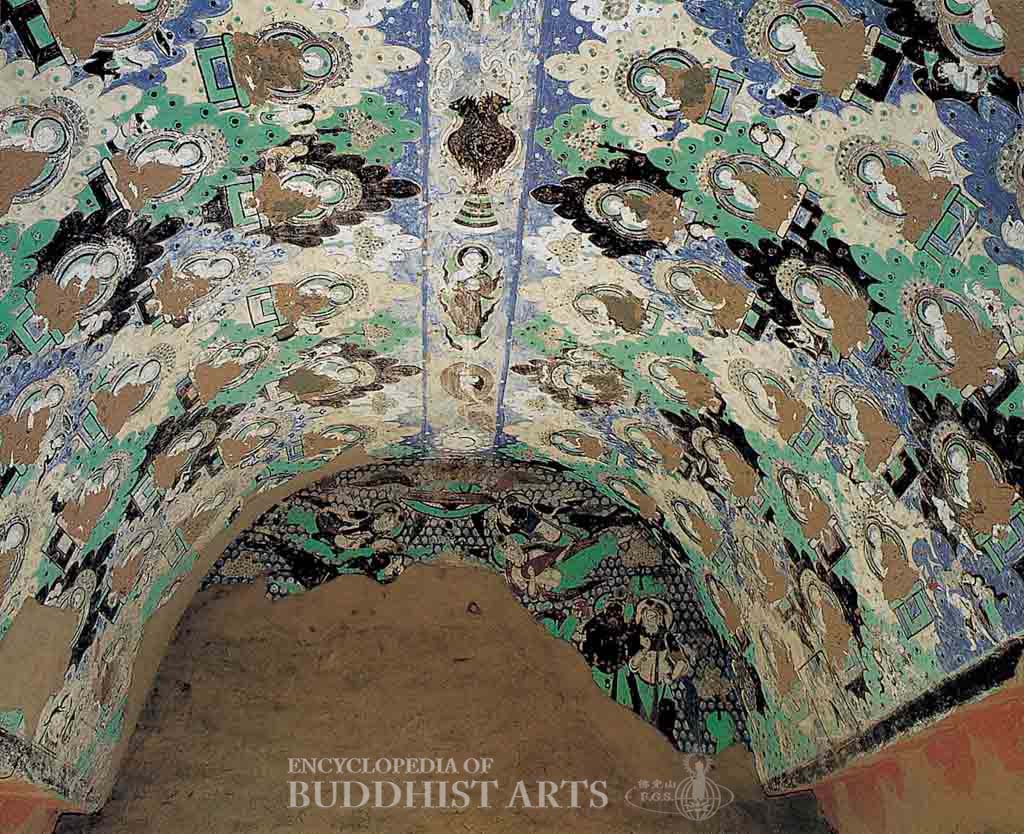
Kizil Cave 8: Main Chamber - Front Wall and Ceiling
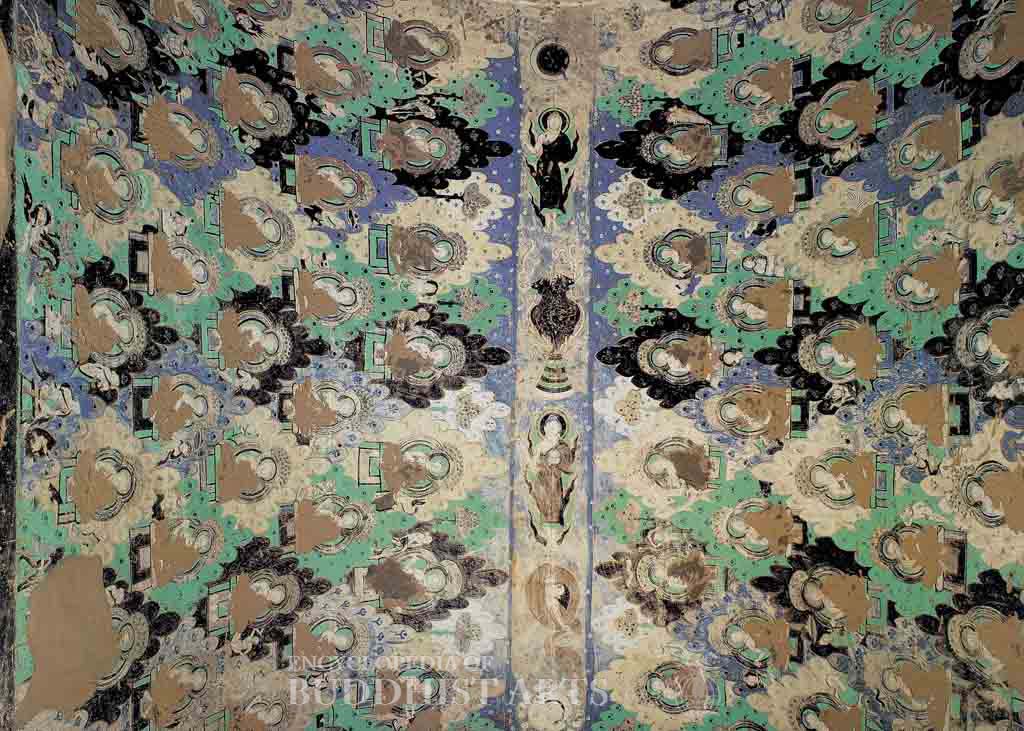
Kizil Cave 8: Main Chamber - Ceiling
Kizil Cave 8
CHINA, Xinjiang, Aksu
Located in the west valley, this central pillar cave was built in the 6th and 7th centuries. The main chamber is square and measures 4.85 m wide, 5.35 m high, and 5.55 m deep. Side corridors leading to the rear corridor form a central pillar which begins at the back wall of the main chamber.
An arched niche, which at one time contained a statue, is located on the back wall of the main chamber. Three large murals about the Life of the Buddha and karma stories are portrayed on either side of the wall. The Buddhas within these murals are seated in full lotus position, clothed in monastic robes, with heads slightly tilted. They have nimbuses and aureoles, and are surrounded by disciples and Bodhisattvas. The central mural on the right wall contains a disciple with three heads whose palms are joined in reverence. There is also a depiction of the Conversion of the Three Kasyapa Brothers to the lower left of the central Buddha. A rabbit within a moon is illustrated above the nimbus of the Buddha in the central mural on the left wall. Two Bodhisattvas to the right of the Buddha are seated with ankles crossed, while to the left are two disciples. This appears to be a depiction of the Naming of Rahula.
A major portion of the front wall mural above the entrance is damaged. Of what remains, a canopy can be seen with a pair of apsaras on each side, and two Bodhisattvas below them on the left. On the central ridge of the barrel-vaulted ceiling are illustrations of a garuda and various deities. Five descending rows of diamond-shaped illustrations are shown on both sides of the ceiling, each containing a seated Buddha in the center surrounded by karma story or Jataka depiction. The specific content of most of these scenes is no longer discernible.
A total of 16 Kuchean figures making offerings are illustrated on the walls of the left and right corridors. The Distribution of Relics Among the Eight Kings is illustrated on the front wall of the rear corridor, and at the back and side walls are platforms that once held statues. Some murals appear to have been removed from the cave.
For more details, go to the Encyclopedia of Buddhist Arts: Caves R-L, page 469.
Cite this article:
author = Hsingyun and Youheng and Johnson, Peter and Mankuang and Huntington, Susan and Edson, Gary and Neather, Robert,
booktitle = {Encyclopedia of Buddhist Arts: Caves R-L},
pages = 469,
title = {{Kizil Cave 8}},
volume = 6,
year = {2016}}