
Kizil Cave 181: Life of the Buddha and Karma Stories

Kizil Cave 181: Life of the Buddha and Karma Stories (detail)

Kizil Cave 181: Life of the Buddha and Karma Stories (detail)
Kizil Cave 181: Life of the Buddha and Karma Stories
CHINA, Xinjiang, Aksu
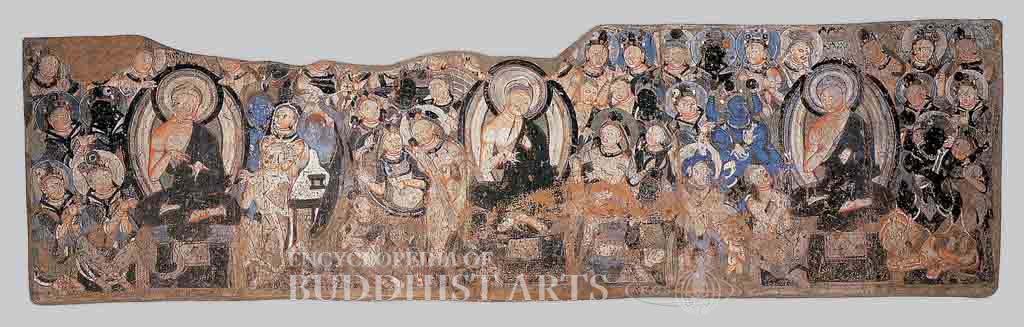
This mural was once located on the left wall of the main hall. There are three illustrations from left to right. The upper edges of the first and second illustration are slightly damaged.
In all three illustrations, the Buddha is clad in a robe draped over the left shoulder, and is seated in full lotus position on a square throne. A parrot is depicted before the throne in the left illustration and there are three rows of figures to the right and left of the Buddha. The upper row on the left side portrays three heavenly beings with palms joined in reverence, one of whom is missing. Two heavenly beings converse below, and in the bottom row, two more are seated with palms joined and legs crossed. In the upper right row, additional heavenly beings hold a zither and a panpipe. One of the figures seen in the middle row is blue-skinned and appears to be a yaksa. Another, an elderly figure, holds a tall thin staff. A figure in the bottom row rests on one knee and faces the Buddha with palms joined. Beside him is a queen standing before a royal palace.
A kneeling figure below the Buddha’s throne is depicted in the central illustration. On the right side, two figures sit on high circular thrones, while five figures above listen to the Dharma. On the left, two figures stand with legs crossed, and one of them holds a harp. There are three figures behind them, and one sits cross-legged below.
In the illustration to the right, a figure kneels with palms joined below and to the left of the Buddha. Behind is a figure with blue hair and unusual ears who holds the hand of a child. They appear to be Hariti and her son. Above them is a blue-skinned, six-armed figure, and further above are five figures listening to the Dharma. On the right side of the Buddha is Mahesvara riding a magic cow, while six other figures with nimbuses listen to the Buddha’s teaching above them.
For more details, go to the Encyclopedia of Buddhist Arts: Caves R-L, page 573.
Cite this article:
author = Hsingyun and Youheng and Johnson, Peter and Mankuang and Huntington, Susan and Edson, Gary and Neather, Robert,
booktitle = {Encyclopedia of Buddhist Arts: Caves R-L},
pages = 573,
title = {{Kizil Cave 181: Life of the Buddha and Karma Stories}},
volume = 6,
year = {2016}}