

Kizil Cave 224: Main Chamber
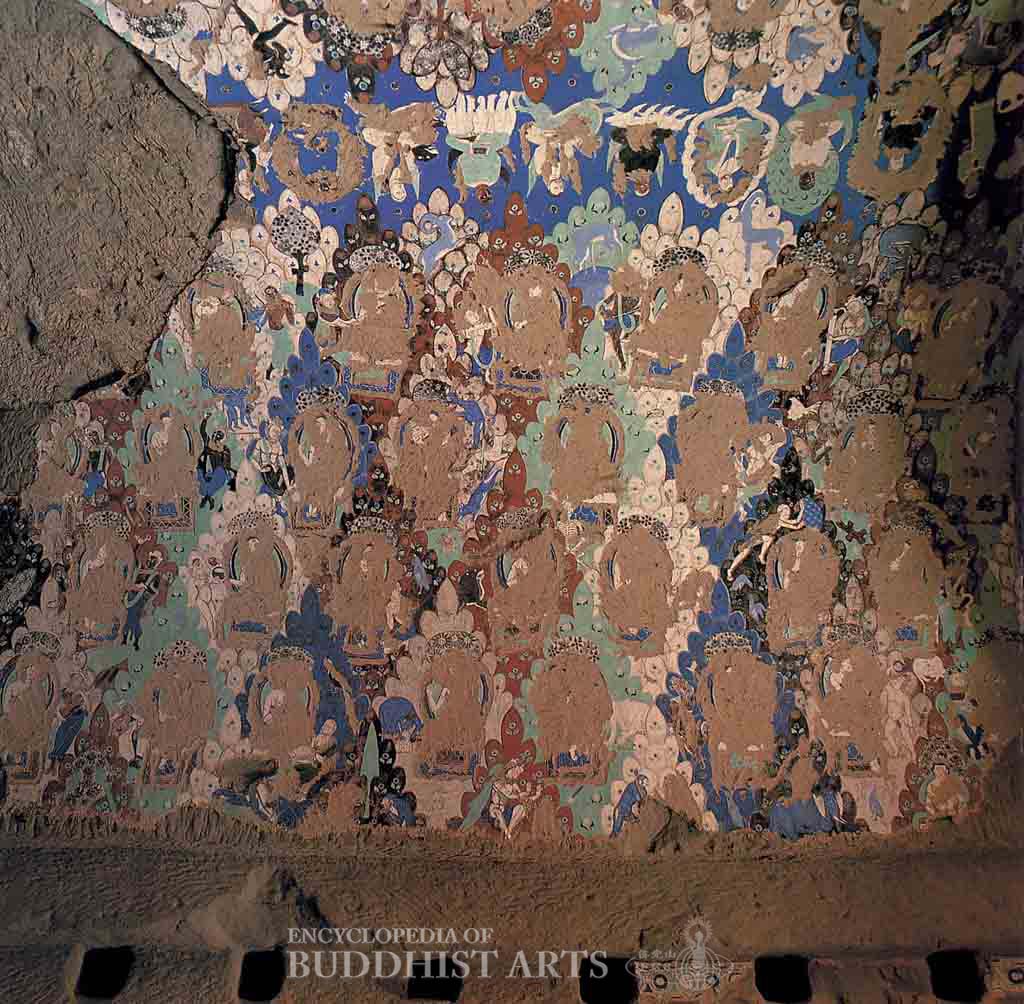
Kizil Cave 224: Main Chamber - Ceiling (right side)
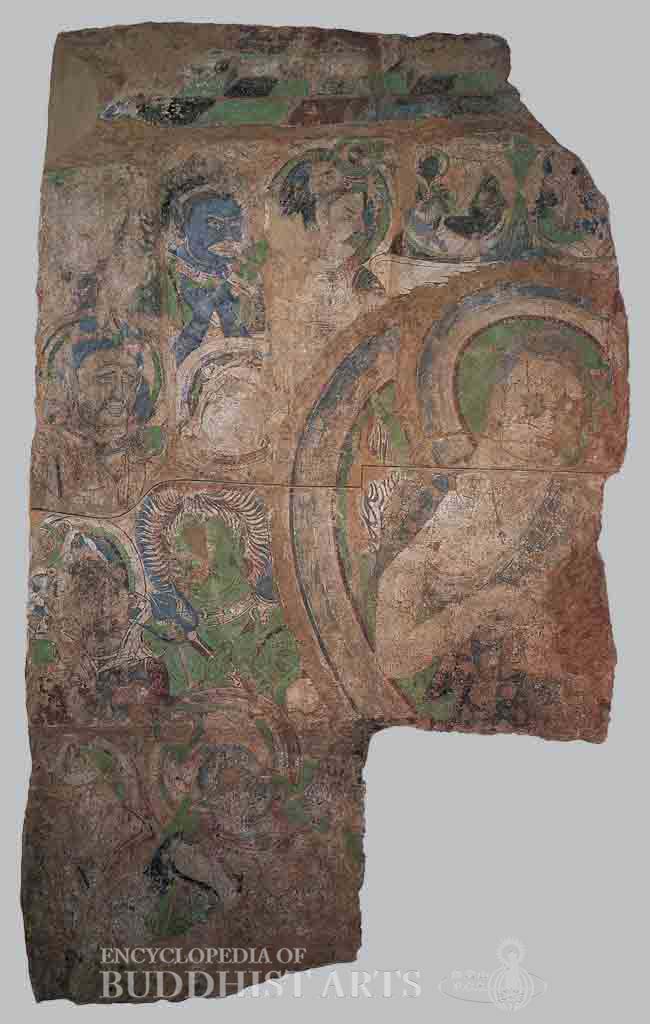
Kizil Cave 224: Mural (fragment)
Kizil Cave 224
CHINA, Xinjiang, Aksu
This 7th century cave is located in the north of the rear mountains. It is a central pillar cave with an antechamber, main chamber, and corridors. The antechamber has a flat ceiling and measures 3.36 m wide, 3.31 m high, and 2.35 m deep. The main chamber has a barrel-vaulted ceiling and corbels lining the side walls. It measures 3.45 m wide, 3.58 m high, and 3.5 m deep. The corridors form the central pillar. The side corridors have entrance and exit doorways on the back wall of the main chamber which leads to the rear corridor. The corridors also have barrel-vaulted ceilings.
The cave is relatively well-preserved, with the antechamber still intact. It is the only cave at Kizil with murals in the antechamber. Unfortunately, the mural of the Buddha Teaching the Dharma on the right wall has been removed.
There is an arched niche on the back wall of the main chamber which once housed a Buddha statue. Murals depicting the Life of the Buddha are located on the two side walls. Each wall has two rows of illustrations consisting of eight scenes, which portray an aspect of the Buddha’s teachings. The illustrations are not separated by margins but are differentiated by the characters’ directional postures. The recognizable illustrations include First Turning of the Dharma Wheel and Conversion of the Three Kasyapa Brothers. Traces of removed murals are still visible on the walls.
An illustration on the central ridge depicts the story of Sumagadha’s Invitation, the figures arranged in a row. On each side of the ceiling are diamond-shaped illustrations of the Jatakas and karma stories, including Clam Reborn as a Heavenly Being, Disobedient Drummer and the Bandits, Offering Banners to the Buddha, Devadatta Attacking the Buddha with a Rock, Poor Woman Offering a Lamp to the Buddha, Angulimalya and His Wrongdoings, and Jataka of the Bodhisattva Staying Still for Birds.
The rear corridor, now bereft of its reclining Buddha statue and much of the murals, displays a scene of the Buddha’s parinirvana. A mostly removed illustration of King Ajatasatru and Varsakara is depicted on the inner wall of the left corridor. Illustrations of the First Buddhist Council and the Distribution of Relics Among the Eight Kings, originally located in the right corridor, have been removed.
For more details, go to the Encyclopedia of Buddhist Arts: Caves R-L, page 589.
Cite this article:
author = Hsingyun and Youheng and Johnson, Peter and Mankuang and Huntington, Susan and Edson, Gary and Neather, Robert,
booktitle = {Encyclopedia of Buddhist Arts: Caves R-L},
pages = 589,
title = {{Kizil Cave 224}},
volume = 6,
year = {2016}}