
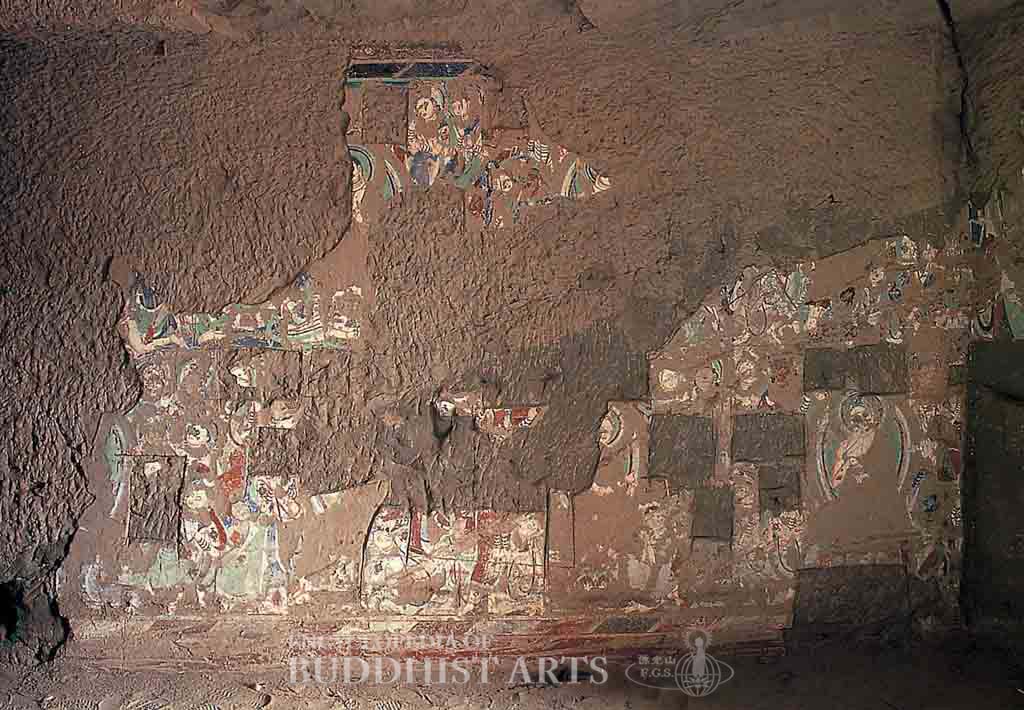
Kizil Cave 205: Main Chamber - Life of the Buddha and Karma Stories
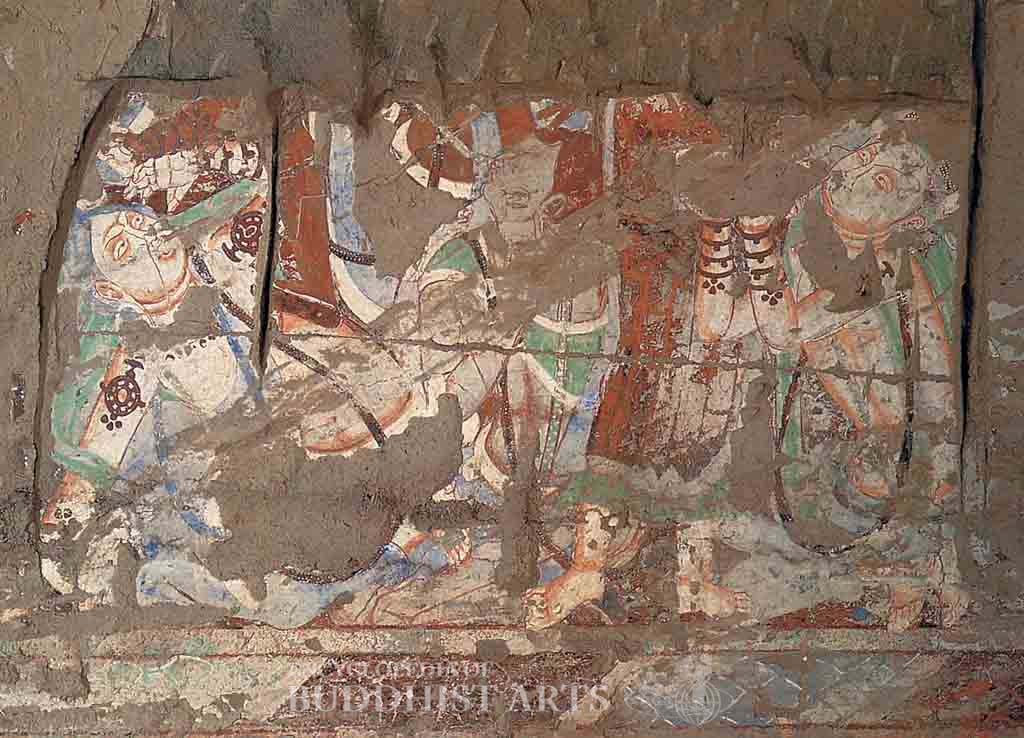
Kizil Cave 205: Main Chamber - Life of the Buddha and Karma Stories (left wall)

Kizil Cave 205: Main Chamber - Ceiling
Kizil Cave 205
CHINA, Xinjiang, Aksu
This central pillar cave is positioned in the south of the rear mountain area. It dates to the 6th and 7th centuries and has an antechamber, a main chamber, and corridors. Side corridors on both ends of the back wall connect to the rear corridor, forming a central pillar. The rectangular antechamber measures 3.82 m in width, 2.98 m in height, and 3.6 m in depth. The square main chamber is 3.3 m wide, 3.2 m high, and 3.5 m deep, and has a barrel-vaulted ceiling with a layer of corbel.
The niches on the side walls of the antechamber have arched ceilings. The front wall and ceiling of the antechamber have collapsed, and there are traces of murals on the walls. The back wall contains a doorway which leads to the main chamber.
The front wall of the main chamber has illustrations of the Life of the Buddha, with people making offerings, including Kuchean royalty, on either side of the entrance. An image of Maitreya Bodhisattva in Tusita Heaven is depicted above the entrance. The ceiling contains a series of narrative illustrations of karma stories on the central ridge and diamond-shaped Jataka tales on the sides. The back wall has a niche with an arched ceiling, but the Buddha statue that once stood within it is missing. Murals of the Life of the Buddha and karma stories are found on the left and right walls. The rear corridor contains a circumambulation path, and murals depicting scenes from the Mahaparinirvana Sutra. More Jataka murals decorate the ends of the corridor. The cave reflects and builds upon the local Kuchean style, with colors applied using heavy dyes.
For more details, go to the Encyclopedia of Buddhist Arts: Caves R-L, page 583.
Cite this article:
author = Hsingyun and Youheng and Johnson, Peter and Mankuang and Huntington, Susan and Edson, Gary and Neather, Robert,
booktitle = {Encyclopedia of Buddhist Arts: Caves R-L},
pages = 583,
title = {{Kizil Cave 205}},
volume = 6,
year = {2016}}