
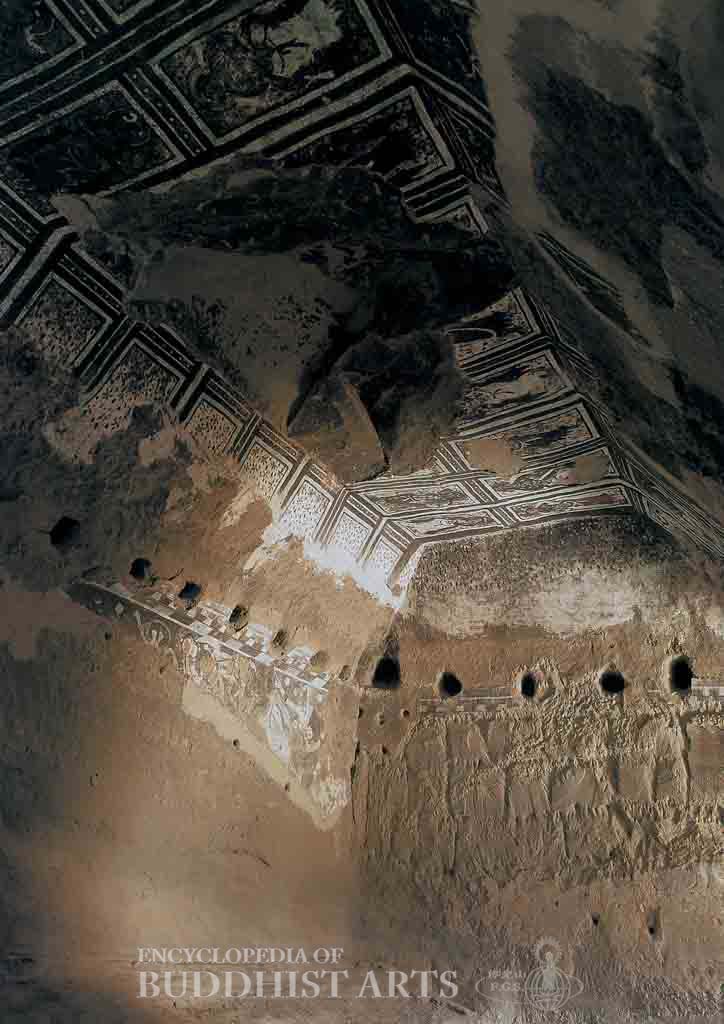
Kizil Cave 77: Rear Corridor
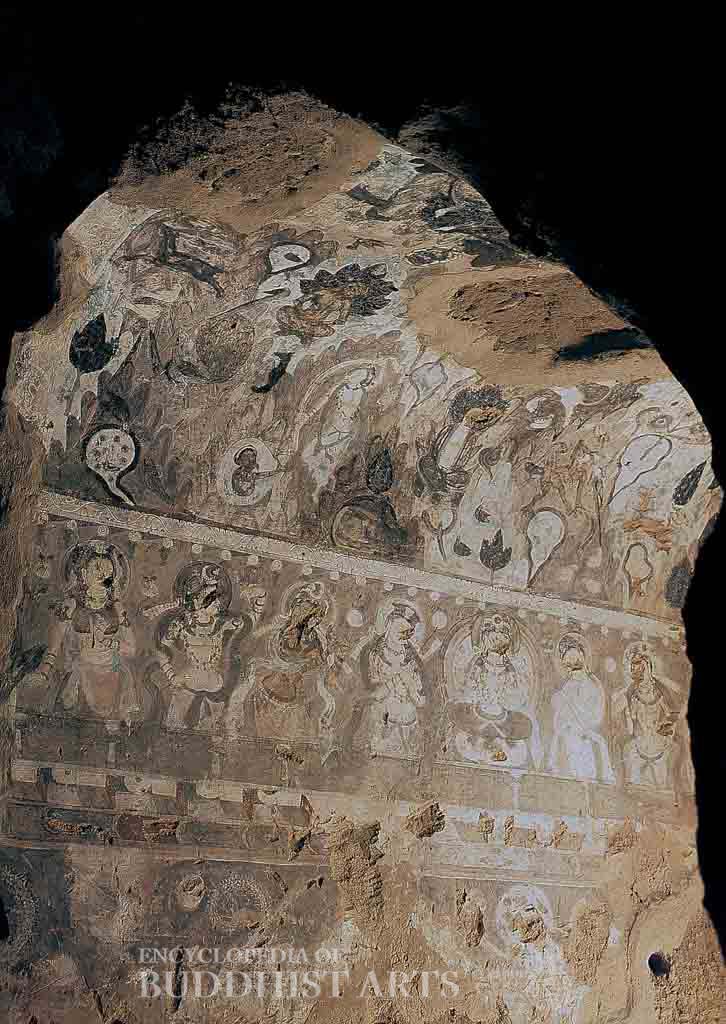
Kizil Cave 77: Right Corridor
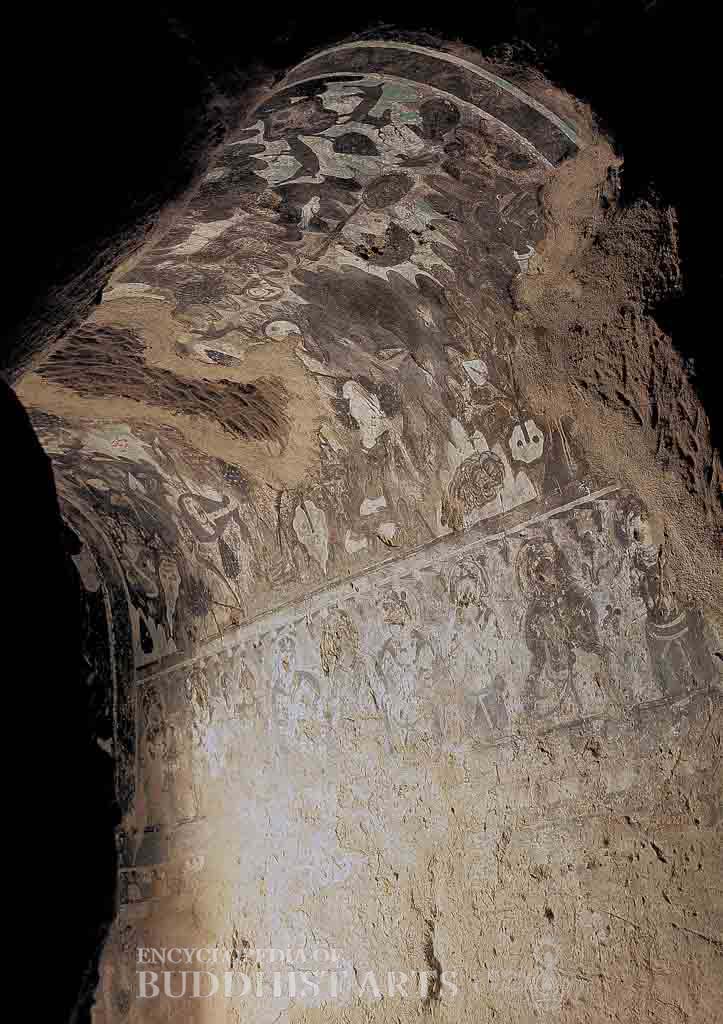
Kizil Cave 77: Left Corridor
Kizil Cave 77
CHINA, Xinjiang, Aksu
Located in the west valley, this great Buddha cave was built in the 4th century, exemplifying the rapid development of Buddhist art at the time. This cave is composed of a main chamber, right and left corridors, and a rear corridor. The main chamber is 6.3 m in width and 3 m in depth. Originally, a large clay standing Buddha statue was installed on the back wall of the main chamber; however, the statue is now missing. The murals in the main chamber are mostly damaged. The side corridors run from the back wall to a rear corridor which has a trapezoidal ceiling and is relatively spacious, with a width of 8.56 m, a height of 5.12 m, and a depth of 4.28 m.
The side corridors have barrel-vaulted ceilings and the murals within each are similar in content and layout. Each of the outer walls contains a mural of the Buddha Teaching the Dharma, flanked by Brahma, Sakra, and other heavenly beings. Painted on the center of the barrel-vaulted ceilings are astrological signs and the remnants of images of Vayu and nagas. Various images are depicted on each side of the ceiling, including ponds, trees, animals, monks and monkeys in meditation, and heavenly beings. Simple in composition, these images convey an atmosphere of tranquility. There is a seated Buddha painted on the semicircular wall above the entrance to each of the left and right corridors.
Painted on the walls of the rear corridor are images of the Buddha’s cremation and the division of his relics, as well as Bodhisattvas and stupas. A parinirvana platform, on which a reclining Buddha at one time rested, is located on the back wall. The remaining images of two apsaras and one grieving disciple can be found above the platform on the back wall. Rows of rectangular frames are depicted on the ceiling, each of which contains an image of a heavenly being. This is the only example of this style of imagery extant within the Kizil Caves.
For more details, go to the Encyclopedia of Buddhist Arts: Caves R-L, page 520.
Cite this article:
author = Hsingyun and Youheng and Johnson, Peter and Mankuang and Huntington, Susan and Edson, Gary and Neather, Robert,
booktitle = {Encyclopedia of Buddhist Arts: Caves R-L},
pages = 520,
title = {{Kizil Cave 77}},
volume = 6,
year = {2016}}