

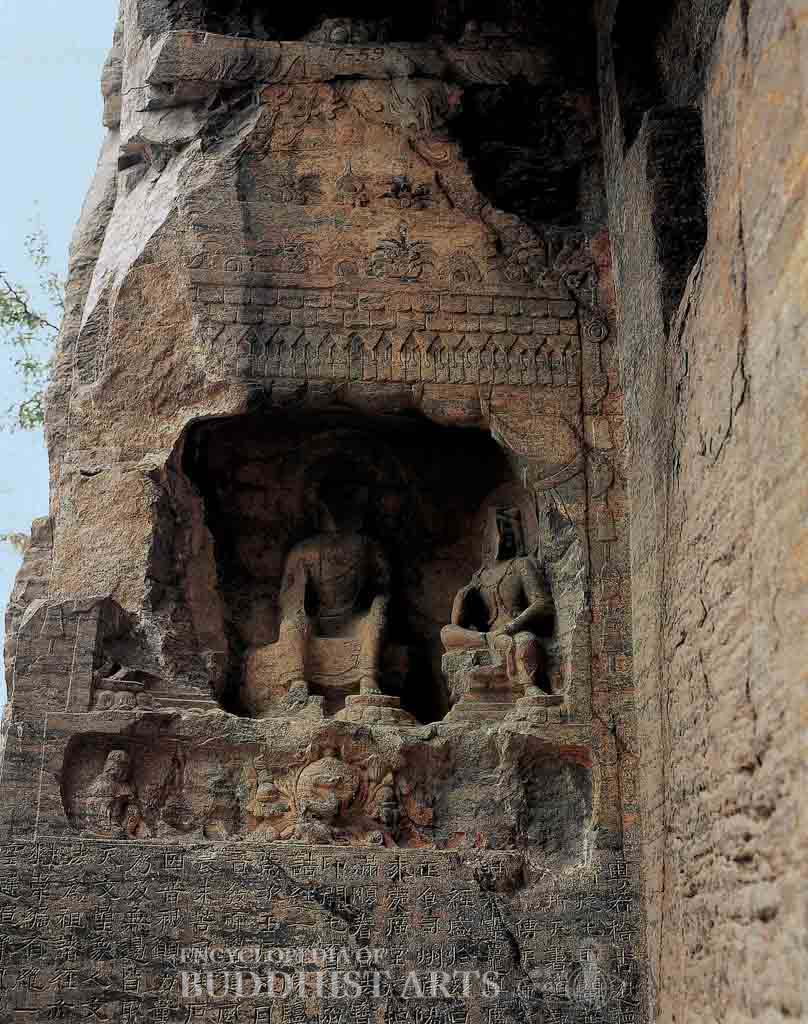
North Xiangtangshan Grottoes: Grotto 9 - Buddha Triad (central pillar, north side); Northern Qi dynasty; Stone
North Xiangtangshan Grottoes: Grotto 2
North Xiangtangshan Grottoes
CHINA, Hebei, Handan
The North Xiangtangshan Grottoes were originally named the Gushan (Drum Mountain) Grottoes. They are situated in Hebei province, within the Fengfeng mining district in the city of Handan. Initial construction began in 550 of the Eastern Wei dynasty (534–550), and was completed during the Northern Qi (550–577) to Sui (581–618) dynasties. The existing 22 grottoes are distributed over four areas: Grottoes 1, 2, and 3 are situated in the south; Grottoes 4, 5, 6, and 7 are in the central area; Grottoes 8, 9, 10, and 11 are in the north; and Grottoes 12 to 22 are located in the Jiutiaodong area. The most prominent grottoes are 3, 4, and 9, and they are known as South Grotto, Central Grotto, and North Grotto, respectively. Those in the Jiutiaodong area are mainly small meditation grottoes.
Grotto 3 contains engravings of the Buddhas of the Past, Present, and Future. The image groups consist of either a Buddha as the central figure with two disciples and four Bodhisattvas, or a central Buddha with four disciples and two Bodhisattvas. An interesting feature of this grotto is the extensive engraving of Buddhist scriptures on the outer walls, including the Sutra of Innumerable Meanings, Vimalakirti Sutra, and the Sutra on Maitreya Attaining Buddhahood. Hence, it is also known as the Grotto of the Sutra Engravings. According to the Record of Sutra Engraving in Jinchang, the engraving of the Vimalakirti Sutra and the Sutra on Maitreya Attaining Buddhahood began in 568 and was completed in 572. The sutras engraved on the front (west) wall of the grotto suggest that the construction of the grotto was finished before the sutra engraving began.
Grotto 4 is a central pillar cave with a special layout. A circumambulatory passage is formed around the central pillar. A niche cut into the west side of the central pillar depicts a Buddha, two disciples, and two Bodhisattvas. The central pillar is built on a platform, and the west, south, and north sides of the platform are carved with mountain censers, Heavenly Kings, crouching lions, and monks making offerings. Large niches are cut into the side walls of this grotto as well, with Bodhisattvas and warriors enshrined within them.
Grotto 9 is also known as the Gao Huan Tomb Grotto. A hidden grave was discovered on the upper section of the central pillar’s south face. This fits with the statements found in the Expanded Edition of Biographies of Eminent Monks and Comprehensive Mirror to Aid in Government. The central pillar is the largest and earliest in the Xiangtangshan Grottoes. The upper part of the central pillar’s east side is connected to the back (east) wall of the grotto, while niches are cut into the south, north, and west sides of the pillar. There is a central Buddha with two Bodhisattvas in each niche.
For more details, go to the Encyclopedia of Buddhist Arts: Caves Mo-S, page 1278.
Cite this article:
author = Hsingyun and Youheng and Johnson, Peter and Mankuang and Huntington, Susan and Edson, Gary and Neather, Robert,
booktitle = {Encyclopedia of Buddhist Arts: Caves Mo-S},
pages = 1278,
title = {{North Xiangtangshan Grottoes}},
volume = 8,
year = {2016}}