
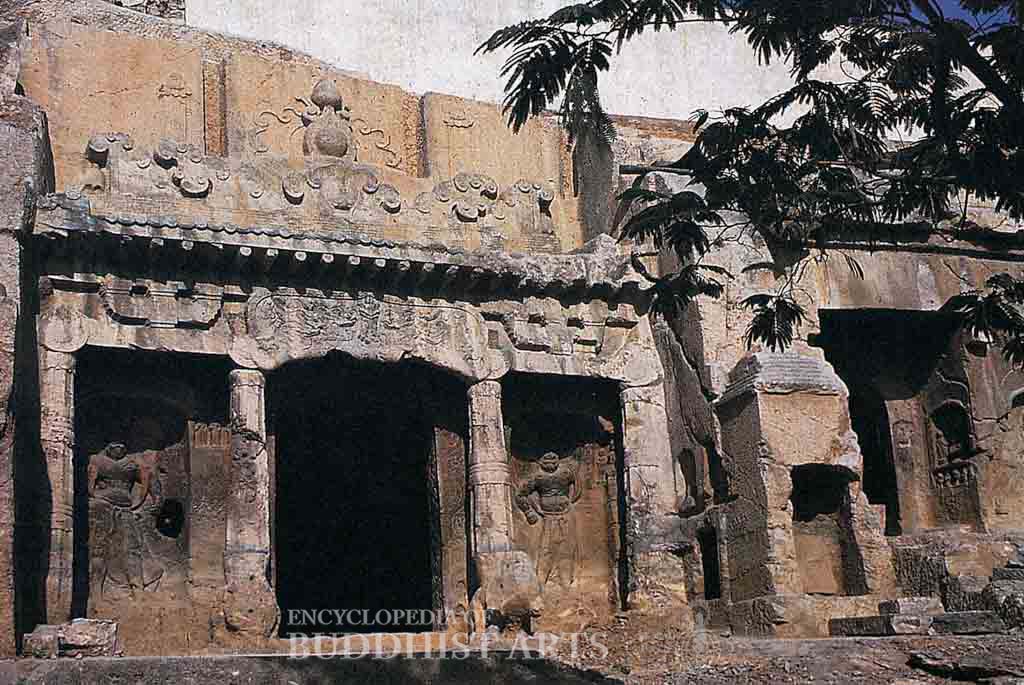
South Xiangtangshan Grottoes: Grotto 7
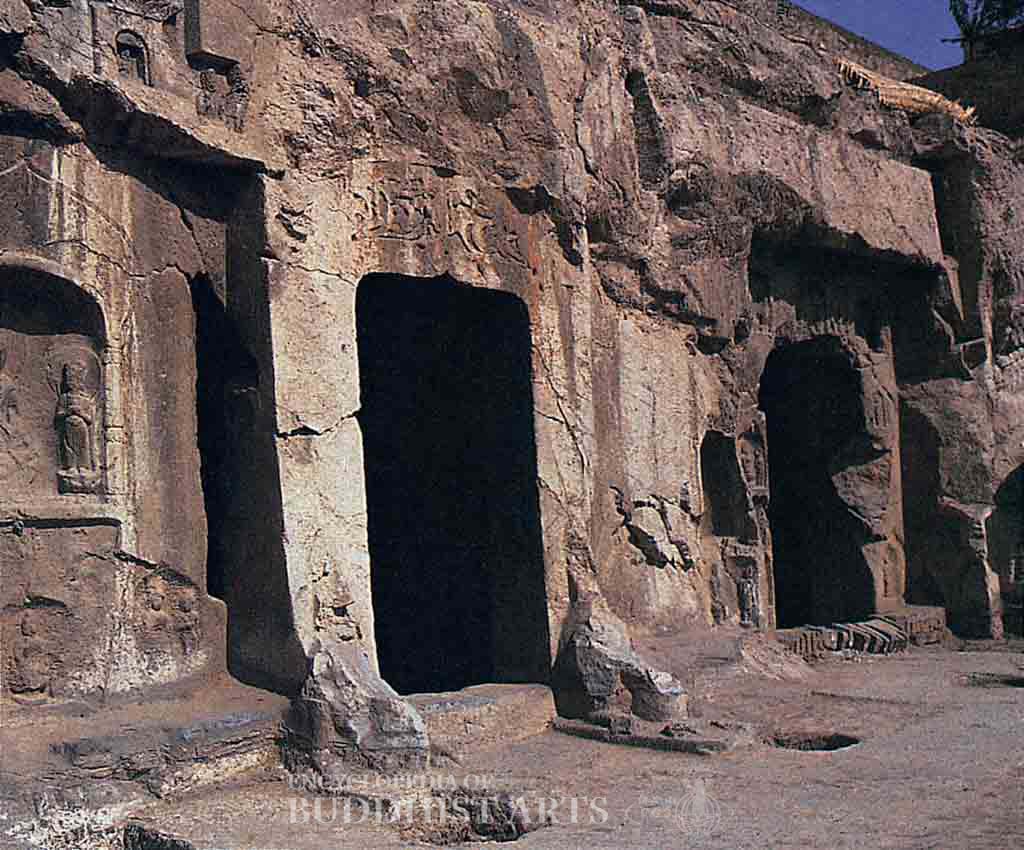
South Xiangtangshan Grottoes: Grottoes 5 and 6
South Xiangtangshan Grottoes
CHINA, Hebei, Handan
The South Xiangtangshan Grottoes are located on the southern hillside of Gushan (Drum Mountain) in the Fengfeng mining district of Handan, Hebei. There are seven main grottoes dating from the Northern Qi dynasty (550–577) that still are well preserved. They are built in two levels: two of the grottoes are on the lower level and five on the upper level. Grottoes 1 and 2 on the lower level are both central pillar grottoes. They were built at the same time, with a similar layout and size. According to a stele carved on the exterior of Grotto 2, the construction of these grottoes was initiated by the monk Huiyi of Linghua Temple in 565 of the Northern Qi dynasty. The prime minister Gao A’nagong, who once rested here on his way out of the capital, donated money after he saw the first stages of construction. Not long after the grottoes had been completed, however, the Northern Qi dynasty was destroyed by the Northern Zhou dynasty (557–581).
The arched doorways of Grottoes 1 and 2 are formed by columns carved with twin dragons. These, as well as two other columns, support the structure above the front portico. The eaves and brackets below have been carved in imitation of wooden structures. In Grotto 1 there were originally seven statues on the west side of the central pillar; however, only six of them have survived. Additionally, there is a row of five niches on both the south and north walls, and another two niches can be found on each end of the east wall. In Grotto 2, only the west side of the central pillar has a niche. Unfortunately, the carvings inside the niche have been destroyed. The north and south sides of the central pillar are decorated with the Thousand Buddha motif. The north and south walls are also each carved with a row of five niches, and the east wall has one niche on each end. There are reliefs of the Western Pure Land above the entrances of Grottoes 1 and 2 on the interior. However, the illustrations in Grotto 2 were removed in the early 20th century.
In addition, there are sutras engraved in both Grottoes 1 and 2. Grotto 1 is also known as the Avatamsaka Grotto because the Avatamsaka Sutra is the main sutra engraved in it. Engraved into the west and south walls are the “Chapter on the Four Noble Truths,” the “Chapter on Awakening by Light,” the “Chapter on Bodhisattvas asking for Clarification,” and the “Chapter on Pure Conducts” from the Avatamsaka Sutra. In Grotto 2 the Prajnaparamita Sutra is the main sutra and it is therefore called the Prajna Grotto. The Saptasatika Prajnaparamita Sutra is engraved beside the entrance. On the columns on both of the niches cut out of the south, north, and front walls, the “Chapter on the Supreme Dharma” from the Pancavimsatisahasrika Prajnaparamita Sutra is engraved. The grottoes on the upper level, numbers 3, 5, and 7, all have the Buddhas of the Past, Present, and Future as the main sculpture subjects. Grottoes 4 and 6 have Buddhas sitting in full lotus position depicted on their walls, and seated Bodhisattva statues can be found in both corners of their back walls. Additionally, Grotto 4 is engraved with the “Universal Gateway Chapter” from the Lotus Sutra.
For more details, go to the Encyclopedia of Buddhist Arts: Caves Mo-S, page 1421.
Cite this article:
author = Hsingyun and Youheng and Johnson, Peter and Mankuang and Huntington, Susan and Edson, Gary and Neather, Robert,
booktitle = {Encyclopedia of Buddhist Arts: Caves Mo-S},
pages = 1421,
title = {{South Xiangtangshan Grottoes}},
volume = 8,
year = {2016}}