
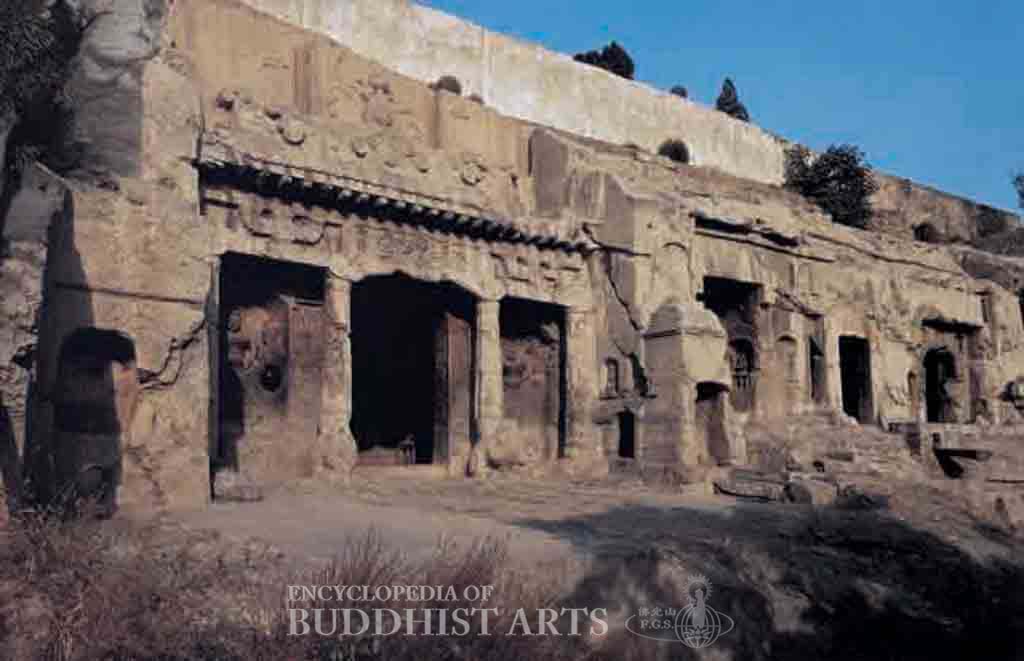
South Xiangtangshan Grottoes: Grottoes 4 to 7
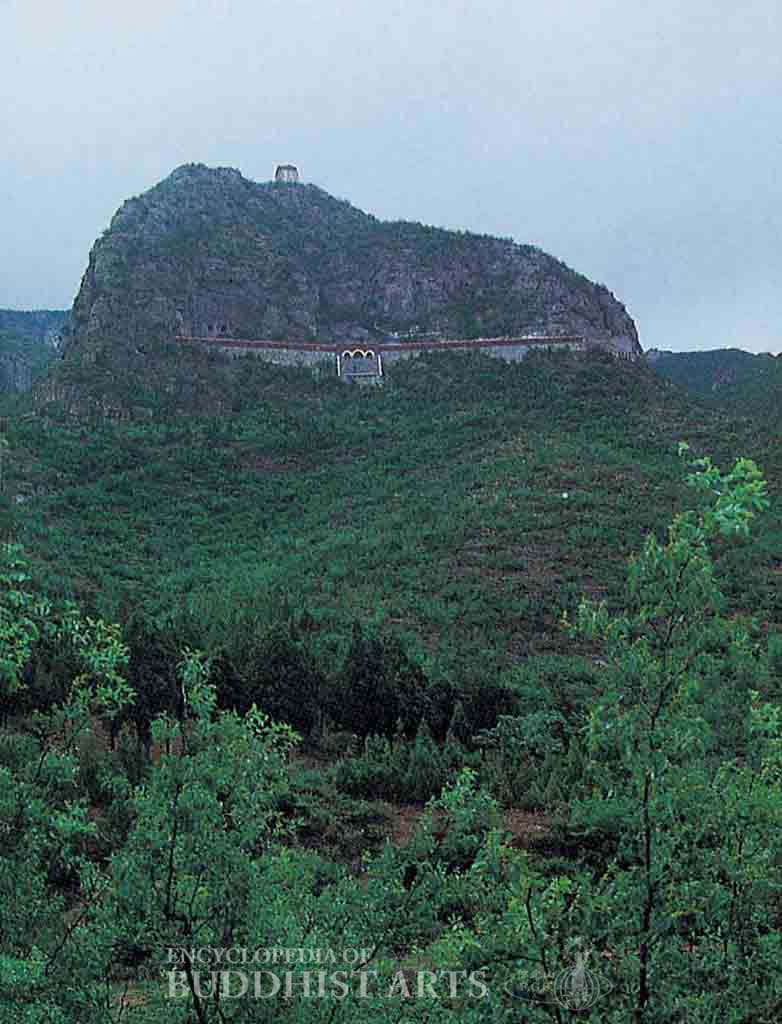
North Xiangtangshan Grottoes
Xiangtangshan Grottoes
CHINA, Hebei, Jinzhong
The Xiangtangshan Grottoes are situated on and around Gushan (Drum Mountain) in Handan, Hebei. The area consists of the North Xiangtangshan Grottoes, South Xiangtangshan Grottoes, and Shuiyu Temple Grottoes. The grottoes were constructed under the patronage of the imperial family, leading officials, and eminent monks during the Eastern Wei (534–550) and Northern Qi (550–577) dynasties, and construction continued into the Sui dynasty (581–618). This set of grottoes was listed as a National Cultural Heritage Site in 1961.
The North Xiangtangshan Grottoes are the largest in Hebei. The best known are Grottoes 3, 4, and 9. In addition, there are six smaller grottoes, as well as 15 meditation grottoes distributed across the mountainside beneath Grottoes 4 and 9.
There are multiple historical records regarding the excavation of the site. All statements have attributed the construction to Gao Huan and his son, Emperor Wenxuan (reigned 550–559), of the Northern Qi dynasty. This is corroborated by statements found in the Comprehensive Mirror to Aid Government, the Expanded Edition of Biographies of Eminent Monks, and the National Gazetteer of the Yuan Dynasty.
Grotto 9 is the oldest and largest of the North Xiangtangshan Grottoes. The cliffsides have undergone serious erosion due to constant weathering. Grotto 9 is a central pillar grotto, with three niches carved on the south, north, and west sides of the central pillar. A Buddha and two Bodhisattvas are engraved within each niche. Sculptures of mythical creatures are found on the four bottom corners of the central pillar. Figures of mountain censers, twin lions, and deities were carved in relief on the platform supporting the pillar. A niche-like opening located at the top of the south side of the central pillar leads to a rectangular chamber with a vaulted ceiling. The chamber is 1.33 m in width, 1.66 m in height, and 3.9 m in depth. Buddha statues are enshrined within the chamber. This chamber was likely concealed with merely a niche-like opening because it was the tomb of the imperial family of the Northern Qi dynasty.
Grottoes 3 and 4 have exteriors with imitation wooden eaves. They are also central pillar grottoes with a niche cut into the west side of both pillars. Grotto 3 has three niches carved on three walls and Buddhist scriptures engraved on both the inside and outside. The sutra engraving project began in 568 of the Northern Qi dynasty and was completed in 572. Additionally, there are two Buddha statues sitting side by side on the back wall.
The South Xiangtangshan Grottoes can be found in the southern foothills of Gushan. They include seven grottoes divided into two levels: two grottoes on the lower level and five on the upper level. There are also nine small meditation grottoes distributed throughout the northwest section of this group. A stele inscribed by monk Daojing during the Sui dynasty was discovered at the outer entrance of Grotto 2. According to this stele, construction on the South Xiangtangshan Grottoes was initiated by monk Huiyi of Linghua Temple in 565, with assistance from Prime Minister Gao Anagong of the Northern Qi dynasty. The date of completion is very close to the year when Emperor Wu (reigned 560–578) destroyed the Northern Qi dynasty.
Grottoes 1 and 2 are both on the lower level and contain large central pillars. Because the Avatamsaka Sutra and Saptasatika Prajnaparamita Sutra are carved in the grottoes, they are named the Huayan (Avatamsaka) Grotto and the Bo’re (Prajna) Grotto. The layouts of Grottoes 1 and 2 are quite similar. Niches are cut into three walls of Grotto 1 and on the back (west) wall of Grotto 2. In both, there is a row of niches cut into the north and south walls. Relief illustrations of the Western Pure Land are depicted above the entrances on the interior. The relief illustration from Grotto 2 was removed in the early 20th century and taken to the USA In Grotto 1, the west niche cut into the central pillar originally housed seven statues, but the only original works preserved are the main statue and disciples on each side. The sculptures in the niche on the central pillar of Grotto 2 were destroyed but the Thousand Buddhas remain carved on both sides of the niche. Grottoes 3, 5, and 7 on the upper level all have a niche cut into each of the three walls. The Buddhas of the Past, Present, and Future are the main subjects in these grottoes. Imitation wooden eaves characterize the exteriors of the grottoes, similar to those outside Grottoes 3 and 4 of the North Xiangtangshan Grottoes. Carved illustrations of the Buddha entering parinirvana are depicted above the entrance to Grotto 5.
The Shuiyu Temple Grottoes are located in the eastern foothills of Gushan. The West Grotto, East Grotto, cliffside sculptures, and sutra pillars within the grottoes are well-preserved. The West Grotto has a similar layout to that of Grotto 9 of the North Xiangtangshan Grottoes. It is carved into the cliffside with imitation wooden architecture on the exterior. There are niches cut into three sides of the central pillar. An inscription can be read below the entrance that indicates the construction project was led by an eminent monk, who had a close relationship with the imperial family.
For more details, go to the Encyclopedia of Buddhist Arts: Caves T-Z, page 1515.
Cite this article:
author = Hsingyun and Youheng and Johnson, Peter and Mankuang and Huntington, Susan and Edson, Gary and Neather, Robert,
booktitle = {Encyclopedia of Buddhist Arts: Caves T-Z},
pages = 1515,
title = {{Xiangtangshan Grottoes}},
volume = 9,
year = {2016}}