
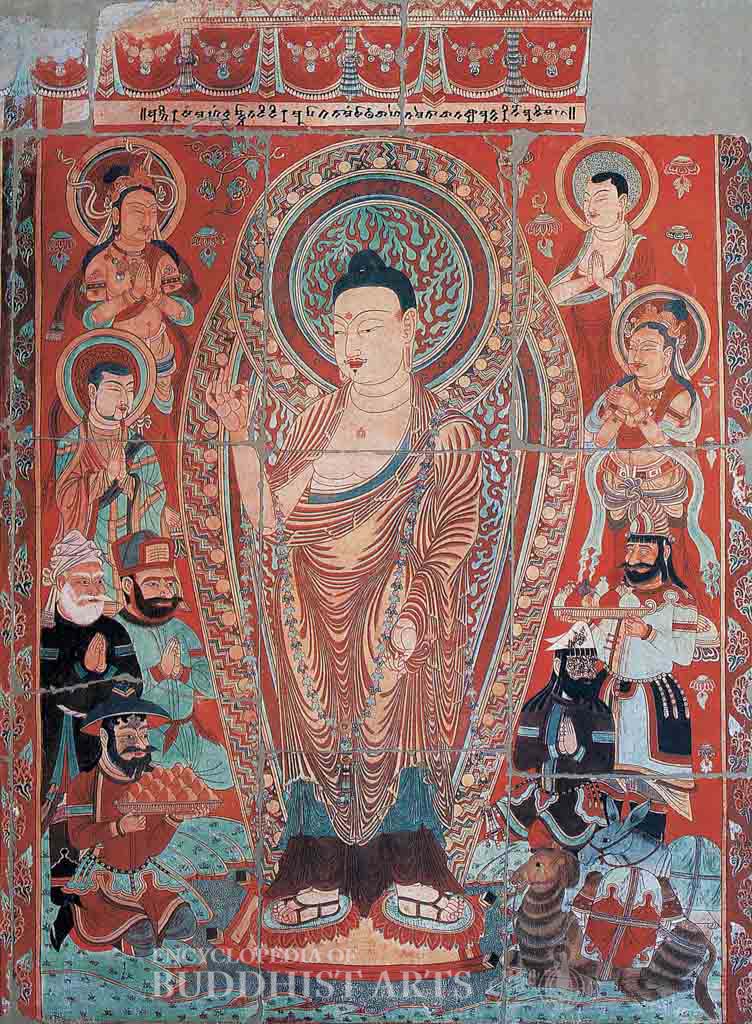
Bezeklik Cave 20: Illustration of the Abhiniskramana Sutra (detail)
Bezeklik Cave 20: Illustration of the Abhiniskramana Sutra
CHINA, Xinjiang, Turpan
This illustration was originally situated on the outer wall of the north corridor. It illustrates a story from the Abhiniskramana Sutra in which Sakyamuni Buddha, in a previous life, made offerings to various Buddhas, which helped him to attain Buddhahood. This is one of the more common themes from the Uighur (mid-9th century–1209) ruling over Gaochang period.
The standing Buddha in the center of the image forms the vitarka (teaching) mudra with a raised hand. The figure is surrounded by a triple-layered nimbus and aureole, with jewels and flames decorating the outer layers. The Buddha wears a densely draped monastic robe, an ornament extending to the knees, and sandals. He is depicted standing with each foot on a lotus pedestal, supported by a wooden platform on a pond. From top to bottom, a Bodhisattva, a monk, and three figures kneeling to make offerings can be seen on the left. On the right, from top to bottom, there is a monk, a Bodhisattva, a figure making offerings, and a figure with joined palms. A donkey and camel carrying materials are shown below.
For more details, go to the Encyclopedia of Buddhist Arts: Caves A-E, page 138.
Cite this article:
author = Hsingyun and Youheng and Johnson, Peter and Mankuang and Huntington, Susan and Edson, Gary and Neather, Robert,
booktitle = {Encyclopedia of Buddhist Arts: Caves A-E},
pages = 138,
title = {{Bezeklik Cave 20: Illustration of the Abhiniskramana Sutra}},
volume = 5,
year = {2016}}