
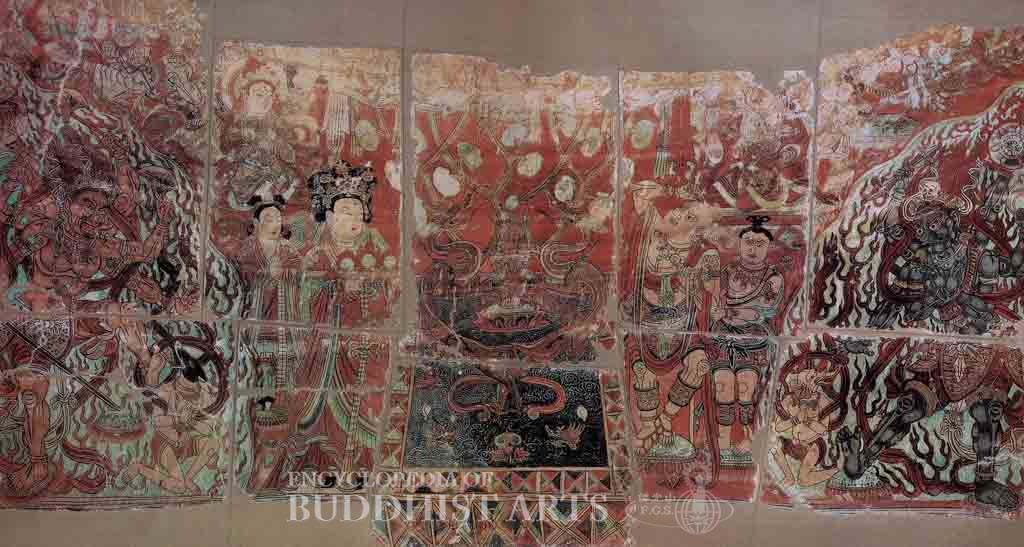
Bezeklik Cave 20: Main Chamber - Illustration of Campassionate Avalokitesvara (back wall); circa 9th–10th century
Bezeklik Cave 20
CHINA, Xinjiang, Turpan
Situated within the middle cliff on the west bank of the Murtuk River, Bezeklik Cave 20 was constructed during the early period of Uighur (mid-9th century–1209) ruling over Gaochang. It was built with mud bricks and uses the original cave, which was blocked off, as a foundation. This central pillar cave consists of an antechamber, as well as a rectangular main chamber with a vaulted ceiling and a central pillar surrounded by corridors. The murals within Cave 20 are particularly well preserved due to the cave being buried under quicksand for a significant period of time. Many of the murals originally located in this cave were removed; some of which are now in collections at the Museum of Asian Art in Berlin, while others were destroyed.
Three rows of portraits of Uighur donors exist on both sides of the doorway on the front wall of the antechamber. Male donors are depicted on one side of the doorway, while female donors are depicted on the other side. These images are believed to be realistic representations of the Uighur royal family, making them particularly rare and giving them high artistic value.
An illustration of Compassionate Avalokitesvara can be found on the back (west) wall of the main chamber, and portraits of Vaisravana, Heavenly King of the North, are painted on the side walls. Along the outer wall of the rear corridor are illustrations of 15 Jataka tales which can be found in the Abhiniskramana Sutra. An inscription written in the Brahmi script is above each scene. The inner wall of the north corridor displays life-sized portraits of three Superintendents Monks: Fahui, Jinhui, and Zhitong. Their names are written in both Chinese and Uighur scripts above the portraits. The inner wall of the south corridor displays portraits of three monks holding flowers with inscriptions written in Brahmi script above them.
These murals all maintain the key stylistic traits of Tang dynasty (618–907) art, including fluid lines, smooth curves, and bright colors, which make the murals lively and vivid. The images in this cave also demonstrate the multi-ethnic and multi-cultural interaction in the region during the period of its creation.
For more details, go to the Encyclopedia of Buddhist Arts: Caves A-E, page 136.
Cite this article:
author = Hsingyun and Youheng and Johnson, Peter and Mankuang and Huntington, Susan and Edson, Gary and Neather, Robert,
booktitle = {Encyclopedia of Buddhist Arts: Caves A-E},
pages = 136,
title = {{Bezeklik Cave 20}},
volume = 5,
year = {2016}}