

Putuoshan (aerial view)
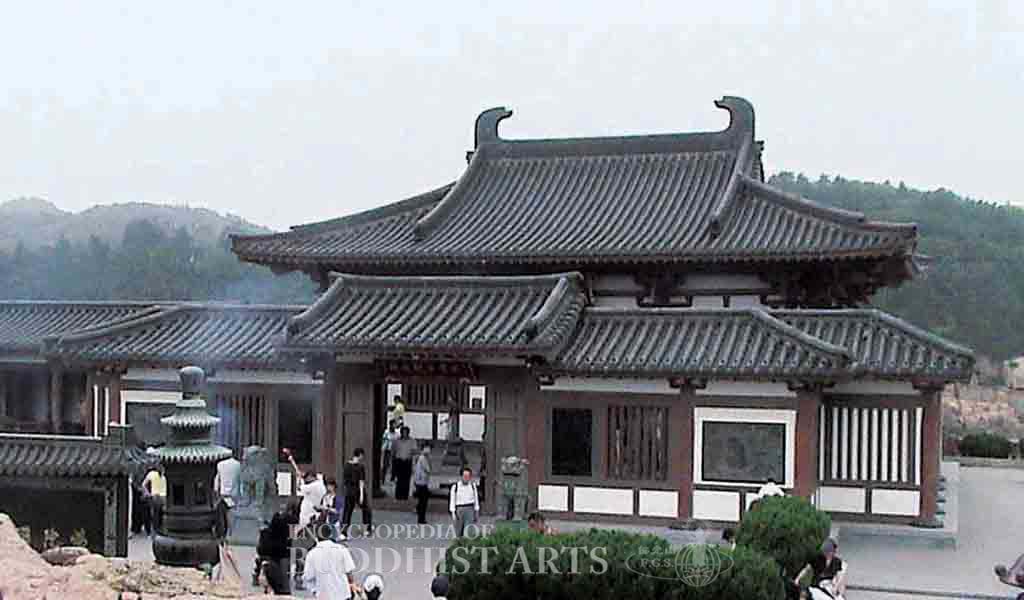
Putuoshan: Refusal to Abandon Avalokitesvara Temple
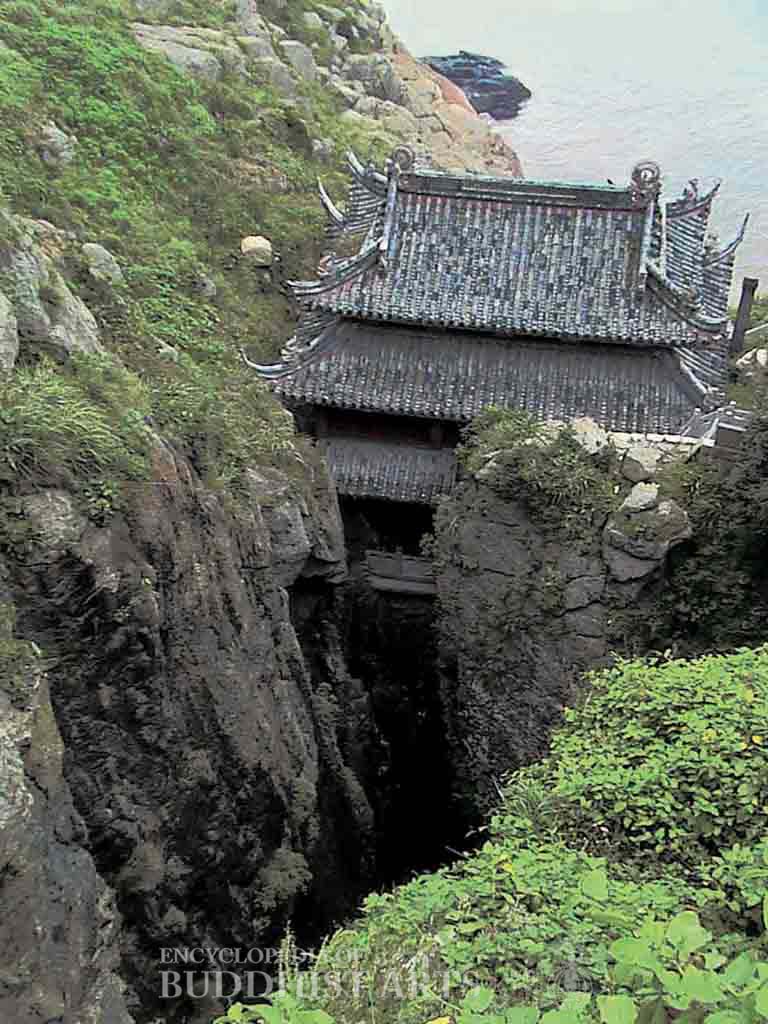
Putuoshan: Fanyin Cave
Putuoshan
CHINA, Zhejiang, Zhoushan
Putuo is the Chinese transliteration of the Sanskrit term Potalaka, meaning a Beautiful White Flower. Putuoshan is a small mountainous island off the coast of Zhejiang province. It is one of the Four Sacred Buddhist Mountains in China. It is often referred to as the Buddhist Kingdom amidst the Sea and Sky and is known as the abode of Avalokitesvara.
During the rule of Emperor Xuanzong (reigned 712–756) of the Tang dynasty, a Buddhist monk from India came and witnessed the manifestation of Avalokitesvara teaching the Dharma. The Bodhisattva offered him a seven-colored jewel and he declared this place to be the abode of Avalokitesvara. In 863 during the Tang dynasty, the Japanese monk Egaku was on his way home with a statue of Avalokitesvara from Wutaishan. When his ship was passing the island, a vicious storm arose and the ship was forced to seek shelter on the island. Egaku and the locals then built a temple called Refusal to Abandon Akalokitesvara Temple for the statue. This is the story of the founding of the first temple on Putuoshan.
In 1080 during the Northern Song dynasty, the emperor ordered the construction of Baotuo Guanyin Temple to honor Avalokitesvara, which heralded the start of its popularity. In 1131 during the Southern Song dynasty, Chan Master Zhenxie built Hai’an Gujuechu (Place of Solitude on the Seashore) and gave numerous Dharma lectures. He unified the temples under the Chan school. During the Ming dynasty (1368–1644), the temples were continuously repaired under the patronage of the imperial court. In 1699, Emperor Kangxi (reigned 1661–1722) of the Qing dynasty ordered the reconstruction of Puji (Universal Liberation) Temple and Fayu (Dharma Rain) Temple. Huiji Hermitage was expanded into a temple under imperial order in 1793. These three temples, Puji, Fayu, and Huiji, became the Three Major Temples on Putuoshan. Throughout the Yuan (1271–1368), Ming, and Qing (1644–1911) dynasties the temples were continuously expanded. At the height of its prosperity, there were over 200 temples and more than 3,000 monastics on Putuoshan. In 1997 an 18 m high bronze statue of Avalokitesvara of the South Sea was constructed on Putuoshan.
On the island, there are three famous sites, considered to be the Three Treasures of Putuoshan. Firstly, the Prabhutaratna Pagoda, located to the southeast of Puji Temple, was built in the Yuan dynasty and is the oldest structure on the island. Secondly, there is the Avalokitesvara stele in Yangzhi Temple. Thirdly, the Perfect Understanding Hall is situated within Fayu Temple. It was once the Hall of Nine Dragons in the Ming imperial palace and was moved here during the early Qing dynasty from Nanjing. There are also many caves on Putuoshan, the most famous ones being Chaoyin Cave and Fanyin Cave.
For more details, go to the Encyclopedia of Buddhist Arts: Architecture M-S, page 856.
Cite this article:
author = Hsingyun and Youheng and Johnson, Peter and Mankuang and Lancaster, Lewis,
booktitle = {Encyclopedia of Buddhist Arts: Architecture M-S},
pages = 856,
title = {{Putuoshan}},
volume = 3,
year = {2016}}