
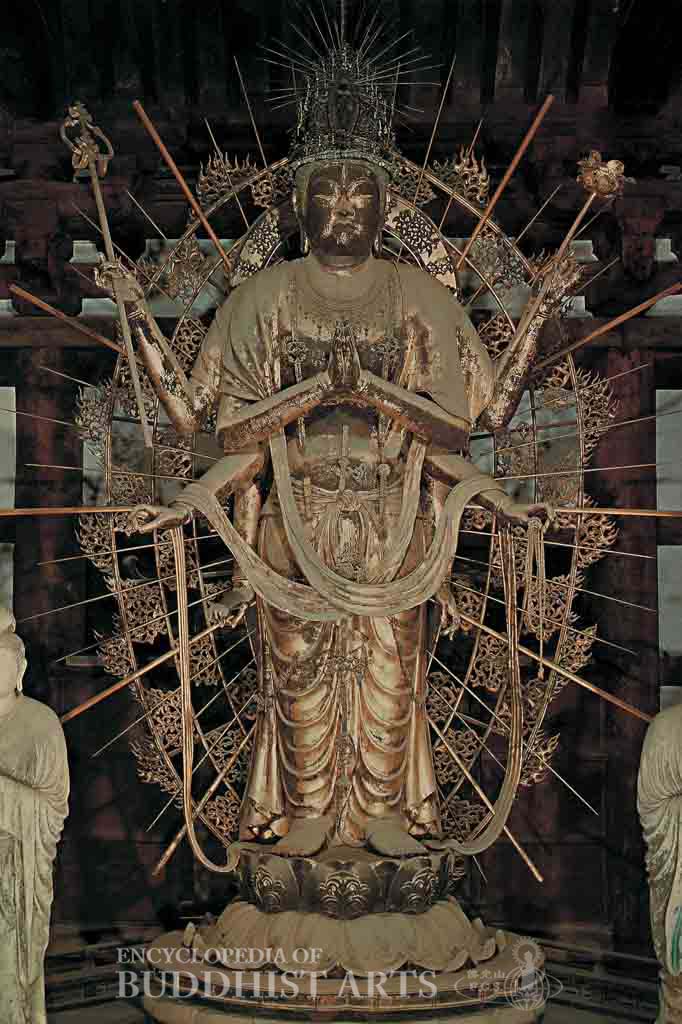
Todaiji Temple Lotus Hall: Amoghapasa Avalokitesvara
Dry lacquer
Todaiji Temple Lotus Hall: Amoghapasa Avalokitesvara
JAPAN, Nara; Nara period
Created over the years 746 to 749, this is the oldest example of this form of Avalokitesvara in Japan. The rope is the figure’s main attribute, symbolizing the Bodhisattva’s compassionate deliverance of all sentient beings from suffering. Since Emperor Shomu (reigned 724–749) and Empress Komyo promoted Buddhism, the best artistic talent and financial resources went into the creation of this Avalokitesvara, resulting in a figure that joins the style of Vajrayana Buddhism with the realism of the Nara period. A representative work of the hollow dry lacquer technique practiced during the time, it was listed as a National Treasure in 1952.
The gilded and painted figure has eight arms and a vertical wisdom eye in the center of the forehead. A deer-skin covers a long belted skirt. The primary hands fold around a jewel at the chest. The hunting rope is held in the middle left hand with a lotus bloom above. The lower pair of hands is in lotus mudra, as is the hand above on the right, while a monk’s staff is held in the top right hand. The Bodhisattva wears an intricately carved silver crown inlaid with over twenty-six thousand gemstones, including jadeite, amber, crystal, and pearls. The center of the crown features a small standing Buddha figure. The sturdy figure is ornately dressed and ornamented. A stole falls from the shoulders to loop decoratively over the third pair of arms. A four-layer mandorla with 42 light rays is behind the figure. The mandorla’s intersections and rim are embellished with flame motifs and the tips of the crown are decorated with eight lotus motifs.
For more details, go to the Encyclopedia of Buddhist Arts: Sculpture St-Z, page 1219.
Cite this article:
author = Hsingyun and Youheng and Lovelock, Yann and Chou, Yuan and Huntington, Susan and Edson, Gary and Neather, Robert,
booktitle = {Encyclopedia of Buddhist Arts: Sculpture St-Z},
pages = 1219,
title = {{Todaiji Temple Lotus Hall: Amoghapasa Avalokitesvara}},
volume = 13,
year = {2016}}