

Baoguo Temple: Main Hall

Baoguo Temple (aerial view)

Baoguo Temple: Great Hero Hall (interior)
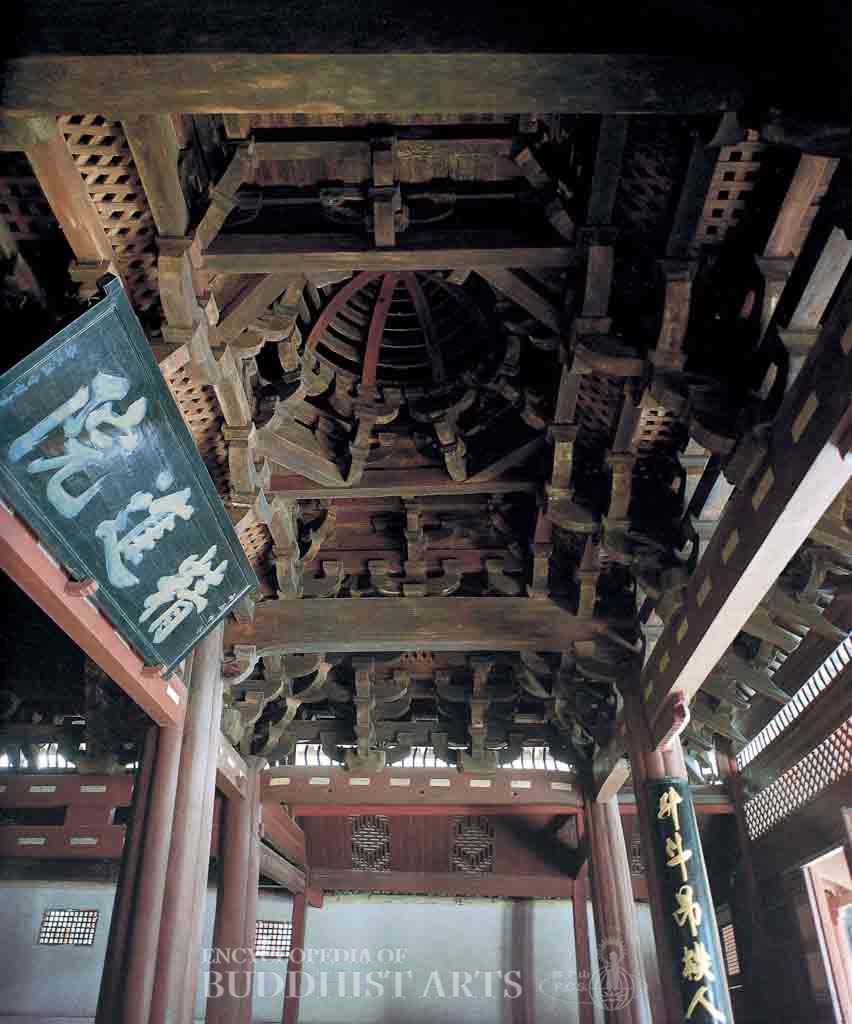
Baoguo Temple: Main Hall (interior)
Baoguo Temple
CHINA, Zhejiang, Ningbo
Located on the slopes of Lingshan (Spiritual Mountain), the temple was founded at the end of the Eastern Han dynasty (25–220). It was destroyed during the Buddhist persecution in 845 during the Tang dynasty and was rebuilt in 880. It has been repaired and expanded a number of times in its history. It was listed as a National Cultural Heritage Site in 1961.
The temple faces southeast and was built to fit in with the contours of the mountain. The temple consists of three compounds: the central, east, and west compounds. The east compound has five courtyards and the west compound contains seven courtyards. Within the central compound there are the main temple gate, Heavenly King Hall, Great Hero Hall, Avalokitesvara Hall, and the sutra repository. In front of the main temple gate, there are two Tang dynasty (618–907) sutra pillars that were relocated there. Apart from the Great Hero Hall, which was built in 1013 during the Northern Song dynasty, all the other buildings were either reconstructed or added during the rule of Emperor Kangxi (reigned 1661–1722) of the Qing dynasty. There are no passageways or side halls on either side of the central compound, only walls are used to divide the three compounds. This layout is unusual for temples in China.
The Great Hero Hall was expanded during the Qing dynasty, so that it is now a five-by-three bay structure with a double-eave hip-and-gable roof. The lower eave is markedly extended. The upper and lower eaves seem abnormally close together, which is an unusual architectural characteristic for Buddhist architecture. Inside the hall there are three delicate octagonal caisson ceilings at the front. These are the earliest examples of this type of architectural feature in China. The columns supporting the hall are made of wooden segments that form a petal shape. This type of pillar construction is mostly found in Jiangnan (region south of the Yangtze River) and was often employed in Song dynasty (960–1279) architecture.
For more details, go to the Encyclopedia of Buddhist Arts: Architecture A-F, page 51.
Cite this article:
author = Hsingyun and Youheng and Johnson, Peter and Mankuang and Lancaster, Lewis,
booktitle = {Encyclopedia of Buddhist Arts: Architecture A-F},
pages = 51,
title = {{Baoguo Temple}},
volume = 1,
year = {2016}}