
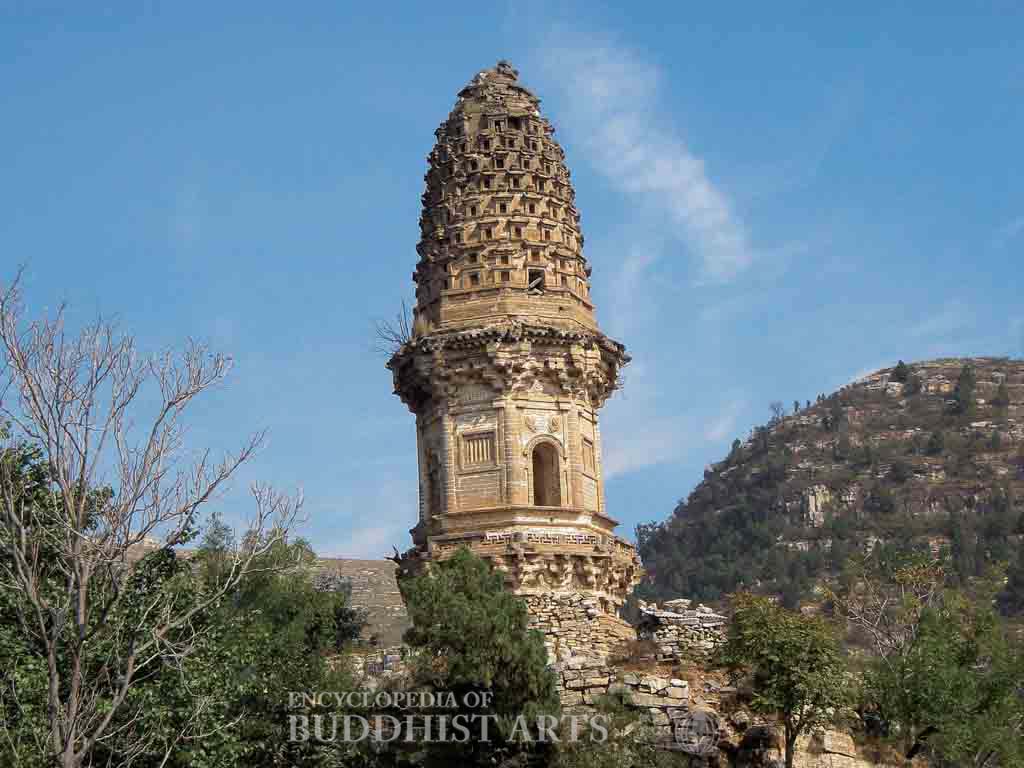
Qinghua Temple Flower Pagoda
Qinghua Temple Flower Pagoda
CHINA, Hebei, Baoding
The pagoda is located on top of a cliff. It used to be in front of the main temple gate of Qinghua Temple, which has since been destroyed. It was probably built during the Liao (907–1125) or Jin (1115–1234) dynasty. It was listed as a National Cultural Heritage Site in 2001.
The octagonal brick pagoda is divided into three sections: the base, body, and spire. The whole structure is 13 m high. It stands on an octagonal Sumeru platform base with bracket sets, which support the base of the body. Carved balustrades surround the base and the panels of the balustrades are carved in geometric patterns. There are arched doorways on four sides of the pagoda body alternating with fake vertical bar windows. There are rounded pilasters at the corners linked by architraves. Prominent brick bracket sets support the eaves. The spire is a tapered curved shape with 120 Buddha niches in eight layers. The Buddha statues are missing and the finial no longer exists. A Buddha statue is enshrined within the pagoda. This is one of the rare surviving flower pagodas.
For more details, go to the Encyclopedia of Buddhist Arts: Architecture M-S, page 873.
Cite this article:
author = Hsingyun and Youheng and Johnson, Peter and Mankuang and Lancaster, Lewis,
booktitle = {Encyclopedia of Buddhist Arts: Architecture M-S},
pages = 873,
title = {{Qinghua Temple Flower Pagoda}},
volume = 3,
year = {2016}}