
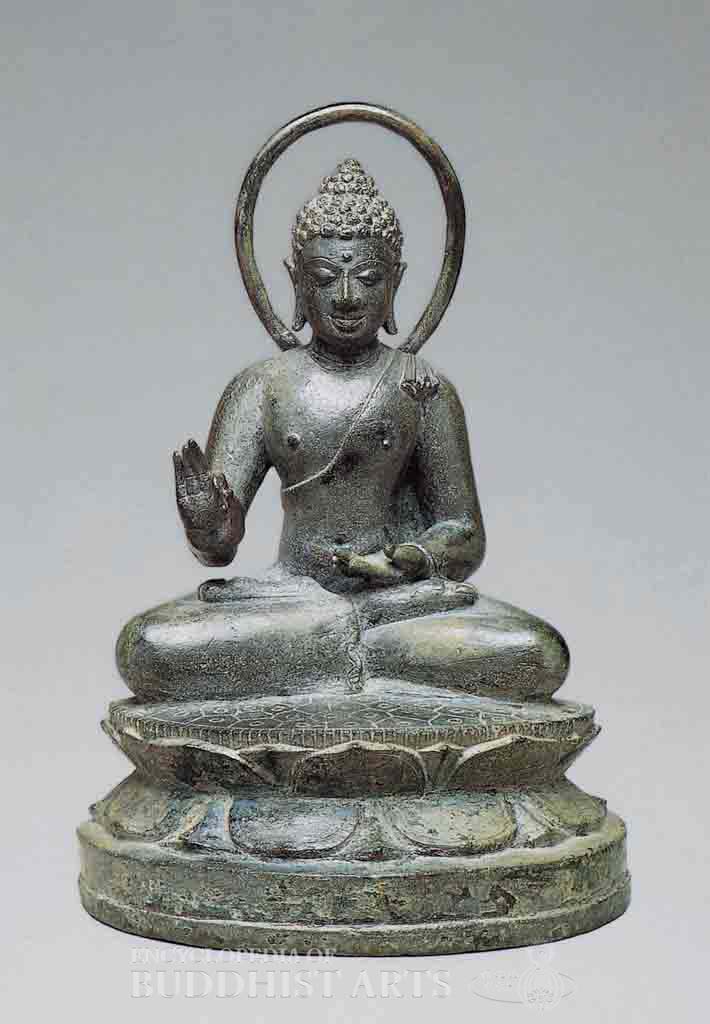
Java: Vairocana Buddha
Bronze
Java: Vairocana Buddha
INDONESIA, Java
The statue was created during the Central Java period (circa 7th–13th century) and depicts a seated Vairocana Buddha. The figure is upon a double lotus throne in full lotus position, with the right hand in vitarka (teaching) mudra. The oval nimbus is hollow and despite being plain, the two openings behind the lotus throne indicate that there was once a mandorla behind the body. However, the statue is characterized by the simplicity of its execution, extending to the bare incisions to indicate eyebrows and the restrained hemline of the monastic robe that runs across the chest. There is scarcely a fold indicated on the robe apart from the slight ripple where it falls over the right ankle and left wrist and the pleats where the material is pulled forward over the left shoulder. The detailed treatment of the lotus throne makes an interesting contrast, with its overlapping petals and minutely depicted seed pod.
For more details, go to the Encyclopedia of Buddhist Arts: Sculpture G-M, page 489.
Cite this article:
author = Hsingyun and Youheng and Lovelock, Yann and Chou, Yuan and Huntington, Susan and Edson, Gary and Neather, Robert,
booktitle = {Encyclopedia of Buddhist Arts: Sculpture G-M},
pages = 489,
title = {{Java: Vairocana Buddha}},
volume = 11,
year = {2016}}