
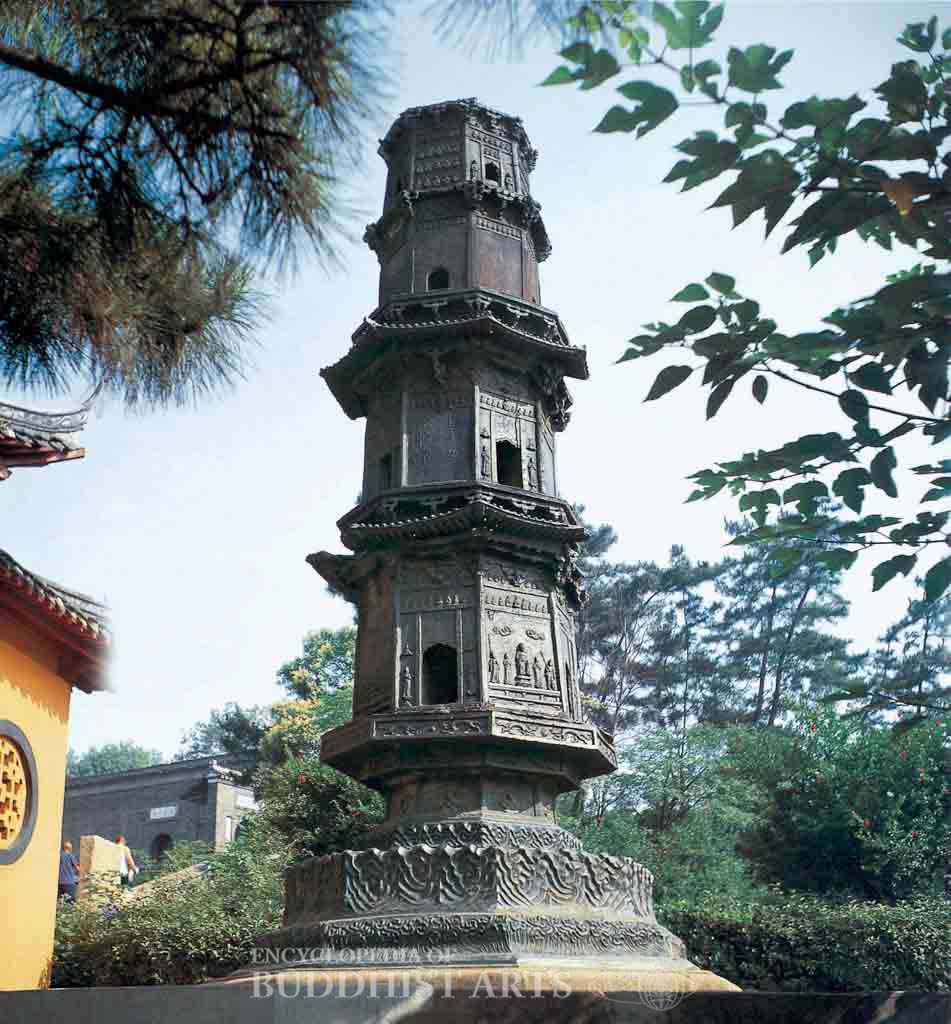
Ganlu Temple Iron Pagoda
Ganlu Temple Iron Pagoda
CHINA, Jiangsu, Zhenjiang
Ganlu means Sweet Dew. It is also known as Weigong (Duke of Wei) Pagoda. It is one of the last eight existing iron pagodas in China. It was built during the rule of Emperor Jingzong (reigned 824–826) of the Tang dynasty by Li Deyu, the Duke of Wei, in order to pray for Emperor Muzong (reigned 820–824), who had passed away. It was originally seven stories high and constructed from stone, but it was destroyed towards the end of the Tang dynasty (618–907). It was rebuilt as a nine-story iron pagoda between 1068 and 1078 during the Northern Song dynasty (1068–1077). The pagoda was damaged by high winds in 1582 during the Ming dynasty. Although it was repaired, it was reduced to seven stories. It experienced damage from high winds and lightning storms during the late Qing dynasty (1644–1911). Restoration was carried out in 1960 and it was listed as a Provincial Cultural Heritage Site in 1982.
The four-story, octagonal, iron pagoda is approximately 8 m high. It was built to resemble a wooden pagoda. The base, first and second stories are original structures from the Song dynasty (960–1279), while the third and fourth stories were cast in the Ming dynasty (1368–1644).
A limestone base platform is situated at the bottom with an iron Sumeru base resting on it. The top part of the Sumeru base has a depiction of two dragons playing with a pearl, while the lower part is decorated with heavenly mountains, floating clouds, and waves. There is a seated Buddha on each side of the concave section. Doorways are located on alternate sides of each story, while images of Buddhas, apsaras, dragons, beasts, and various decorative floral designs can be found all over the structure. The two lower stories have a base, eaves and bracket sets, all of which were cast in the proportions stipulated during the Song dynasty. More than 2,500 artifacts were excavated from the base in 1960. The most valuable item among them was a stele inscription written by Li Deyu recording the re-interment of the relic in Chanzhong Temple.
For more details, go to the Encyclopedia of Buddhist Arts: Architecture G-L, page 362.
Cite this article:
author = Hsingyun and Youheng and Johnson, Peter and Mankuang and Lancaster, Lewis,
booktitle = {Encyclopedia of Buddhist Arts: Architecture G-L},
pages = 362,
title = {{Ganlu Temple Iron Pagoda}},
volume = 2,
year = {2016}}