
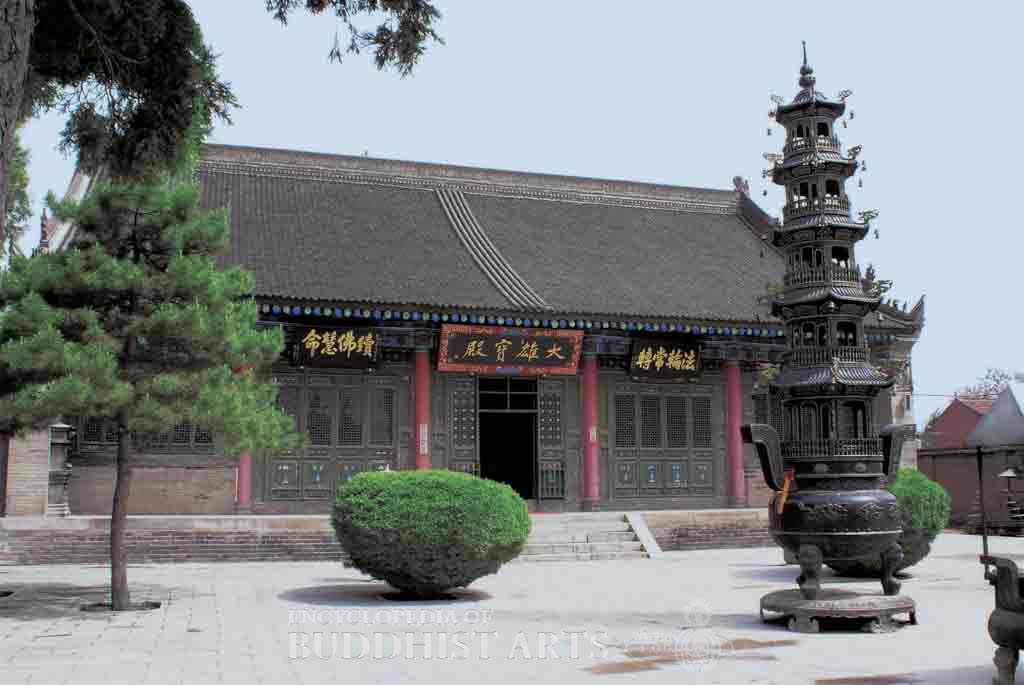
Xiangji Temple: Great Hero Hall
Xiangji Temple
CHINA, Shaanxi, Xi’an
Xiangji means Accumulated Fragrance. It is considered one of the ancestral temples of the Pure Land school. When Master Shandao of the Pure Land school passed away in 706 during the Tang dynasty, his disciple Huaiyun built a pagoda in his memory. Subsequently, buildings were added to form Xiangji Temple. It became the first temple of the Pure Land school. However, it gradually declined and was later destroyed during the rule of Emperor Tongzhi (reigned 1862–1874) of the Qing dynasty. From 1979 to 1980, the temple underwent large-scale reconstruction. It was listed as a key Buddhist temple in the Han region of China in 1983.
The existing buildings consist of the Shandao Pagoda, Jingye Pagoda, great hall, Great Hero Hall, Dharma Hall, gateway, and Heavenly King Hall. The Shandao Pagoda and Jingye Pagoda were constructed during the Tang dynasty (618–907), and the great hall was renovated during the Qing dynasty. The Great Hero Hall was moved here in 1979. The Dharma Hall, the blue limestone gateway, and the Heavenly King Hall were all constructed at a later date. The Great Hero Hall houses a statue of Amitabha Buddha, as well as a wooden statue of Master Shandao, which was a gift from Japan.
Master Honen made use of Shandao’s Commentary on the Amitayurdhyana Sutra to find the Pure Land school in Japan in the 12th century. Master Shandao is recognized as its patriarch and Xiangji Temple as its ancestral temple.
For more details, go to the Encyclopedia of Buddhist Arts: Architecture T-Z, page 1310.
Cite this article:
author = Hsingyun and Youheng and Johnson, Peter and Mankuang and Lancaster, Lewis,
booktitle = {Encyclopedia of Buddhist Arts: Architecture T-Z},
pages = 1310,
title = {{Xiangji Temple}},
volume = 4,
year = {2016}}