
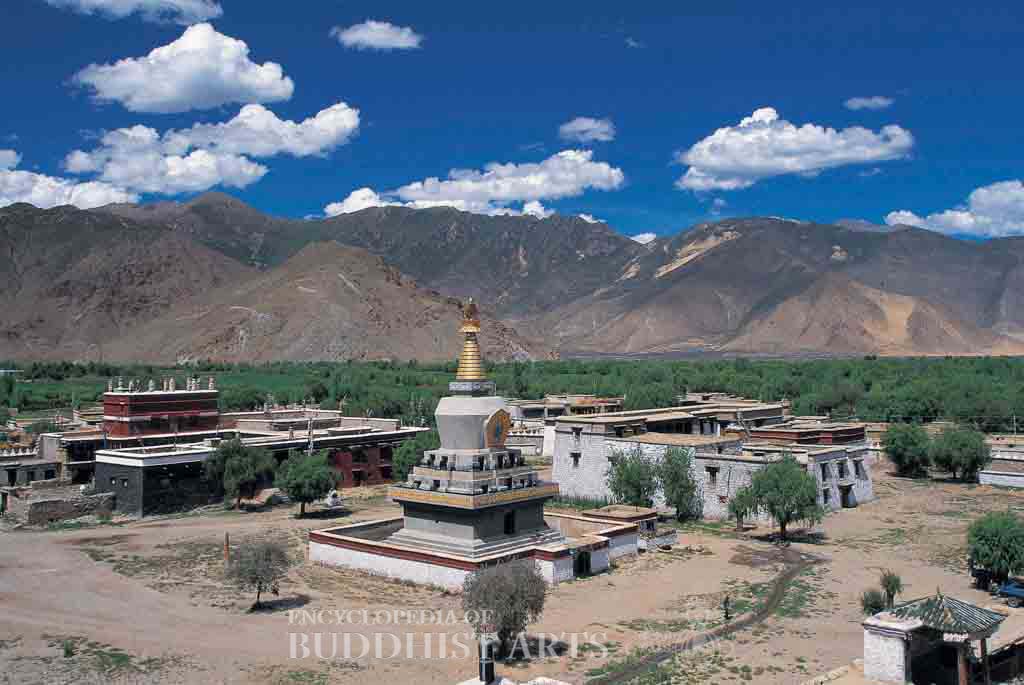
Samye Monastery
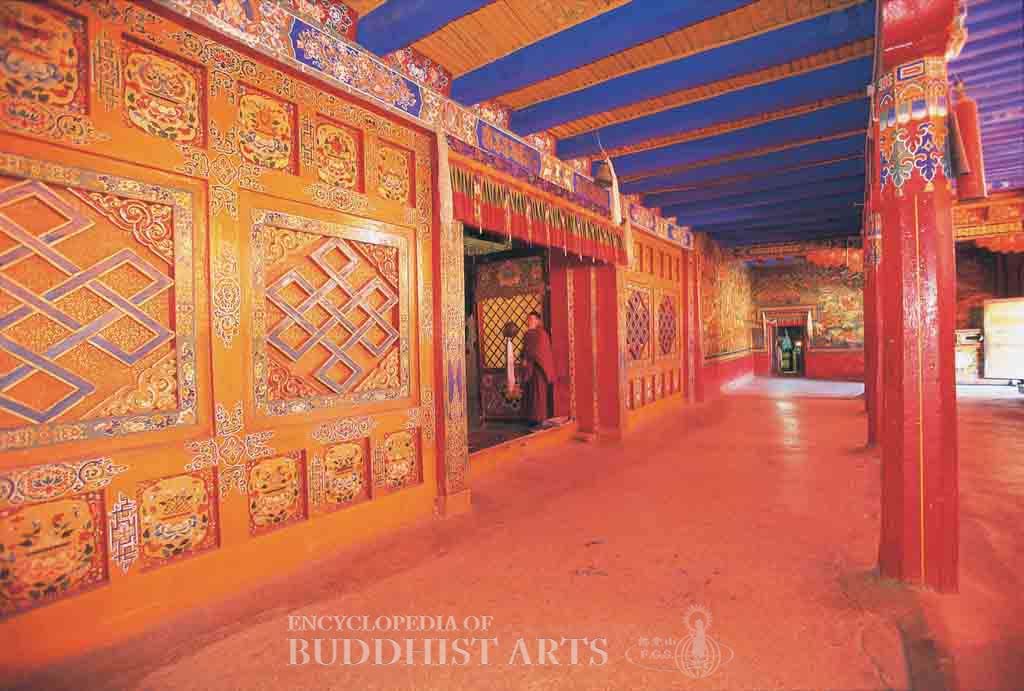
Samye Monastery: Central Hall - Entrance Hall
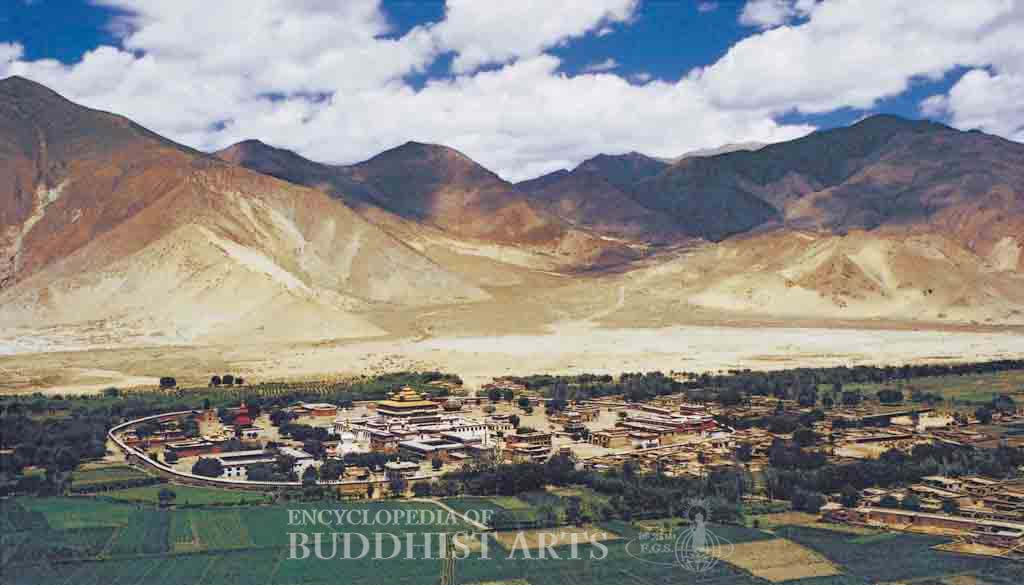
Samye Monastery (aerial view)
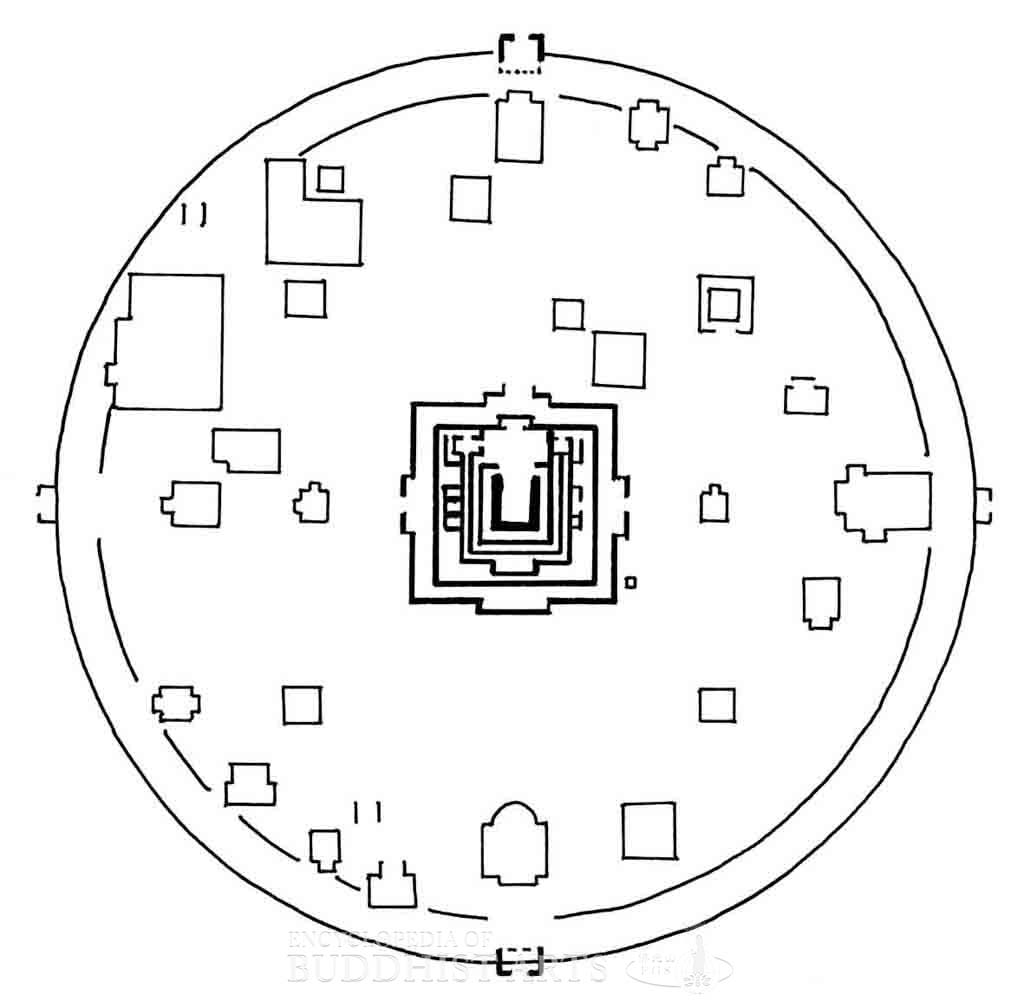
Samye Monastery (site layout)
Samye Monastery
CHINA, Tibet, Lhoka
The monastery is located to the north of the Yarlung Tsangpo River in Granang, Lhoka. It was built during the late 8th century by renowned Indian monks Santarakshita and Padmasambhava. The foundation was laid by King Trisong Detsen (reigned 755–797) of the Tibetan Empire. The design was modeled after the Odantapuri Monastery in Bihar, India. Upon the completion of the monastery, Santarakshita invited eminent monks to teach the Dharma in the monastery, and seven men from noble families, known as the Seven Enlightened Disciples of Samye, were ordained. It became the first Buddhist monastery in Tibet, and played an influential role in the early development of Tibetan Buddhism. Monastic translators from India, China and Tibet gathered here and translated a large number of Mahayana and Vajrayana texts. They also made catalogs of the translated sutras, which laid the important foundation for the Tibetan canons, the Kangyur and Tengyur. In the 9th century Buddhism was persecuted and the monastery was closed. It was subsequently reopened and became a monastery of the Nyingma school. During the Sakya hegemony (1236–1354), renovations were carried out under military and administrative leaders from the Sakya school, and it became a monastery of the Sakya school, as well as the Nyingma school. It was damaged and renovated a number of times throughout its history. The renovation of 1981 restored it to its original scale. It was listed as a National Cultural Heritage Site in 1996.
The monastery occupies more than 11 ha. Its principal buildings are the central hall, the black, red, white and green stupas, and various other halls. The architectural layout forms a giant mandala, a representation of Buddhist cosmology. The central hall in the middle symbolizes Mount Sumeru, which is at the center of the universe. There is a Sun Hall and a Moon Hall on either side of the central hall. The four stupas at the corners of the central hall symbolize the Four Heavenly Kings living by the mountainside. The 12 shrines surrounding the central hall represent the four great continents and eight small continents. The boundary wall represents the Iron-Ring Mountains bordering the universe.
The temple contains various artifacts, such as the stone stele at the entrance of the central hall, constructed as a mark of respect for King Trisong Detson’s vow to propagate the Dharma, and a Tang-style bronze bell hanging on the entrance hall of the central door. Both of these are from the original monastery.
For more details, go to the Encyclopedia of Buddhist Arts: Architecture M-S, page 924.
Cite this article:
author = Hsingyun and Youheng and Johnson, Peter and Mankuang and Lancaster, Lewis,
booktitle = {Encyclopedia of Buddhist Arts: Architecture M-S},
pages = 924,
title = {{Samye Monastery}},
volume = 3,
year = {2016}}