

Bingling Temple Cave 169
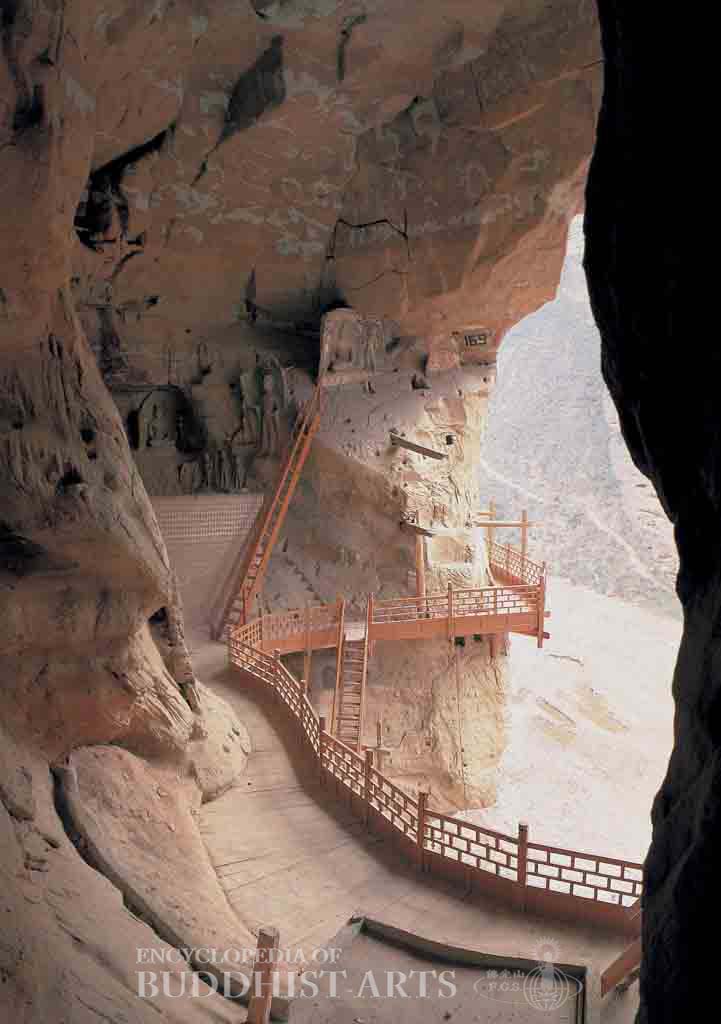
Bingling Temple Cave 169

Bingling Temple Cave 169: South Wall
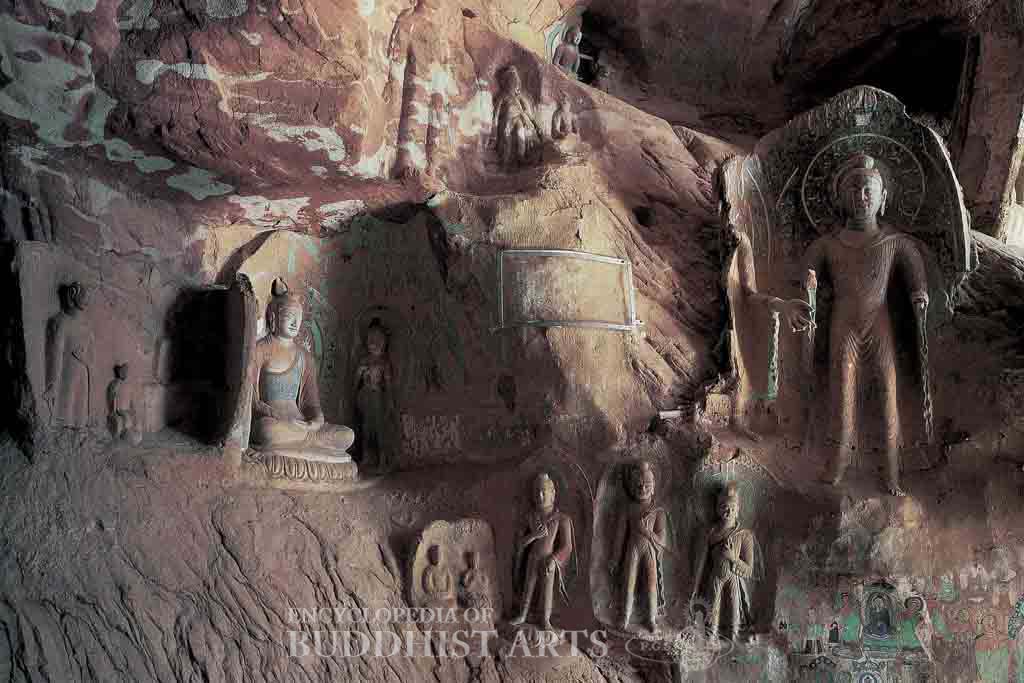
Bingling Temple Cave 169: North Wall
Bingling Temple Cave 169
CHINA, Gansu, Linxia
This cave is also known as Bridge South Cave. It is located at the top level in the northern end of the lower temple caves, to the south of Niche 171. It is an irregular natural cave measuring 26.75 m in width, 15 m in height, and 19 m in depth. The cave entrance faces east and is about 50 m above the base of the cliff. This is the largest and oldest cave within the cave system, and is also the richest in content. Originally, it was filled with sculptures and murals, though only 24 niches and murals are currently extant. Most of the artwork was created during the Western Qin Kingdom period (385–431), with a few works dating to the late Northern Wei dynasty (386–534). Niches 1 to 9, 14, 16 to 18, and 20 to 23 contain a total of 68 clay sculptures, while Murals 10 to 13, 15, 19, and 24 cover a total of 150 sq m.
Along the top of the back (west) wall is Niche 18, which contains two standing Buddhas and eleven seated Buddhas. These Buddhas are all sculpted in a similar style which is simple and unsophisticated, leading scholars to believe that they may be some of the oldest figures within the cave. Below these are Niches 16 and 17. Niche 16 contains clay sculptures of five seated Buddhas, a standing Buddha, and a Bodhisattva in contemplation. Most of these sculptures are badly damaged due to weathering. Niche 17 originally housed a Buddha and two Bodhisattvas; however, only one Bodhisattva remains.
The sculptures on the north wall can be divided into upper, middle, and lower levels. At the top are Niches 1 and 2, each containing a seated Buddha. Niche 3 is located on the right side of the wall near the entrance and contains a Buddha, a Bodhisattva, and a Heavenly King. In the middle and lower sections are Niches 4 to 9 and 14. Niches 5 and 8 hold two clay Buddha sculptures made during the Northern Wei dynasty. Niches 4 and 6 each contains a Buddha and two Bodhisattvas. Niche 7 houses two standing Buddhas, while Niche 9 contains three standing Buddhas. Niche 14 is carved with three seated Buddhas. An inscription located near the carvings date to 420.
There are three levels of sculptures along the south wall. Niche 23 is located at the top and contains five seated Buddhas forming the dhyana (meditation) mudra. An inscription dated 396 is engraved between the Buddhas. The middle level features Niches 21 and 22; Niche 21 houses a Buddha and a Bodhisattva, while Niche 22 contains two seated Buddhas. On the lower level is Niche 20, which holds a well-preserved sculpture of the Ascetic Sakyamuni flanked by two other Buddhas on each side.
There are many murals scattered on the walls and within the niches of the cave. Among these, the murals located on the north wall within Niches 3, 6, 7, and 14 are the best preserved. The most popular themes depicted in the murals are the Buddha teaching the Dharma and the Thousand Buddhas. In general, the content of the murals show strong influence by the Mahayana Buddhist tradition. In addition, a 53-line inscription of the Adbhuta Dharma Paryaya Sutra is engraved in Niche 14.
For more details, go to the Encyclopedia of Buddhist Arts: Caves A-E, page 172.
Cite this article:
author = Hsingyun and Youheng and Johnson, Peter and Mankuang and Huntington, Susan and Edson, Gary and Neather, Robert,
booktitle = {Encyclopedia of Buddhist Arts: Caves A-E},
pages = 172,
title = {{Bingling Temple Cave 169}},
volume = 5,
year = {2016}}