
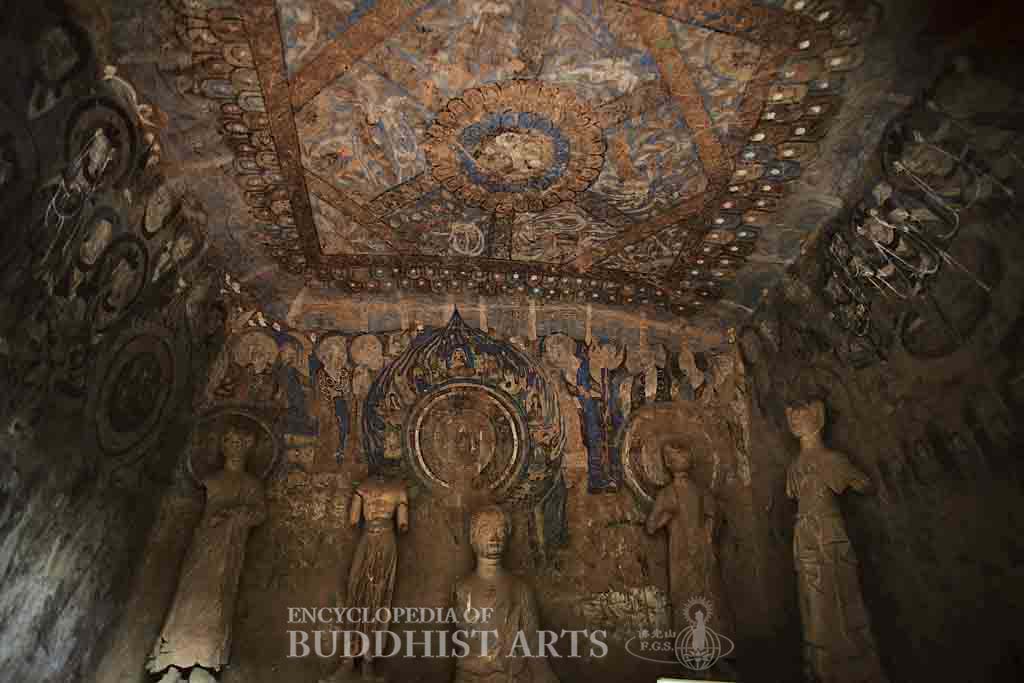
Bingling Temple Cave 8
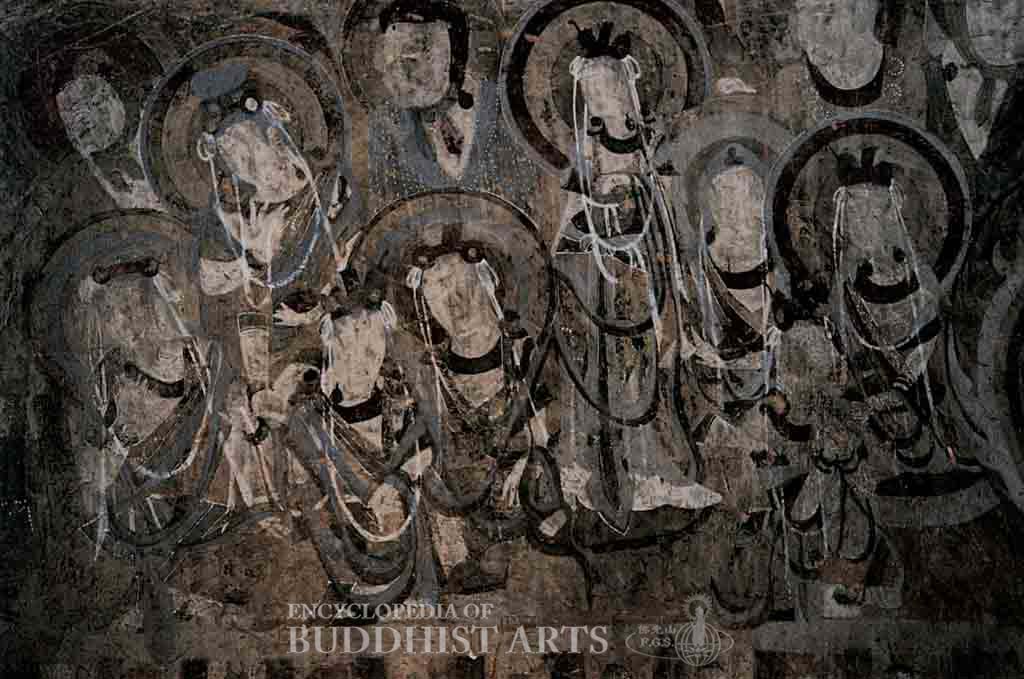
Bingling Temple Cave 8: Bodhisattvas and Disciples (south wall, upper register)
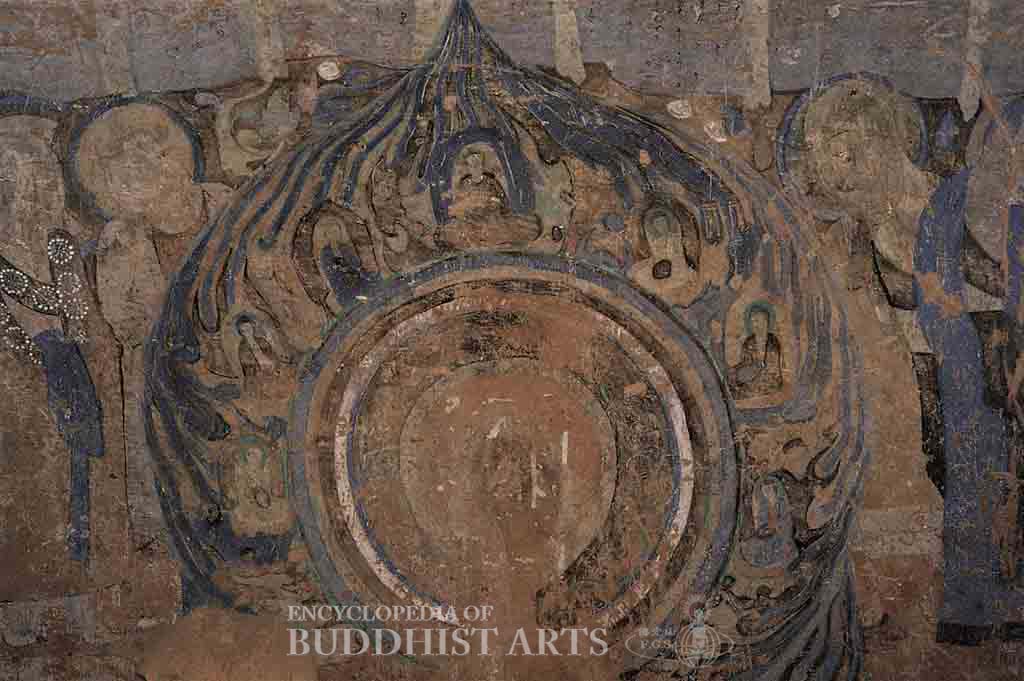
Bingling Temple Cave 8: Nimbus of the Buddha (back wall)
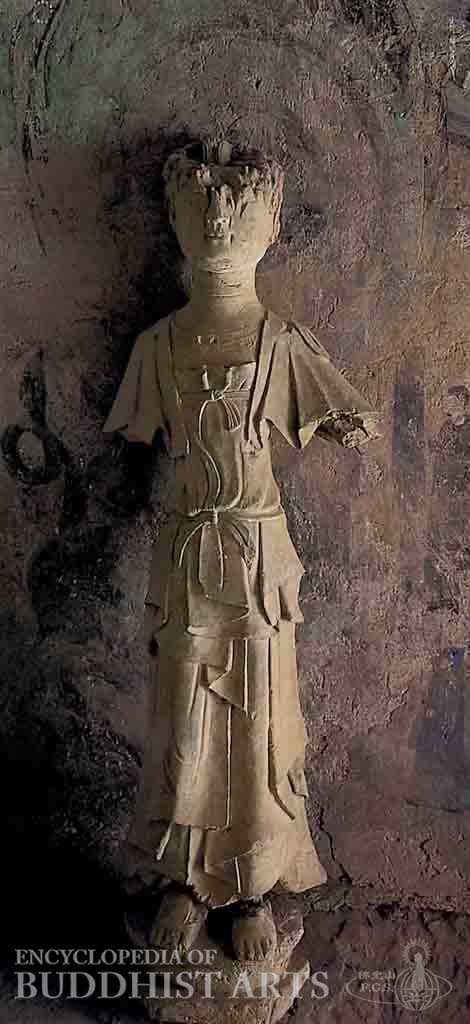
Bingling Temple Cave 8: Bodhisattva (north wall)
Bingling Temple Cave 8
CHINA, Gansu, Linxia
Cave 8 is located at mid-level in the southern section of the lower temple caves, and contains some of the finest works at the site dating to the Sui dynasty (581–618). The rectangular cave has a flat ceiling and measures 2.25 m wide, 1.8 m high, and 2.05 m deep. The remaining murals and sculptures are all original artworks from the Sui dynasty with the exception of one Bodhisattva created during the Tang dynasty (618–907), found to the left of the Buddha on the back (west) wall. Most of the sculptures in the cave have been damaged, particularly those along the back wall, as well as the Bodhisattvas along the north and south walls. There is also evidence that some remaining statues have been shifted from their original positions.
The central seated Buddha on the back wall has a round face with delicate features and facial hair detailed in black ink. The usnisa has been damaged but the coiffure is still visible. The Buddha wears a monastic robe which leaves the right shoulder and part of the chest bare, displaying a swastika painted in black ink in the center of the chest. The left hand rests upon the knee, while the right arm is missing. The two disciples flanking the Buddha are recognizable as Mahakasyapa and Ananda, although the tops of their heads have been damaged.
The Bodhisattva on the north wall of the cave has a rounded face and slim physique. The figure wears a delicately layered garment tied with sashes at the chest and waist. The statue stands barefoot upon a lotus pedestal. The top of the head and both arms are damaged, although the rest of the statue is well preserved. The technique and skill employed in creating this figure is exceptional; the clothing is ornate and realistic, particularly in the detailing of the folds and sashes. Due to the high level of skill demonstrated in this carving, it is considered to be a masterpiece of the Sui dynasty.
Large murals cover most of the walls and ceiling in Cave 8. The diamond-in-square ceiling has a triple-layered lotus medallion in the center and six segments of apsara. The back and side walls are painted with only the nimbuses of the Buddha, Bodhisattvas, and disciples. Paintings of five disciples, each standing in a different pose, are on each side of the Buddha’s nimbus. The front (east) wall is decorated with illustrations of the Vimalakirti Sutra, including images of Vimalakirti and Manjusri.
The murals on the upper register of the south wall depict images of seven disciples and eight Bodhisattvas wearing headdresses decorated with long white ribbons. Two rows of donor figures are found on the lower part of the wall: 11 male figures on the top row, each accompanied by a cartouche, and 15 female figures on the bottom row. The murals on the north wall are almost symmetrical to those on the south, except that the upper part of the wall only depicts five Bodhisattvas and five disciples.
For more details, go to the Encyclopedia of Buddhist Arts: Caves A-E, page 163.
Cite this article:
author = Hsingyun and Youheng and Johnson, Peter and Mankuang and Huntington, Susan and Edson, Gary and Neather, Robert,
booktitle = {Encyclopedia of Buddhist Arts: Caves A-E},
pages = 163,
title = {{Bingling Temple Cave 8}},
volume = 5,
year = {2016}}