
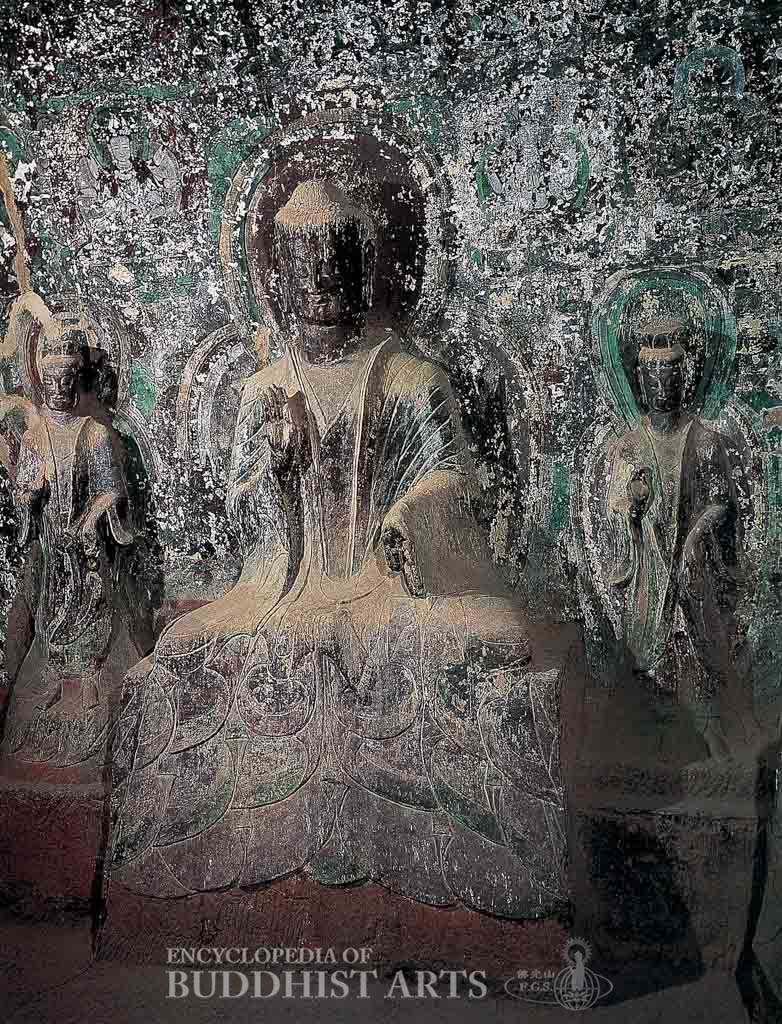
Bingling Temple Cave 132: Dipamkara Buddha Triad
Stone
Bingling Temple Cave 132: Dipamkara Buddha Triad
CHINA, Gansu, Linxia; Northern Wei dynasty
These statues are located on raised platforms on the south wall. According to the arrangement of statues within the cave, the main statue on this wall represents Dipamkara Buddha, a Buddha of the past. Dipamkara sits in the full lotus position on a raised platform, with the hands forming the abhaya (fearlessness) and varada (wish-granting) mudras. The Buddha has a flat usnisa and a slightly upturned mouth, and wears a long monastic robe with finely detailed folds.
The Bodhisattvas on either side of Dipamkara wear headdresses in the shape of flowers, monastic robes, and long stoles crossed in the front. Their faces are long and narrow, and their expressions are calm and contemplative.
For more details, go to the Encyclopedia of Buddhist Arts: Caves A-E, page 169.
Cite this article:
author = Hsingyun and Youheng and Johnson, Peter and Mankuang and Huntington, Susan and Edson, Gary and Neather, Robert,
booktitle = {Encyclopedia of Buddhist Arts: Caves A-E},
pages = 169,
title = {{Bingling Temple Cave 132: Dipamkara Buddha Triad}},
volume = 5,
year = {2016}}