
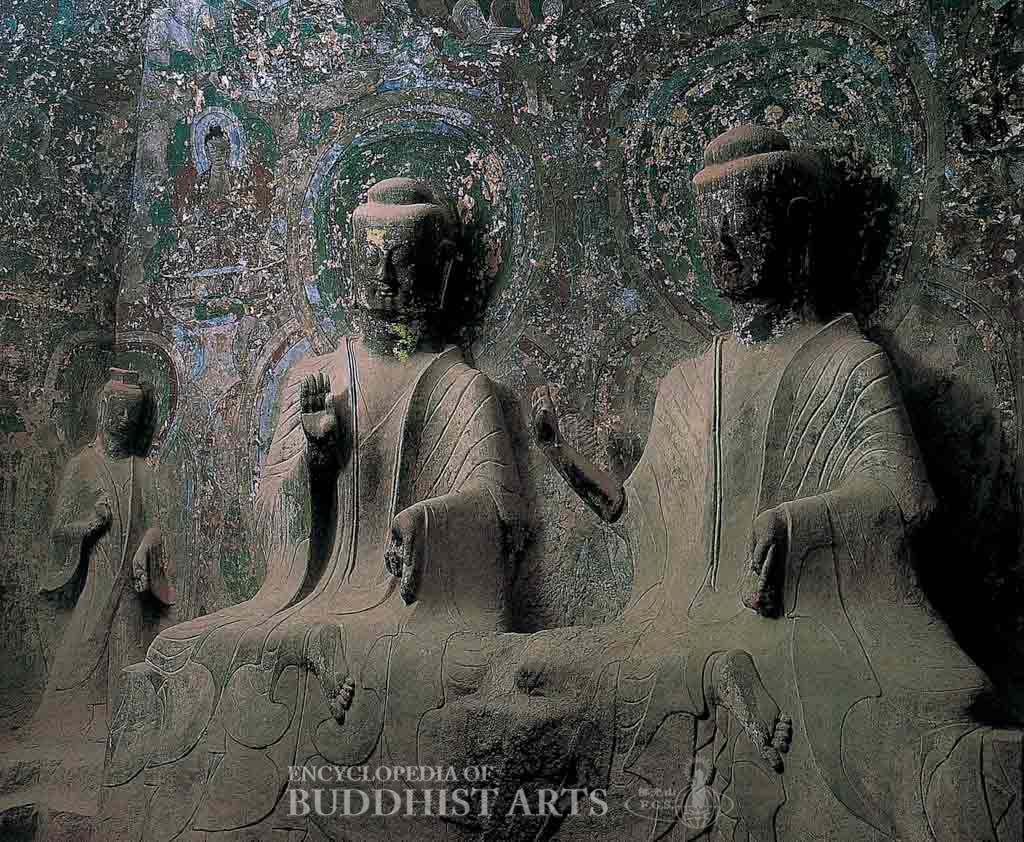
Bingling Temple Cave 132: Sakyamuni and Prabhutaratna Buddhas (back wall)
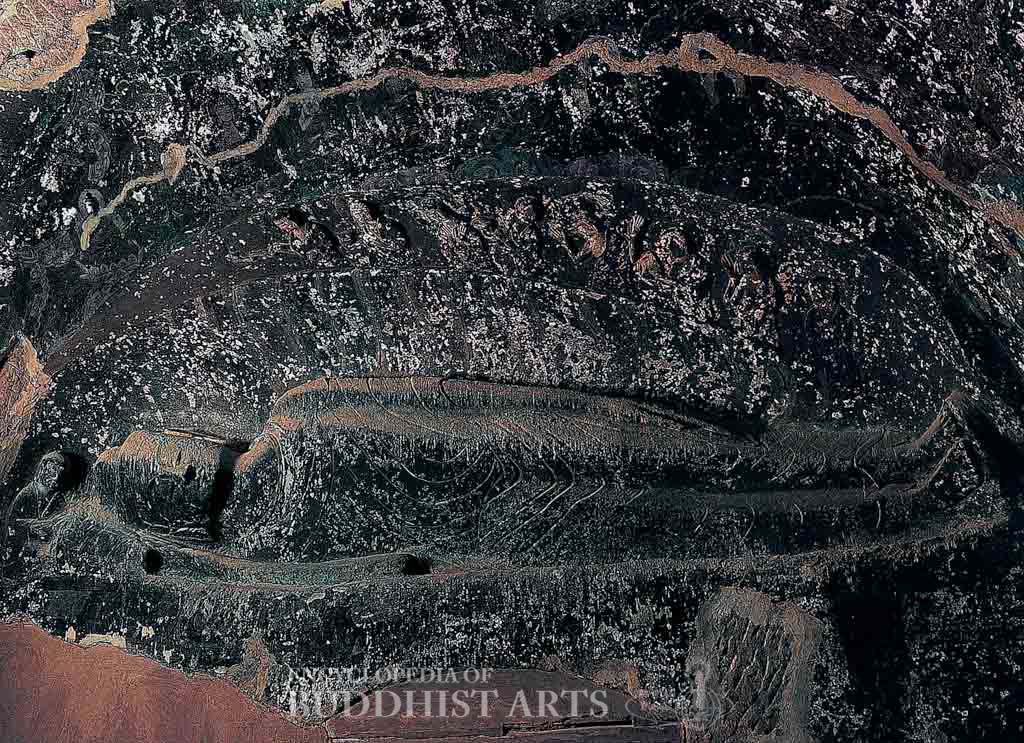
Bingling Temple Cave 132: Reclining Buddha Surrounded by Disciples (front wall)
Bingling Temple Cave 132
CHINA, Gansu, Linxia
Cave 132 is located at mid-level within the middle section of the lower temple caves. The cave measures 4.1 m in width, 3.5 m in height, and 3.9 m in depth, while the entrance to the cave is 1.63 m high. Construction began during the Northern Wei dynasty (386–534), although the murals on the cave walls and ceiling were repainted during the Ming dynasty (1368–1644). The cave has a three-tier, diamond-in-square ceiling. It is carved with an image of a lotus-born child and painted with honeysuckle and other floral patterns, surrounded by 22 Buddha images.
Statues of Sakaymuni and Prabhutaratna Buddhas, as well as two Bodhisattvas, are featured on the back (west) wall. The Buddha statues are approximately 2.6 m high, while the Bodhisattvas are 1.33 m high. Both Buddhas have flat usnisas, long faces, small mouths, and thin lips. The mouths are curved into slight smiles and their eyes are half closed. They wear loose, draped monastic robes which cover the front of their thrones. Both Buddhas raise their hands, and each has the right foot exposed. The Bodhisattvas stand on either side wearing long robes and stoles that are crossed at the front. A mural of a Buddha and two Bodhisattvas, as well as several seated Buddhas, is painted on the back wall.
Carvings of a Buddha and two Bodhisattvas can be found on the south wall. The layout and style of the statues are similar to those along the back wall. A 2.55 m high statue of Maitreya Buddha sitting with legs crossed at the ankles and flanked by Bodhisattvas is on the north wall. The murals on the north and south walls include Vajrayana Buddhist themes such as a Wisdom King, Usnisa Sitatapatra, and Green Tara; and Mahayana themed murals such as Manjusri Bodhisattva, Avalokitesvara in royal ease posture, Sudhana paying homage to Avalokitesvara, a monk at sea, and Lord Guan.
A round, shallow niche containing a reclining Sakyamuni Buddha surrounded by disciples is on the front (east) wall above the cave entrance. The reclining Buddha is 2.15 m in length and oriented with the head to the north. The Buddha has a cylindrical face, closed eyes, and lies on his right side while dressed in a monastic robe with lightly engraved folds. The disciple Subhadra kneels at the Buddha’s head, supporting the pillow. Subhadra is known as the last person accepted as a disciple before the Buddha’s parinirvana. Eight other disciples in mourning are carved above the Buddha, with their expressions and gestures indicating their grief. Eight images of seated Buddhas are painted above the Buddha niche, and two Heavenly Kings and a number of practitioners are at the bottom of the wall alongside the cave entrance. Most of the murals have suffered severe damage from incense smoke and are now difficult to discern.
For more details, go to the Encyclopedia of Buddhist Arts: Caves A-E, page 167.
Cite this article:
author = Hsingyun and Youheng and Johnson, Peter and Mankuang and Huntington, Susan and Edson, Gary and Neather, Robert,
booktitle = {Encyclopedia of Buddhist Arts: Caves A-E},
pages = 167,
title = {{Bingling Temple Cave 132}},
volume = 5,
year = {2016}}