
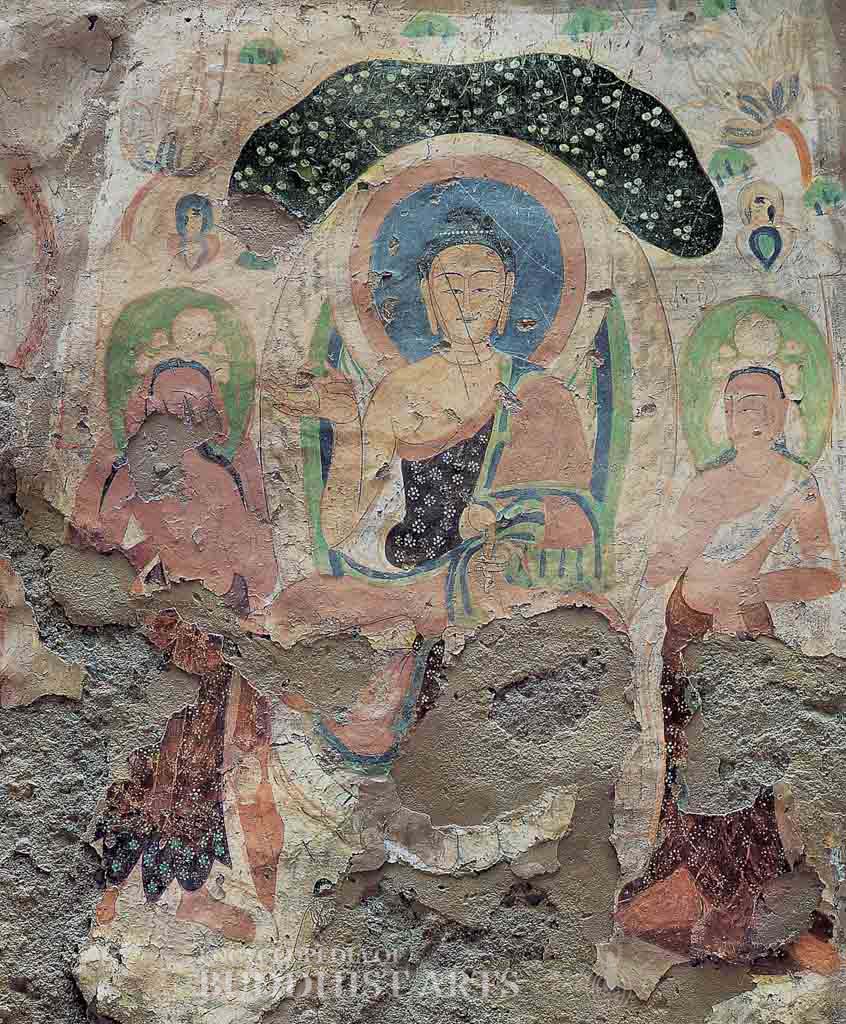
Bingling Temple Niche 195: Murals - Buddha and Two Bodhisattvas
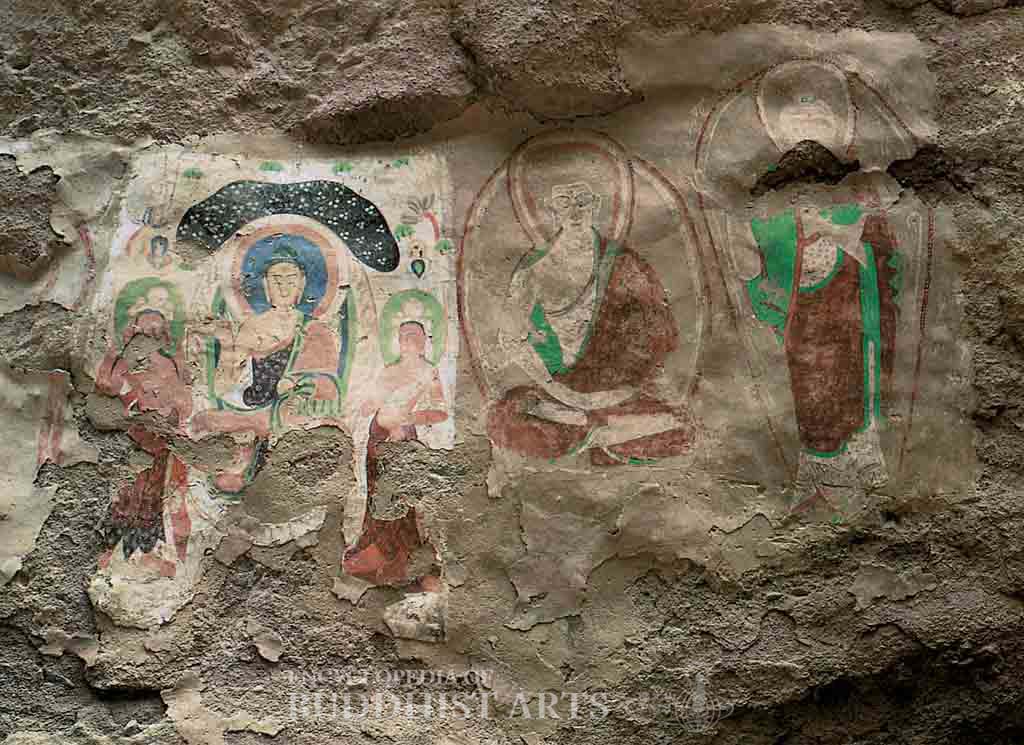
Bingling Temple Niche 195: Murals
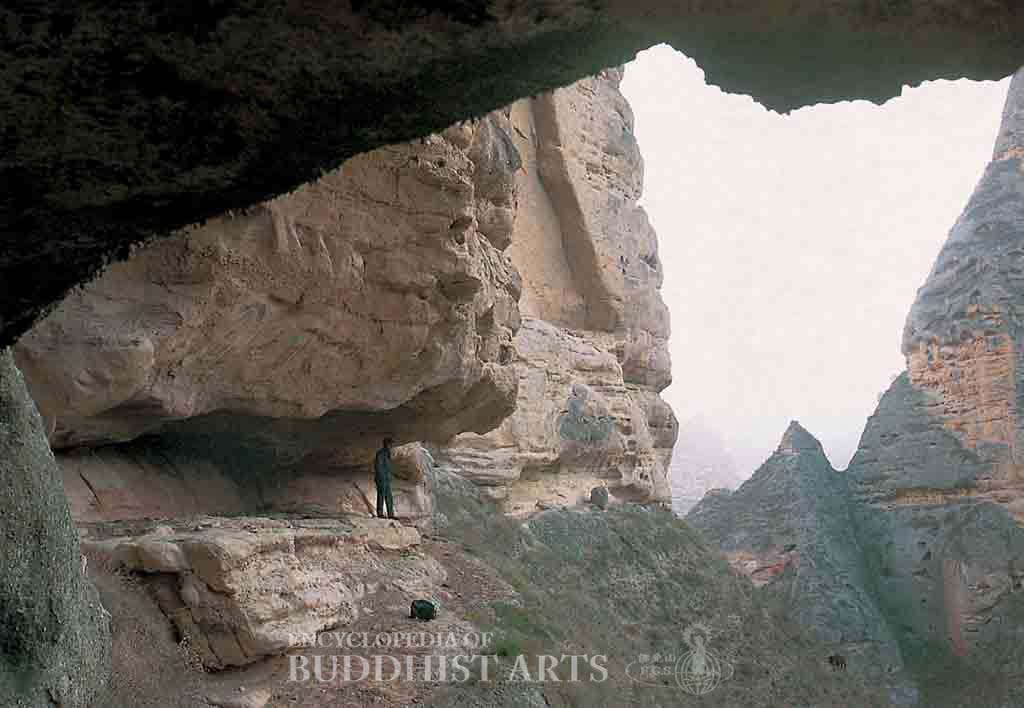
Bingling Temple Niche 195
Bingling Temple Niche 195: Murals
CHINA, Gansu, Linxia; Western Qin Kingdom
Niche 195, also known as Foye Platform, is located on the west cliff face 1 km north of the lower temple caves, at about 200 m above ground level. The niche is 20 m wide, 4.6 m high, and 4.1 m deep. The only remaining murals are located on the overhang above the niche, occupying a total area of 6.8 sq m. The murals are composed of three sets of illustrations. From left to right, these include: a Buddha and two Bodhisattvas, a seated Buddha, and a standing Buddha. Although the lower section of the illustration on the left has almost entirely flaked off, it is nevertheless considered to hold the highest artistic value of the three paintings, due to its more skillful and detailed composition. Overall, these paintings have marked similarities with those found in Cave 169, which were painted during the Western Qin Kingdom period (385–431). The soft, delicate lines and coloration are reminiscent of the unique style of paintings created during the Western Qin Kingdom.
The Buddha and two Bodhisattvas in the painting on the left are depicted upon a square, white background. The Buddha has a high usnisa, oval face, and long earlobes. His monastic robes draped over one shoulder, and are composed of an inner and outer layer. One hand grasps the corner of the robe, while the other is raised forming the vitarka (teaching) mudra. A colorful nimbus and mandorla can be seen behind the Buddha. A tree-shaped canopy, decorated with patterns resembling plum blossoms, is depicted above the nimbus. Both Bodhisattvas flanking the Buddha stand in tribhanga postures, wearing headdresses and long lower garments decorated with small white flowers. The figure on the right also wears a white stole draped over the chest possibly and possibly forms the vitarka (teaching) mudra with the right hand. Both Bodhisattvas have a mineral green nimbus with a small lotus-born being painted above it. Small jeweled trees and lotus flowers are found at the very top of the painting.
The seated Buddha in the center of the three murals and the standing Buddha on the far right both wear inner and outer monastic robes painted in mineral green and ocher. The seated Buddha forms the dhyana (meditation) mudra with both hands, while the standing Buddha holds an alms bowl in one hand and forms the vitarka (teaching) mudra with the other. Both Buddhas have a nimbus and mandorla painted in red and white. These two illustrations are painted in a simple style, particularly in contrast with the more detailed image on the left.
For more details, go to the Encyclopedia of Buddhist Arts: Caves A-E, page 194.
Cite this article:
author = Hsingyun and Youheng and Johnson, Peter and Mankuang and Huntington, Susan and Edson, Gary and Neather, Robert,
booktitle = {Encyclopedia of Buddhist Arts: Caves A-E},
pages = 194,
title = {{Bingling Temple Niche 195: Murals}},
volume = 5,
year = {2016}}