
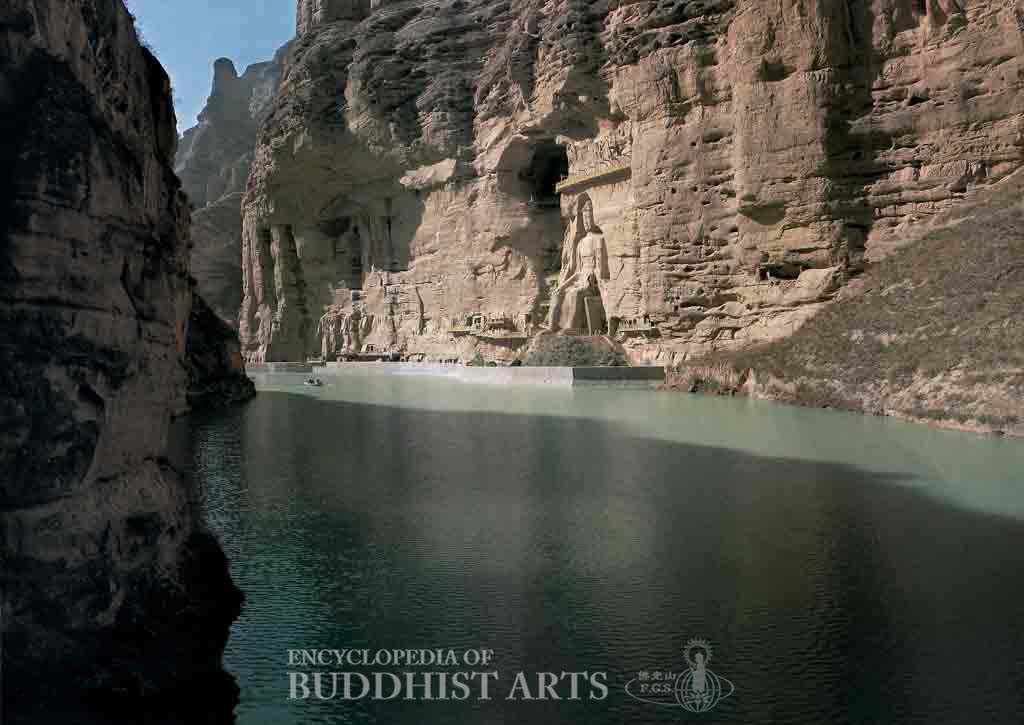
Bingling Temple Caves: Lower Temple Caves
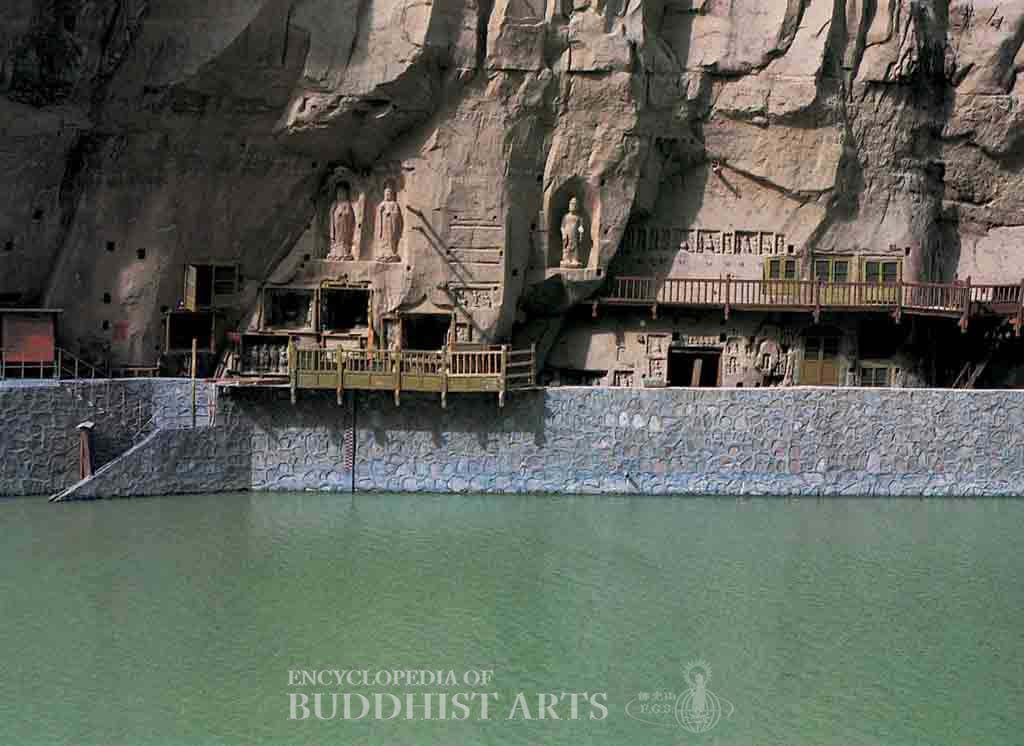
Bingling Temple Caves: Tang Dynasty Caves and Niches
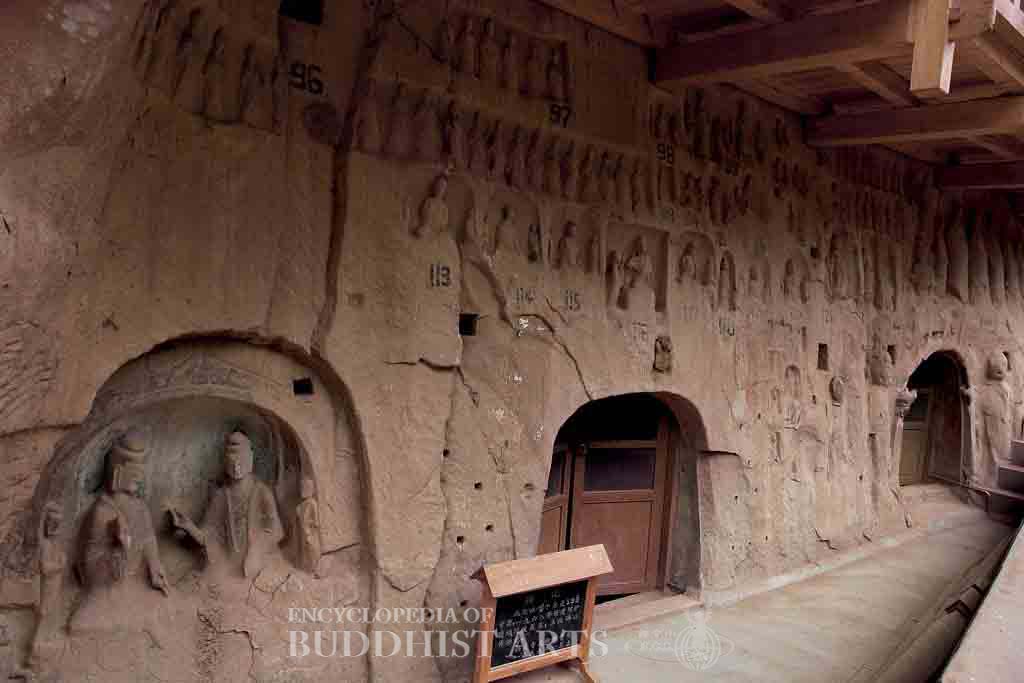
Bingling Temple Caves: Northern Wei Dynasty Caves and Niches
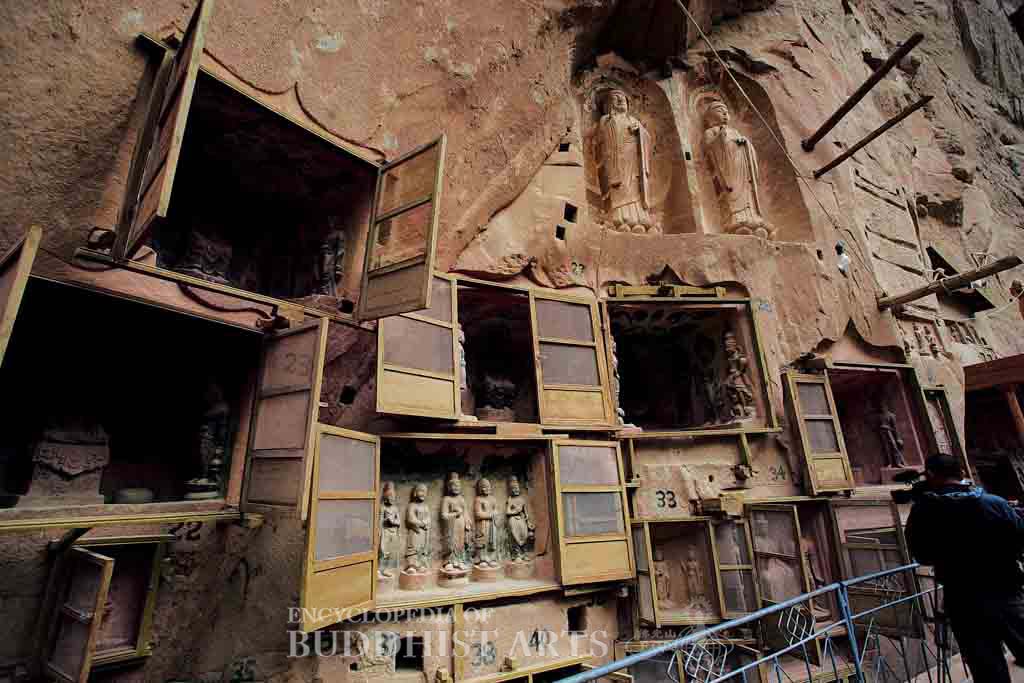
Bingling Temple Caves: Tang Dynasty Caves and Niches
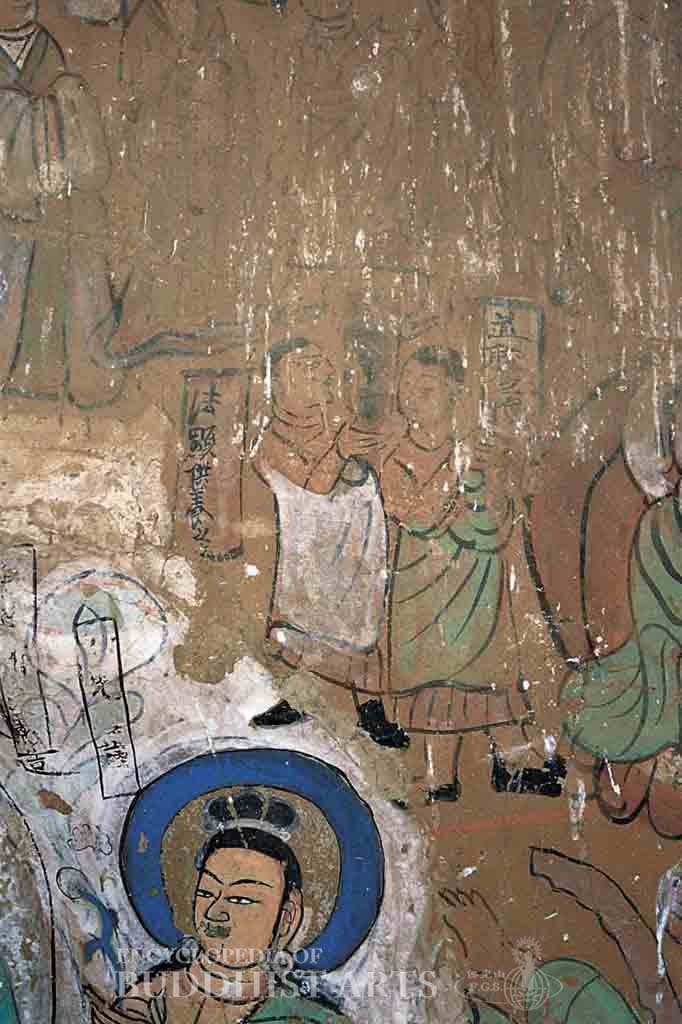
Bingling Temple Caves: Cave 169 - Donors - Faxian and Daocong (north wall)
Bingling Temple Caves
CHINA, Gansu, Linxia
The Bingling Temple Caves are located 35 km southwest of Yongjing county in the city of Linxia. They are situated in the red sandstone cliff face of Xiaojishishan (Small Accumulated Rock Mountain) along the west bank of Dasigou (Great Temple Gorge), a small northern stream of the Yellow River. According to the records of Commentary on the River Classic, before the Northern Wei dynasty (386–534) the Bingling Temple Caves were known as the “Ghost Caves.” During the Tang dynasty (618–907), the caves were known first as Longxing Temple Caves, and later as Lingyan Temple Caves. The first written record of the name “Bingling Temple” was created during the Song dynasty (960–1279). There is also another saying that the name “Bingling” is derived from a Tibetan phrase meaning “dwelling place of Maitreya.”
The caves can be separated into three areas: upper and lower temple caves, and the gorge area. The upper temple caves comprise of 13 caves and niches, while the lower temple caves, located along the wider sections of the Great Temple Gorge, contain 195. The remaining 8 caves are located in the gorge area, lying between the upper and lower temple areas. The majority of the caves were constructed over the course of the 500 years spanning from the Western Qin Kingdom (385–431) to the end of the Tang dynasty (618–907). After the Song dynasty (960–1279), the creation of new caves and niches declined and the majority of the work at the site was devoted to repairs; however, new murals continued to be painted until the Ming dynasty (1368–1644). There are a total of 216 caves and niches at the site, containing 815 sculptures, nearly 1,000 sq m of murals, and over 60 inscriptions. The Bingling Temple Caves were listed as a National Cultural Heritage Site in 1961.
One of the caves which contains the most representative works dating to the Western Qin Kingdom is Cave 169, located 50 m above ground level on the northern side of the lower temple caves. The majority of the carvings within the cave are composed of either pure clay or clay with a stone core. They are located within small niches with painted clay backscreens, distributed arbitrarily around the cave. These sculptures display influences from northern China as well as traces of Gandharan and Mathuran styles. The cave also contains murals with themes including the Buddha teaching the Dharma, the Vimalakirti Sutra, and images of donors including eminent monks such as Tanmopi, Daorong, and Faxian. This cave has been particularly important for research on early Buddhist history.
During the Northern Wei dynasty, the cave site was expanded to include 9 caves and 33 niches, including Caves 124, 126, 128, 132, 146, and 172. These caves are situated mid-level in the central and northern sections of the lower temple cave area. Caves 126 and 146 function as central caves, with most of the other caves surrounding them. Notably, Cave 126 houses an inscription from the year 513 and a statue of Cao Ziyuan, who ruled the area during the Northern Wei dynasty. The statues within the caves demonstrate a delicate style, with great emphasis placed upon the folds and details in the garments.
Although few caves have been dated to the Northern Zhou dynasty (557–581), some statues from that period can be found within Caves 6 and 172. The clay Buddha and two Bodhisattvas on the back wall of Cave 6 have characteristic Northern Zhou features such as low, flat usnisas, round faces, robust physiques, and thick, trumpet-shaped skirts for their garments. In Cave 172, a wooden structure containing sets of three statues on each interior wall has also been dated to this period, though the murals on the structure were created later.
Caves 8 and 82 were constructed during the Sui dynasty (581–618). Cave 8, located at the southern end of the cave system, contains statues of a Buddha, two disciples, and two Bodhisattvas. The distinguishing features of these statues are their round faces and realistic clothing, a style which was reflected in subsequent Tang dynasty creations. In this way, the Sui dynasty marked an important transitional period in artistic styles employed in cave art in the region.
Works from the Tang dynasty constitute more than two thirds of those found within the Bingling Temple Caves system, scattered across various locations. The most active periods for cave and niche creation were during the Early Tang period (618–712), especially during the rules of Emperor Gaozong (reigned 649–683) and Empress Wu Zetian (reigned 684–705).
Caves and niches created during the Early Tang period include Niches 49 to 58, 64, 137, 153, 154, 155, and 171 as well as Caves 3, 4, 91, 92, 93, and 147. Cave 3 is particularly notable due to the presence of the stone pagoda in the center of the cave. Niche 171 is also notable as it houses a giant statue of Maitreya Buddha, measuring 27 m in height. Cave 4 is one of the rare examples from the Early Tang period at the site. It contains a Buddha flanked by two disciples and two Bodhisattvas, with characteristics such as round, delicate faces and slender bodies. Niches 51 to 54 and 56 also have inscriptions which date them to the year 681. The carvings dating to the High Tang period (712–756) are characterized by their realistic, dynamic features and poses, as well as the high level of artistic skill employed in their creation.
Caves created during the Mid-Tang (756–846) and Late Tang (846–907) periods include Caves 9, 10, and 11. The carvings from this period have round, plump physiques and faces. In addition to carvings, most of the caves and niches created during the Tang dynasty originally contained murals; however, due to subsequent repairs and repainting, these have largely been lost. The few murals which have survived can be found within Caves 10, 11, 23, and 27. These consist primarily of aureoles, canopies, flowers, clouds, and lotus stems portrayed in a delicate, vivid style.
The majority of the murals currently preserved in the caves were either painted or recreated during the Ming dynasty, and depict Vajrayana Buddhist themes. Murals characteristic of this period can be found in Caves 3, 4, 70, 128, 132, 144, 168, and 172. The murals are generally composed of line drawings created in a detailed, concise style. The colors seen in these murals are primarily mineral green, mineral blue, and vermilion.
In addition to carvings and murals, there are a number of cartouches and inscriptions scattered among the caves and niches. Outside of Cave 169, there is an ink inscription dating to the year 420, one of the earliest on record in China. Also worthy of mentioning is an inscription above Niche 64 that was written in the year 678 by eminent poet Zhang Chujin.
For more details, go to the Encyclopedia of Buddhist Arts: Caves A-E, page 153.
Cite this article:
author = Hsingyun and Youheng and Johnson, Peter and Mankuang and Huntington, Susan and Edson, Gary and Neather, Robert,
booktitle = {Encyclopedia of Buddhist Arts: Caves A-E},
pages = 153,
title = {{Bingling Temple Caves}},
volume = 5,
year = {2016}}